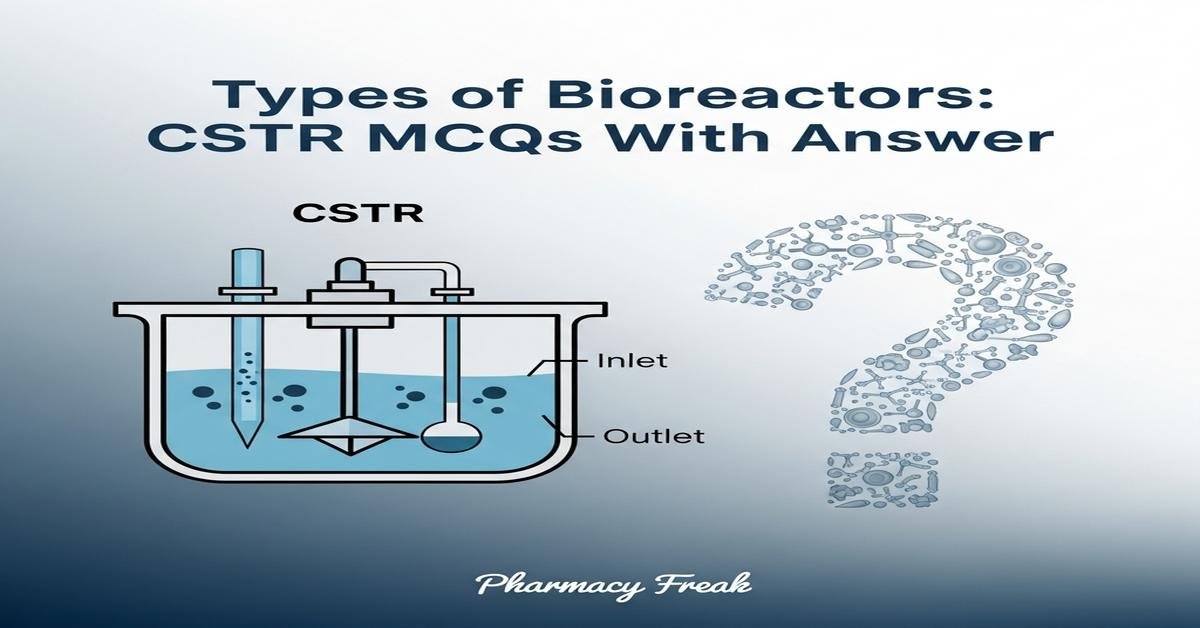
Introduction: Types of bioreactors: CSTR MCQs With Answer is a focused quiz set designed for M.Pharm students studying Bioprocess Engineering and Technology. This collection emphasizes the Continuous Stirred-Tank Reactor (CSTR) — its design principles, hydrodynamics, mixing, mass and heat transfer, kinetics, scale-up issues and practical control considerations. Questions range from theoretical fundamentals such as residence time distribution and steady-state material balances to applied topics like oxygen transfer, impeller selection, and non-ideal flow corrections. Each multiple-choice question is intended to deepen conceptual understanding and prepare students for examinations and practical bioprocess design tasks by testing both reasoning and calculation-ready concepts.
Q1. What characterizes an ideal CSTR in terms of concentration distribution?
- Concentration varies exponentially with radius
- Perfect radial and axial gradients exist
- Uniform concentration throughout the reactor volume
- Concentration is highest at the impeller and decreases towards walls
Correct Answer: Uniform concentration throughout the reactor volume
Q2. For a first-order irreversible reaction A → products in a CSTR at steady state, which expression relates outlet concentration CA to inlet concentration CA0, residence time τ, and rate constant k?
- CA = CA0 / (1 + k τ)
- CA = CA0 * exp(-k τ)
- CA = CA0 * (1 + k τ)
- CA = CA0 / (1 – k τ)
Correct Answer: CA = CA0 / (1 + k τ)
Q3. Which parameter is most directly used to quantify mixing intensity in a stirred CSTR?
- Volumetric mass transfer coefficient (kLa)
- Pipette flow rate
- Power per unit volume (P/V)
- Head loss across the reactor
Correct Answer: Power per unit volume (P/V)
Q4. In a CSTR handling aerobic fermentation, the critical parameter to maintain cell growth is:
- Low impeller speed to prevent shear
- High kLa to satisfy oxygen demand
- Maximal substrate concentration to inhibit oxygen transfer
- Zero dead volume
Correct Answer: High kLa to satisfy oxygen demand
Q5. Which of the following best describes residence time distribution (RTD) in an ideal CSTR?
- RTD is a Dirac delta function at τ
- RTD is an exponential decay function
- RTD is uniform between 0 and 2τ
- RTD shows two peaks due to recirculation
Correct Answer: RTD is an exponential decay function
Q6. When scaling up a CSTR, maintaining geometric similarity and constant power per unit volume most directly impacts:
- Residence time distribution only
- Shear rates, mixing time and mass transfer
- Electrical conductivity of the broth
- Feed composition
Correct Answer: Shear rates, mixing time and mass transfer
Q7. In a CSTR, if substrate inhibition is significant, which operating strategy helps maintain productivity?
- Operate at very short residence times only
- Increase inlet substrate concentration indefinitely
- Use fed-batch or continuous feed with low substrate concentration
- Eliminate agitation to reduce substrate uptake
Correct Answer: Use fed-batch or continuous feed with low substrate concentration
Q8. The Mixing time in a CSTR is defined as the time required to:
- Replace one reactor volume with fresh feed
- Reduce temperature by half
- Achieve a specified level of homogeneity after a disturbance
- Complete a single impeller revolution
Correct Answer: Achieve a specified level of homogeneity after a disturbance
Q9. For aerobic cultures, the oxygen transfer rate (OTR) equals the oxygen uptake rate (OUR) at steady state. OTR is often expressed as kLa*(C* – CL). What does C* represent?
- Bulk liquid oxygen concentration
- Saturation concentration of oxygen in liquid at operating conditions
- Concentration of dissolved CO2
- Concentration of oxygen in the feed gas
Correct Answer: Saturation concentration of oxygen in liquid at operating conditions
Q10. Which impeller type is typically preferred in CSTRs for suspending solid particles and promoting axial flow?
- Rushton turbine
- Marine propeller
- Pitch-blade turbine
- Axial-flow hydrofoil impeller
Correct Answer: Axial-flow hydrofoil impeller
Q11. The Damköhler number (Da) in a CSTR context is a ratio of:
- Mass transfer rate to heat transfer rate
- Reaction rate to convective transport rate (residence time)
- Viscosity to density
- Impeller speed to reactor diameter
Correct Answer: Reaction rate to convective transport rate (residence time)
Q12. In a CSTR carrying out a zero-order reaction, how does outlet concentration CA depend on residence time τ?
- CA = CA0 * exp(-k τ)
- CA = CA0 – k τ
- CA = CA0 / (1 + k τ)
- CA increases linearly with τ
Correct Answer: CA = CA0 – k τ
Q13. Which non-ideal behavior is commonly modeled by a series of n ideal CSTRs to approximate a real reactor?
- Perfect plug flow
- Axial dispersion at very high Peclet number
- Deviation from plug flow toward mixed flow (dispersion)
- Uniform temperature profile
Correct Answer: Deviation from plug flow toward mixed flow (dispersion)
Q14. The presence of dead zones in a CSTR most directly causes:
- Increase in effective kLa uniformly
- Reduced overall conversion due to poor mixing
- Faster heat transfer across the reactor
- Perfectly exponential RTD
Correct Answer: Reduced overall conversion due to poor mixing
Q15. In designing a CSTR for an exothermic fermentation, which heat removal strategy is commonly used to maintain temperature control?
- Insulating the reactor to trap heat
- Single small-diameter cooling coil with low surface area
- External heat exchanger with continuous recirculation or jacket with internal coils
- Ceasing agitation to allow natural cooling
Correct Answer: External heat exchanger with continuous recirculation or jacket with internal coils
Q16. Which control variable is most effective for maintaining dissolved oxygen in an aerobic CSTR when substrate feed is constant?
- Adjusting temperature only
- Varying agitation speed or aeration rate
- Altering reactor geometry during operation
- Changing the reactor volume dynamically
Correct Answer: Varying agitation speed or aeration rate
Q17. For CSTRs in series, compared to a single CSTR of equal total volume, the series arrangement provides:
- Worse control over temperature profiles
- Higher conversion for certain kinetics (e.g., first-order)
- Lower overall conversion always
- Identical RTD to a single CSTR
Correct Answer: Higher conversion for certain kinetics (e.g., first-order)
Q18. Which factor does NOT directly affect the volumetric oxygen transfer coefficient (kLa) in a stirred CSTR?
- Agitation speed
- Baffling and impeller configuration
- Dissolved oxygen electrode calibration
- Gas flow rate (aeration rate)
Correct Answer: Dissolved oxygen electrode calibration
Q19. The mean residence time τ in a continuous reactor is defined as:
- Total reactor volume divided by volumetric flow rate
- Volumetric flow rate divided by reactor volume
- Time for one impeller revolution
- Inverse of the first-order rate constant always
Correct Answer: Total reactor volume divided by volumetric flow rate
Q20. Which statement is true regarding CSTR operation at steady state for microbial growth with Monod kinetics?
- Biomass concentration is independent of dilution rate if D < μmax
- At steady state, dilution rate D equals specific growth rate μ for biomass washout boundary
- Washout occurs when μ > D
- Substrate concentration in the reactor equals inlet substrate concentration at steady state
Correct Answer: At steady state, dilution rate D equals specific growth rate μ for biomass washout boundary

