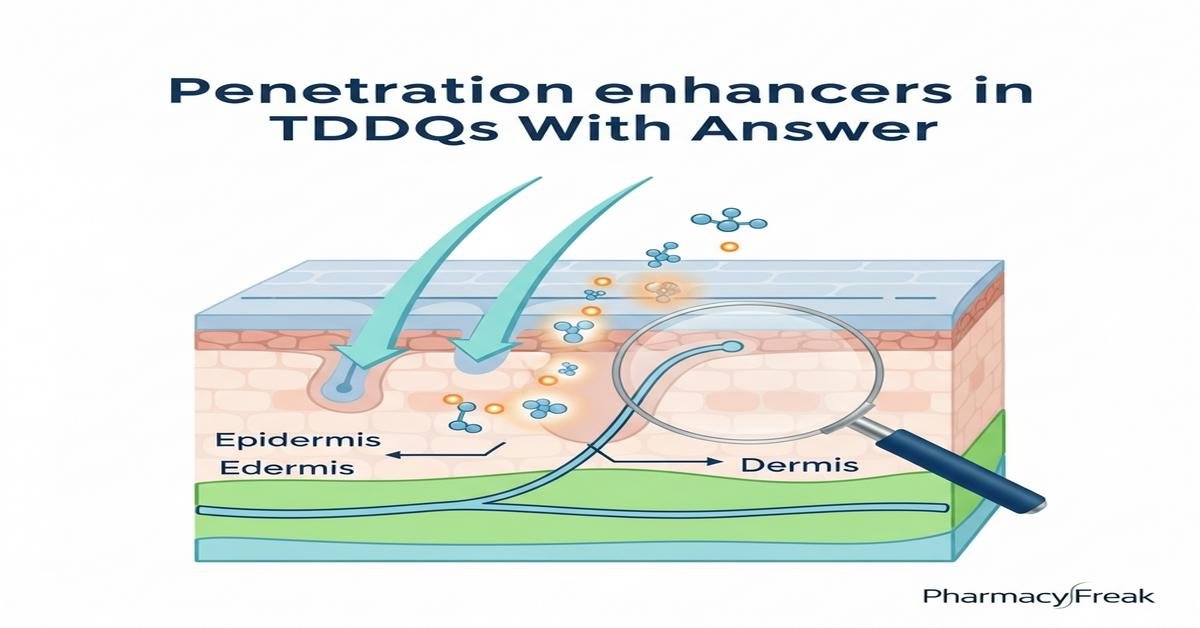
Penetration Enhancers in TDDS MCQs With Answer
Penetration enhancers are a cornerstone of transdermal drug delivery systems (TDDS), enabling therapeutic molecules to traverse the formidable barrier of the stratum corneum. For M. Pharm students, a firm grasp of enhancer classes, mechanisms, selection criteria, safety, and analytical evaluation is essential for rational formulation design. This quiz set focuses on fatty acids, terpenes, sulfoxides, pyrrolidones, surfactants, humectants, and synergistic solvent systems. It also integrates concepts like Fick’s law, lipid phase behavior, ion pairing, eutectic systems, and regulatory considerations. Each MCQ is built to test applied understanding and critical formulation judgment, helping you bridge theory with practice when optimizing TDDS for diverse drug physicochemical profiles.
Q1. Which skin layer is the primary barrier to percutaneous drug penetration relevant to TDDS?
- Stratum corneum
- Viable epidermis
- Dermis
- Hypodermis (subcutaneous tissue)
Correct Answer: Stratum corneum
Q2. Which best describes the mechanism by which long-chain fatty acids like oleic acid enhance skin permeation?
- Insert into stratum corneum lipid lamellae, creating defects and increasing lipid fluidity
- Denature keratin within corneocytes without affecting lipids
- Create permanent pores by irreversibly extracting structural proteins
- Increase tight junction opening within the viable epidermis
Correct Answer: Insert into stratum corneum lipid lamellae, creating defects and increasing lipid fluidity
Q3. What is a key drawback of dimethyl sulfoxide (DMSO) as a penetration enhancer in TDDS?
- It is generally odorless and non-irritant at any concentration
- It shows potent enhancement with minimal toxicity and no stinging
- It can cause erythema, burning/stinging, and a strong odor at higher concentrations
- It is approved for universal use in all marketed TDDS at >50% w/w
Correct Answer: It can cause erythema, burning/stinging, and a strong odor at higher concentrations
Q4. Which statement about Azone (laurocapram) is most accurate?
- It is a lipophilic enhancer that partitions into stratum corneum lipids, inducing microphase separation and fluidization
- It is a strongly hydrophilic solvent that hydrates keratin exclusively
- It is a charged surfactant primarily acting via micellar solubilization
- It is a physical enhancer that creates microchannels mechanically
Correct Answer: It is a lipophilic enhancer that partitions into stratum corneum lipids, inducing microphase separation and fluidization
Q5. Which combination demonstrates well-established synergy for enhancing transdermal permeation?
- Ethanol + oleic acid
- Propylene glycol + water (only)
- Glycerol + sucrose
- Mannitol + urea
Correct Answer: Ethanol + oleic acid
Q6. Which terpene is particularly effective for enhancing the permeation of hydrophilic drugs?
- 1,8-Cineole (eucalyptol)
- Limonene
- Squalene
- Cholesterol
Correct Answer: 1,8-Cineole (eucalyptol)
Q7. In Fick’s law for transdermal flux (J = DKΔC/h), which parameter is most directly increased by an enhancer that promotes drug partitioning into the stratum corneum?
- Partition coefficient (K)
- Diffusion coefficient (D)
- Membrane thickness (h)
- Donor concentration (ΔC)
Correct Answer: Partition coefficient (K)
Q8. Humectant enhancers such as urea and glycerol primarily increase permeation by which mechanism?
- Increasing stratum corneum hydration and swelling, loosening hydrogen-bonded networks
- Forming covalent adducts with drug to create a prodrug
- Inhibiting eccrine sweat gland secretion
- Inducing dermal vasoconstriction
Correct Answer: Increasing stratum corneum hydration and swelling, loosening hydrogen-bonded networks
Q9. Which property best characterizes an ideal chemical penetration enhancer for TDDS?
- Irreversible barrier disruption to maximize flux
- Reversible enhancement with non-irritancy, non-sensitization, and no systemic toxicity
- High volatility and strong odor to indicate activity
- Complete miscibility only with aqueous vehicles
Correct Answer: Reversible enhancement with non-irritancy, non-sensitization, and no systemic toxicity
Q10. Which analytical technique most directly evidences increased stratum corneum lipid disorder after enhancer treatment?
- FTIR showing a shift of CH2 stretching bands to higher wavenumbers
- HPLC assay of drug content in the donor solution
- UV–Vis absorbance of the formulation
- X-ray diffraction of tablet cores
Correct Answer: FTIR showing a shift of CH2 stretching bands to higher wavenumbers
Q11. Among surfactant penetration enhancers, which class generally exhibits the lowest irritation potential on skin?
- Nonionic surfactants (e.g., polysorbates, sorbitan esters)
- Cationic surfactants (e.g., quaternary ammonium compounds)
- Anionic surfactants (e.g., sodium lauryl sulfate)
- Bile salts (e.g., sodium taurocholate)
Correct Answer: Nonionic surfactants (e.g., polysorbates, sorbitan esters)
Q12. The formulation strategy behind the lidocaine–prilocaine eutectic in EMLA primarily improves permeation by:
- Lowering melting points to create a liquid oil phase, increasing thermodynamic activity and skin partitioning
- Ionizing both drugs to enhance aqueous solubility in the stratum corneum
- Forming a covalent prodrug with enhanced permeability
- Increasing drug crystallinity to prolong release
Correct Answer: Lowering melting points to create a liquid oil phase, increasing thermodynamic activity and skin partitioning
Q13. For a weakly basic drug, which ion-pairing approach can increase lipophilicity and skin permeation?
- Forming an ion pair with a lipophilic counterion such as oleic acid or lauryl sulfate
- Pairing with sodium ions in saline
- Pairing with chloride from hydrochloric acid to increase hydrophilicity
- Forming a hydrate with water molecules
Correct Answer: Forming an ion pair with a lipophilic counterion such as oleic acid or lauryl sulfate
Q14. Which enhancer primarily acts as a volatile solvent/cosolvent that elevates thermodynamic activity and can extract some stratum corneum lipids?
- Ethanol
- Azone (laurocapram)
- Sodium lauryl sulfate
- Hydroxypropyl methylcellulose (HPMC)
Correct Answer: Ethanol
Q15. Which enhancer has potent activity but limited regulatory acceptance in marketed TDDS?
- Azone (laurocapram)
- Propylene glycol
- Menthol
- Ethanol
Correct Answer: Azone (laurocapram)
Q16. For polar macromolecules (e.g., peptides), which chemical class tends to be more effective than fatty acids but carries higher irritation risk?
- Bile salts and certain surfactants
- Waxes (e.g., beeswax)
- Silicone oils
- Mineral oils
Correct Answer: Bile salts and certain surfactants
Q17. Which human study is commonly used to assess cumulative irritation and sensitization potential of enhancers or patches?
- Human Repeat Insult Patch Test (HRIPT)
- Draize eye irritation test
- Ames mutagenicity test
- Acute LD50 determination in rodents
Correct Answer: Human Repeat Insult Patch Test (HRIPT)
Q18. Which change in permeation kinetics is typically observed when lipid-fluidizing enhancers are used?
- Reduced lag time and increased steady-state flux
- Increased lag time with unchanged flux
- No change in lag time or flux
- Immediate zero-order delivery with no dependence on skin barrier
Correct Answer: Reduced lag time and increased steady-state flux
Q19. What is a commonly used concentration range of oleic acid as a penetration enhancer in topical/transdermal formulations?
- 1–5% w/w
- 20–40% w/w
- 0.001–0.01% w/w
- >60% w/w
Correct Answer: 1–5% w/w
Q20. Which statement about ethanol–propylene glycol (PG) systems in TDDS is most accurate?
- Propylene glycol can act as a solvent/penetration enhancer and serve as a stratum corneum reservoir, sustaining flux after ethanol evaporates
- Ethanol reduces the drug’s thermodynamic activity in the donor phase
- Propylene glycol is universally incompatible with pressure-sensitive adhesives (PSAs)
- The combination cannot solubilize hydrophilic drugs
Correct Answer: Propylene glycol can act as a solvent/penetration enhancer and serve as a stratum corneum reservoir, sustaining flux after ethanol evaporates

