Cellular reproduction mechanisms MCQs With Answer
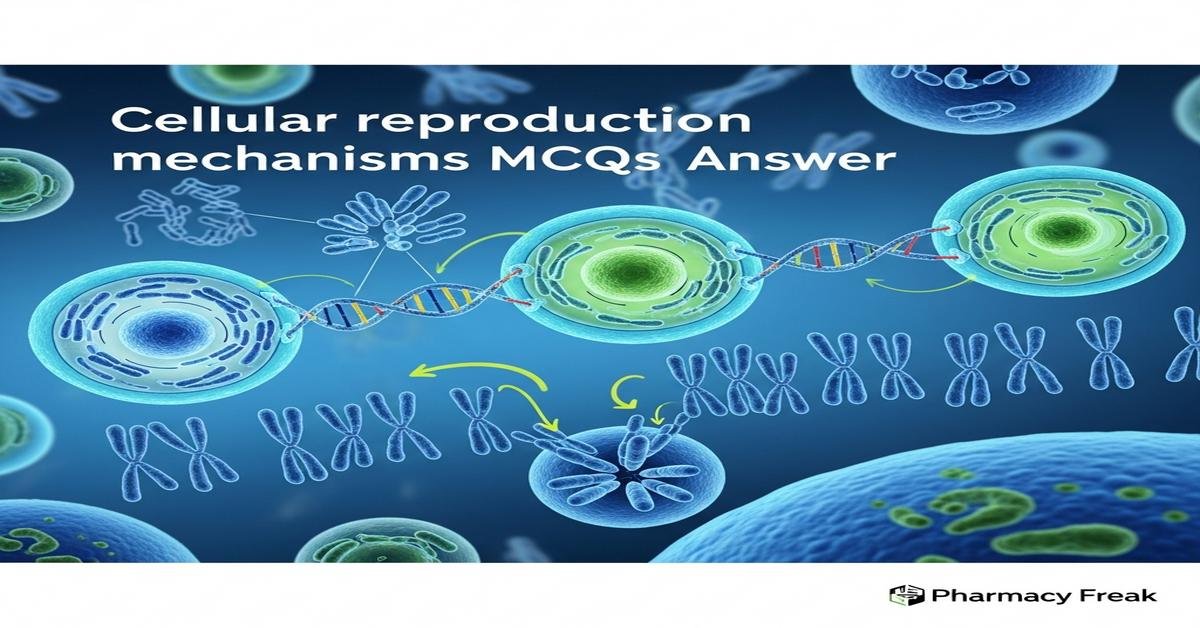
Cellular reproduction mechanisms are central to pharmacology and drug development, encompassing mitosis, meiosis, binary fission, and programmed cell death. B. Pharm students must understand the cell cycle stages (G1, S, G2, M), checkpoints, cyclins/CDKs, DNA replication, chromosomal segregation, cytokinesis, and apoptosis to predict drug actions and toxicities. Molecular targets such as microtubules, topoisomerases, telomerase, p53, and growth-factor signaling are crucial for anticancer and antimicrobial therapies. This concise, high-yield review focuses on regulatory pathways, checkpoint failures, chromosomal nondisjunction, and mechanisms of common antimitotic and DNA-damaging agents, preparing students for applied questions and therapeutic reasoning.
Now let’s test your knowledge with 30 MCQs on this topic.
Q1. Which phase of the eukaryotic cell cycle is primarily dedicated to DNA replication?
- G0 phase
- G1 phase
- S phase
- M phase
Correct Answer: S phase
Q2. Which cyclin–CDK complex drives the G1 to S phase transition in many mammalian cells?
- Cyclin B–CDK1
- Cyclin D–CDK4/6
- Cyclin A–CDK2
- Cyclin E–CDK2
Correct Answer: Cyclin E–CDK2
Q3. The spindle assembly checkpoint prevents anaphase onset until chromosomes are properly attached to spindle microtubules; which proteins are central to this checkpoint?
- MAD and BUB proteins
- P53 and Rb proteins
- Cyclin E and CDK2
- Topoisomerase I and II
Correct Answer: MAD and BUB proteins
Q4. Which event occurs during prophase I of meiosis and is critical for genetic recombination?
- Independent assortment of chromosomes
- Sister chromatid separation
- Crossing-over (homologous recombination)
- Spindle formation with centrosome duplication
Correct Answer: Crossing-over (homologous recombination)
Q5. Microtubule-targeting anticancer drugs like vincristine primarily act by which mechanism?
- Inhibiting DNA polymerase
- Stabilizing microtubules and preventing depolymerization
- Promoting microtubule depolymerization and inhibiting polymerization
- Inhibiting topoisomerase II
Correct Answer: Promoting microtubule depolymerization and inhibiting polymerization
Q6. Taxanes (e.g., paclitaxel) exert antimitotic effects by:
- Preventing microtubule polymerization entirely
- Stabilizing microtubules and preventing their depolymerization
- Blocking DNA replication origins
- Inhibiting centrosome duplication
Correct Answer: Stabilizing microtubules and preventing their depolymerization
Q7. During binary fission in bacteria, which protein forms the contractile ring to divide the cell?
- FtsZ
- Actin
- Myosin II
- Tubulin
Correct Answer: FtsZ
Q8. Which enzyme relieves supercoiling ahead of the replication fork during DNA replication?
- DNA ligase
- Helicase
- Topoisomerase
- Primase
Correct Answer: Topoisomerase
Q9. The checkpoint protein p53 responds to DNA damage primarily by:
- Enhancing telomerase activity
- Inducing cell-cycle arrest or apoptosis
- Activating cyclin B–CDK1
- Promoting DNA methylation
Correct Answer: Inducing cell-cycle arrest or apoptosis
Q10. Which of the following best distinguishes meiosis I from meiosis II?
- Meiosis I separates sister chromatids; meiosis II separates homologous chromosomes
- Meiosis I includes crossing-over; meiosis II resembles mitosis in separating sister chromatids
- Meiosis I has no recombination; meiosis II has extensive recombination
- Meiosis I results in haploid cells; meiosis II produces tetraploid cells
Correct Answer: Meiosis I includes crossing-over; meiosis II resembles mitosis in separating sister chromatids
Q11. Cytokinesis in animal cells is driven mainly by:
- A contractile ring of actin and myosin
- Microtubule sliding alone
- Cell wall formation using cellulose
- DNA condensation forces
Correct Answer: A contractile ring of actin and myosin
Q12. Nondisjunction during meiosis can lead to which of the following conditions?
- Aneuploidy such as Down syndrome
- Polyploidy with no clinical consequences
- Increased telomere length
- Complete loss of chromosomes in all cells
Correct Answer: Aneuploidy such as Down syndrome
Q13. Telomerase activity is most associated with which cell types and relevance to pharmacology?
- Differentiated somatic cells; target for antiviral drugs
- Stem cells and many cancer cells; target for anticancer therapies
- Prokaryotic cells; target for antibiotics
- Red blood cells; target for anticoagulants
Correct Answer: Stem cells and many cancer cells; target for anticancer therapies
Q14. Topoisomerase II inhibitors used in chemotherapy (e.g., etoposide) primarily cause cell death by:
- Stabilizing the topoisomerase II–DNA cleavage complex leading to double-strand breaks
- Blocking microtubule polymerization
- Inhibiting ribosomal protein synthesis
- Stimulating telomerase activity
Correct Answer: Stabilizing the topoisomerase II–DNA cleavage complex leading to double-strand breaks
Q15. The restriction point in G1 (R point) is critical because after it the cell:
- Can no longer enter S phase
- Is irreversibly committed to complete the cell cycle
- Immediately undergoes apoptosis
- Enters a permanently quiescent state
Correct Answer: Is irreversibly committed to complete the cell cycle
Q16. Which protein family directly phosphorylates target proteins to drive cell-cycle progression?
- Cyclins
- Cyclin-dependent kinases (CDKs)
- DNA polymerases
- Topoisomerases
Correct Answer: Cyclin-dependent kinases (CDKs)
Q17. Homologous recombination for DNA repair during S and G2 phases primarily requires which protein?
- RAD51
- Ku70/80
- Telomerase reverse transcriptase
- DNA ligase IV
Correct Answer: RAD51
Q18. Which phase of mitosis is characterized by alignment of chromosomes at the metaphase plate?
- Prophase
- Metaphase
- Anaphase
- Telophase
Correct Answer: Metaphase
Q19. The Hayflick limit refers to:
- The number of replication origins per chromosome
- The limited number of divisions normal somatic cells undergo due to telomere shortening
- The maximum rate of DNA polymerase activity
- The number of checkpoints per cell cycle
Correct Answer: The limited number of divisions normal somatic cells undergo due to telomere shortening
Q20. Which mechanism is a hallmark of intrinsic apoptosis pathway activation?
- Activation of death receptors on the cell surface
- Mitochondrial outer membrane permeabilization and cytochrome c release
- Formation of the apoptosome independent of mitochondria
- Cell lysis due to complement activation
Correct Answer: Mitochondrial outer membrane permeabilization and cytochrome c release
Q21. Inhibition of DNA primase during replication would most directly prevent:
- Unwinding of the DNA helix
- Formation of RNA primers necessary for DNA polymerase
- Ligation of Okazaki fragments
- Supercoiling relief ahead of the fork
Correct Answer: Formation of RNA primers necessary for DNA polymerase
Q22. Which of the following best describes endoreduplication (endoreplication)?
- Repeated rounds of DNA replication without mitosis, leading to polyploid nuclei
- Complete loss of DNA content in apoptotic cells
- Replication exclusively of mitochondrial DNA
- Failure of cytokinesis causing binucleate cells only during embryogenesis
Correct Answer: Repeated rounds of DNA replication without mitosis, leading to polyploid nuclei
Q23. A drug that stabilizes the microtubule plus end and prevents dynamic instability would most likely arrest cells in which phase?
- S phase
- G1 phase
- M phase (mitosis)
- G2 phase
Correct Answer: M phase (mitosis)
Q24. Chromosome condensation during prophase is facilitated primarily by which complexes?
- Condensin complexes
- Replicase complexes
- Spliceosomes
- Proteasomes
Correct Answer: Condensin complexes
Q25. PARP inhibitors are synthetically lethal in tumors deficient in which DNA repair pathway?
- Non-homologous end joining (NHEJ)
- Nucleotide excision repair (NER)
- Homologous recombination (HR), e.g., BRCA-deficient tumors
- Mismatch repair (MMR)
Correct Answer: Homologous recombination (HR), e.g., BRCA-deficient tumors
Q26. During S phase, the leading strand is synthesized continuously while the lagging strand is synthesized as:
- Single continuous fragment
- Multiple Okazaki fragments
- RNA-only segments that are never ligated
- Double-stranded DNA loops
Correct Answer: Multiple Okazaki fragments
Q27. The retinoblastoma protein (Rb) controls G1 progression by:
- Activating E2F transcription factors constitutively
- Sequestering E2F transcription factors until phosphorylated by cyclin–CDK complexes
- Directly phosphorylating DNA polymerase
- Degrading cyclins through ubiquitination
Correct Answer: Sequestering E2F transcription factors until phosphorylated by cyclin–CDK complexes
Q28. Which form of recombination repair corrects double-strand breaks using an undamaged sister chromatid as template?
- Base excision repair
- Mismatch repair
- Homologous recombination
- Direct reversal
Correct Answer: Homologous recombination
Q29. A tumor suppressor that monitors DNA integrity and can induce senescence or apoptosis when activated is:
- EGFR
- P53
- MYC
- HER2
Correct Answer: P53
Q30. Which statement best explains why rapidly dividing cells are more sensitive to many chemotherapeutic agents?
- They express higher telomerase levels making them resilient
- They rely on active DNA replication and mitosis, processes targeted by many drugs, leading to preferential toxicity
- They are less likely to activate apoptosis pathways
- They have fewer checkpoints, so drugs are ineffective
Correct Answer: They rely on active DNA replication and mitosis, processes targeted by many drugs, leading to preferential toxicity


