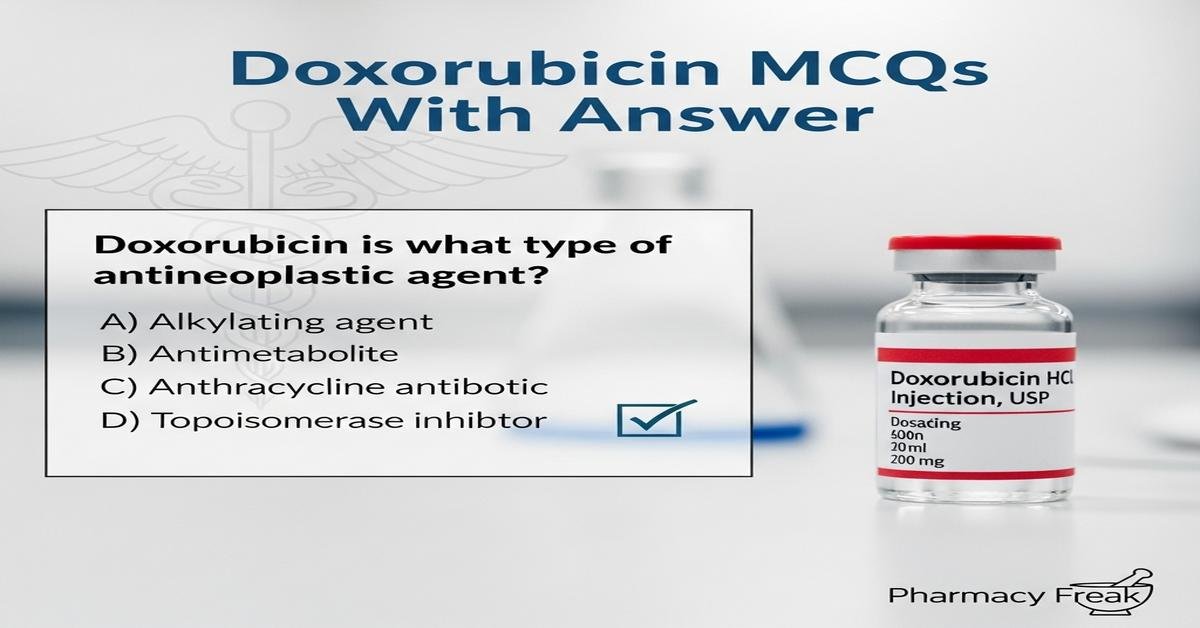
Doxorubicin MCQs With Answer provides B. Pharm students a focused review of doxorubicin pharmacology, mechanism, clinical uses, safety, and monitoring. This collection emphasizes key keywords such as anthracycline, topoisomerase II inhibition, intercalation, cardiotoxicity, cumulative dose, liposomal formulation, extravasation, hepatic metabolism, and dexrazoxane. Questions address dosage forms, administration precautions, adverse effects (myelosuppression, mucositis, alopecia), drug interactions, and mitigation strategies. Designed to deepen understanding beyond basics, the MCQs reinforce clinical relevance, pharmacokinetics, and laboratory monitoring required in oncology pharmacy practice. Clear explanations enable rapid recall and exam preparation. Now let’s test your knowledge with 30 MCQs on this topic.
Q1. Which mechanism primarily explains doxorubicin’s cytotoxic action?
- Alkylation of DNA bases
- Microtubule stabilization
- Intercalation into DNA and topoisomerase II inhibition
- Inhibition of dihydrofolate reductase
Correct Answer: Intercalation into DNA and topoisomerase II inhibition
Q2. Doxorubicin belongs to which class of anticancer drugs?
- Platinum compounds
- Anthracyclines
- Taxanes
- Alkylating agents
Correct Answer: Anthracyclines
Q3. Which adverse effect is most specifically associated with cumulative doxorubicin exposure?
- Renal failure
- Hepatic necrosis
- Cardiotoxicity leading to dilated cardiomyopathy
- Pulmonary fibrosis
Correct Answer: Cardiotoxicity leading to dilated cardiomyopathy
Q4. What is the commonly recommended lifetime cumulative dose limit for conventional doxorubicin to minimize heart damage?
- 200 mg/m2
- 450–550 mg/m2
- 800–1000 mg/m2
- No cumulative limit
Correct Answer: 450–550 mg/m2
Q5. Which agent is used as a cardioprotective drug to reduce doxorubicin-induced cardiotoxicity?
- Mesna
- Amifostine
- Dexrazoxane
- Leucovorin
Correct Answer: Dexrazoxane
Q6. What is a key monitoring parameter before and during doxorubicin therapy?
- Serum creatinine only
- Left ventricular ejection fraction (LVEF) by echocardiography or MUGA
- Blood glucose
- Serum amylase
Correct Answer: Left ventricular ejection fraction (LVEF) by echocardiography or MUGA
Q7. Which formulation of doxorubicin is developed to reduce cardiotoxicity and alter pharmacokinetics?
- Prodrug doxorubicin phosphate
- Liposomal doxorubicin
- Doxorubicin oral tablet
- Doxorubicin intrathecal solution
Correct Answer: Liposomal doxorubicin
Q8. Which route of administration is contraindicated for doxorubicin due to severe neurotoxicity?
- Intravenous bolus
- Intramuscular injection
- Intrathecal administration
- Slow IV infusion
Correct Answer: Intrathecal administration
Q9. Doxorubicin is rapidly taken up by the liver and primarily eliminated via which route?
- Renal excretion of unchanged drug
- Exhalation as CO2
- Biliary excretion of metabolites
- Sweat and saliva
Correct Answer: Biliary excretion of metabolites
Q10. A common visible side effect after doxorubicin infusion is:
- Green urine
- Pink-red discoloration of urine
- Yellow skin discoloration
- Blue sclera
Correct Answer: Pink-red discoloration of urine
Q11. Which laboratory toxicity is most frequently dose-limiting with doxorubicin?
- Thrombocytosis
- Neutropenia (myelosuppression)
- Hyperkalemia
- Hypoglycemia
Correct Answer: Neutropenia (myelosuppression)
Q12. Which statement about doxorubicin-induced extravasation is true?
- Doxorubicin is a non-vesicant and causes no local tissue injury
- Extravasation requires immediate cooling and dexrazoxane can be used
- Warm compresses accelerate tissue damage
- No treatment is necessary; it resolves on its own
Correct Answer: Extravasation requires immediate cooling and dexrazoxane can be used
Q13. The red-orange color of doxorubicin is clinically relevant because:
- It stains urine and contact materials, aiding identification
- It indicates the drug is expired
- It predicts drug potency
- It causes photosensitivity reactions
Correct Answer: It stains urine and contact materials, aiding identification
Q14. Which molecular event produced by doxorubicin contributes to reactive oxygen species (ROS) formation?
- NADPH oxidase inhibition
- Redox cycling of the anthracycline quinone moiety
- Direct mitochondrial DNA replication
- Activation of glutathione peroxidase
Correct Answer: Redox cycling of the anthracycline quinone moiety
Q15. Combination of doxorubicin with which drug class notably increases risk of cardiotoxicity?
- ACE inhibitors
- Beta blockers
- HER2-targeted agents like trastuzumab
- Statins
Correct Answer: HER2-targeted agents like trastuzumab
Q16. Which patient factor most increases the risk of doxorubicin cardiotoxicity?
- Young age under 18
- Preexisting cardiovascular disease or prior chest radiation
- History of migraine
- Male gender
Correct Answer: Preexisting cardiovascular disease or prior chest radiation
Q17. Doxorubicin is contraindicated or used cautiously in severe impairment of which organ?
- Liver (hepatic impairment)
- Thyroid
- Pancreas
- Prostate
Correct Answer: Liver (hepatic impairment)
Q18. Which supportive care measure is commonly used to manage acute nausea and vomiting during doxorubicin therapy?
- Prophylactic antibiotics
- 5-HT3 receptor antagonists and dexamethasone
- High-dose vitamin C
- Antihistamines only
Correct Answer: 5-HT3 receptor antagonists and dexamethasone
Q19. Which statement about liposomal doxorubicin compared to conventional doxorubicin is correct?
- Liposomal form has higher peak free plasma concentrations and increased cardiotoxicity
- Liposomal form reduces exposure of normal tissues and may lower cardiotoxicity
- Liposomal form is given orally
- Liposomal form is more vesicant on extravasation
Correct Answer: Liposomal form reduces exposure of normal tissues and may lower cardiotoxicity
Q20. How does doxorubicin interact with CYP enzymes in clinical practice?
- It is a strong inducer of CYP3A4 causing many drug interactions
- It is primarily metabolized in liver and interactions may occur with strong hepatic enzyme modulators
- It is exclusively renally cleared and unaffected by CYP interactions
- It inactivates CYP2D6 permanently
Correct Answer: It is primarily metabolized in liver and interactions may occur with strong hepatic enzyme modulators
Q21. Which test result would prompt dose reduction or delay of doxorubicin therapy?
- Absolute neutrophil count (ANC) 0.8 x10⁹/L
- Hemoglobin 14 g/dL
- Platelet count 300 x109/L
- Normal LFTs and renal function
Correct Answer: Absolute neutrophil count (ANC) 0.8 x10⁹/L
Q22. Doxorubicin’s anti-tumor activity includes induction of DNA strand breaks through stabilization of which enzyme-DNA intermediate?
- Topoisomerase I-DNA intermediate
- Topoisomerase II-DNA intermediate
- DNA polymerase-DNA intermediate
- RNA polymerase-DNA intermediate
Correct Answer: Topoisomerase II-DNA intermediate
Q23. Which precaution is important when preparing and handling doxorubicin in the pharmacy?
- No special precautions; it is non-hazardous
- Use closed-system transfer devices and appropriate PPE due to cytotoxic risk
- Prepare on open bench without gloves to avoid contamination
- Heat the vial before dilution to enhance solubility
Correct Answer: Use closed-system transfer devices and appropriate PPE due to cytotoxic risk
Q24. Which clinical indication is doxorubicin commonly used for?
- Type 2 diabetes mellitus
- Breast cancer, lymphomas, and sarcomas
- Hypertension
- Bacterial infections
Correct Answer: Breast cancer, lymphomas, and sarcomas
Q25. Radiation recall is a phenomenon associated with doxorubicin. What does it describe?
- Delayed bone marrow recovery after radiotherapy
- Acute inflammatory reaction in previously irradiated tissue after administration of certain drugs
- Permanent loss of radiation therapy effectiveness
- Increased radiation absorption by doxorubicin
Correct Answer: Acute inflammatory reaction in previously irradiated tissue after administration of certain drugs
Q26. Which patient counseling point is appropriate for doxorubicin therapy?
- Avoid exposure of infusion site to ice packs
- Expect temporary hair loss and red-colored urine for 24–48 hours
- No need to report shortness of breath
- Do not use contraception during therapy is unnecessary
Correct Answer: Expect temporary hair loss and red-colored urine for 24–48 hours
Q27. Which feature distinguishes pegylated liposomal doxorubicin from non-pegylated liposomal formulations?
- Pegylation shortens circulation time
- Pegylation increases immunogenicity dramatically
- Pegylation prolongs circulation time and alters tissue distribution
- Pegylation makes drug orally bioavailable
Correct Answer: Pegylation prolongs circulation time and alters tissue distribution
Q28. Use of doxorubicin during pregnancy is associated with which risk?
- No fetal risks; safe in all trimesters
- Potential teratogenicity, especially in first trimester, and fetal toxicity
- Guaranteed congenital heart defects in all cases
- Improved fetal growth
Correct Answer: Potential teratogenicity, especially in first trimester, and fetal toxicity
Q29. Which biochemical change is commonly monitored as part of baseline evaluation before starting doxorubicin?
- Thyroid stimulating hormone only
- Baseline liver function tests (AST, ALT, bilirubin)
- Fasting insulin levels
- Urine ketones
Correct Answer: Baseline liver function tests (AST, ALT, bilirubin)
Q30. Which statement about doxorubicin resistance mechanisms is correct?
- Resistance cannot occur with anthracyclines
- Overexpression of P-glycoprotein efflux pumps and enhanced DNA repair can confer resistance
- Resistance is only due to patient noncompliance
- Resistance is reversed by increasing the dose indefinitely
Correct Answer: Overexpression of P-glycoprotein efflux pumps and enhanced DNA repair can confer resistance


