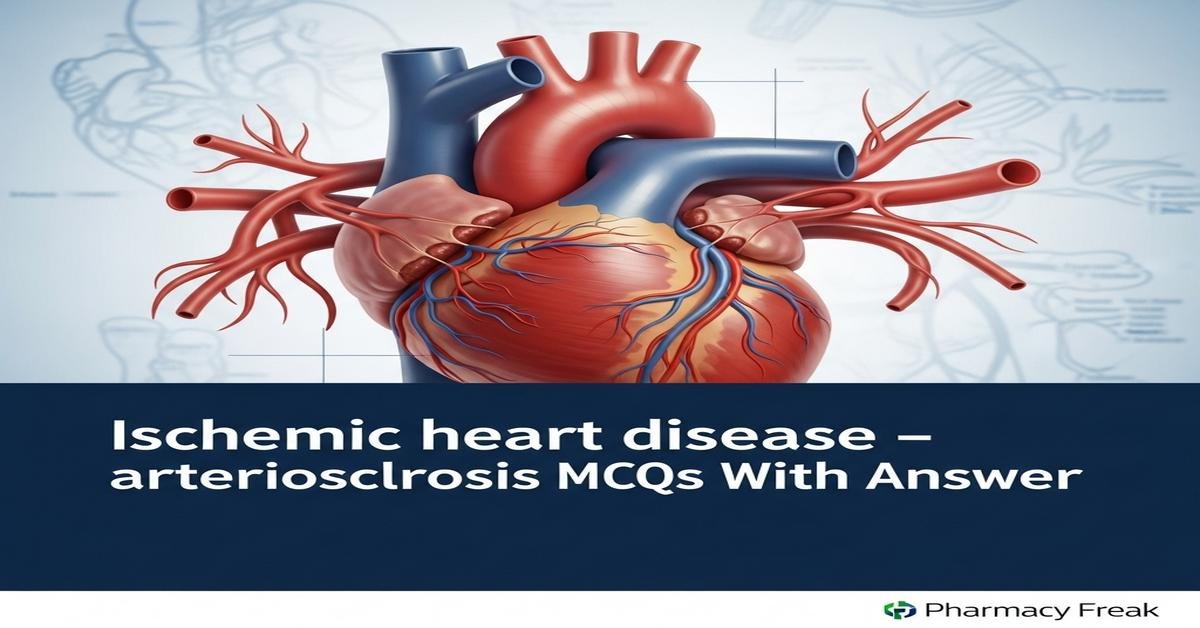
Ischemic heart disease – arteriosclerosis MCQs With Answer
Ischemic heart disease caused by arteriosclerosis is a core topic for B. Pharm students preparing for pharmacology and therapeutics exams. This concise, informative introduction covers pathophysiology, risk factors, clinical presentation, diagnostic markers, and drug-based management including antiplatelets, anticoagulants, thrombolytics, statins, beta-blockers, ACE inhibitors and nitrates. Emphasis is on mechanisms, adverse effects, clinical decision-making and prevention strategies important for pharmacists in patient care. These MCQs reinforce detailed pharmacological principles, ECG and biomarker interpretation, and complication management to build exam confidence and clinical competence. Now let’s test your knowledge with 50 MCQs on this topic.
Q1. Which pathological process is the primary cause of ischemic heart disease in arteriosclerosis?
- Plaque rupture with thrombosis
- Vasculitis of coronary arteries
- Congenital coronary anomaly
- Infective endocarditis
Correct Answer: Plaque rupture with thrombosis
Q2. Which lipid abnormality is most strongly associated with development of atherosclerotic plaques?
- Elevated LDL cholesterol
- Elevated HDL cholesterol
- Decreased triglycerides
- Decreased LDL cholesterol
Correct Answer: Elevated LDL cholesterol
Q3. The initial management priority in acute ST-elevation myocardial infarction (STEMI) is:
- Immediate reperfusion therapy
- High-dose statin only
- Long-term beta blocker initiation at discharge
- Outpatient stress testing
Correct Answer: Immediate reperfusion therapy
Q4. Which biomarker rises first after myocardial necrosis and is most useful for early diagnosis?
- Troponin I/T
- CK-MB
- Myoglobin
- LDH
Correct Answer: Myoglobin
Q5. Typical ECG change in acute transmural (STEMI) infarction is:
- ST-segment elevation in affected leads
- Isolated T-wave inversion without other changes
- Prolonged PR interval only
- Low voltage QRS complexes
Correct Answer: ST-segment elevation in affected leads
Q6. Which antiplatelet agent irreversibly inhibits the P2Y12 ADP receptor?
- Clopidogrel
- Aspirin
- Abciximab
- Ticagrelor
Correct Answer: Clopidogrel
Q7. The mechanism of action of nitrates in angina primarily involves:
- Venodilation reducing preload
- Beta-1 blockade reducing heart rate
- Calcium channel blockade of coronary artery spasm
- Direct thrombolysis of coronary thrombus
Correct Answer: Venodilation reducing preload
Q8. Which class of drug reduces mortality post-myocardial infarction by inhibiting remodeling via RAAS blockade?
- ACE inhibitors
- Long-acting nitrates
- Short-acting calcium channel blockers
- Fibrates
Correct Answer: ACE inhibitors
Q9. High-intensity statin therapy aims to reduce LDL by approximately:
- ≥50%
- 10–20%
- 20–30%
- No change in LDL
Correct Answer: ≥50%
Q10. Which thrombolytic drug is fibrin-specific and often used in STEMI?
- Tissue plasminogen activator (tPA)
- Streptokinase
- Urokinase
- Warfarin
Correct Answer: Tissue plasminogen activator (tPA)
Q11. Variant (Prinzmetal) angina is most commonly treated with which agents?
- Calcium channel blockers and nitrates
- Beta-blockers and digoxin
- High-dose statins alone
- Thrombolytics
Correct Answer: Calcium channel blockers and nitrates
Q12. Which of the following is a major non-modifiable risk factor for arteriosclerosis?
- Age
- Smoking
- Obesity
- Hypertension
Correct Answer: Age
Q13. In unstable angina, cardiac biomarkers are typically:
- Normal or minimally elevated without necrosis
- Markedly elevated consistent with transmural infarction
- Always negative even with MI
- Diagnostically useless
Correct Answer: Normal or minimally elevated without necrosis
Q14. Which enzyme inhibitor reduces synthesis of cholesterol in the liver and upregulates LDL receptors?
- HMG-CoA reductase inhibitors (statins)
- ACE inhibitors
- Calcium channel blockers
- Beta blockers
Correct Answer: HMG-CoA reductase inhibitors (statins)
Q15. A common adverse effect of statins to monitor is:
- Myopathy and elevated CK
- Hypoglycemia
- Hyperkalemia
- Otorrhea
Correct Answer: Myopathy and elevated CK
Q16. Which antithrombotic used during PCI is a glycoprotein IIb/IIIa inhibitor?
- Abciximab
- Clopidogrel
- Heparin
- Ticagrelor
Correct Answer: Abciximab
Q17. The most specific cardiac biomarker for myocardial injury is:
- Cardiac troponin
- Myoglobin
- CK-MB
- AST
Correct Answer: Cardiac troponin
Q18. Which ECG lead changes suggest an anterior wall MI?
- ST elevation in V1–V4
- ST elevation in II, III, aVF
- ST elevation in I and aVL only
- Diffuse ST depression in all leads
Correct Answer: ST elevation in V1–V4
Q19. Which anticoagulant acts by potentiating antithrombin III and is used acutely in ACS?
- Unfractionated heparin
- Warfarin
- Apixaban
- Rivaroxaban
Correct Answer: Unfractionated heparin
Q20. Dual antiplatelet therapy after stent placement usually includes aspirin plus which agent?
- P2Y12 inhibitor (e.g., clopidogrel)
- Warfarin
- Low-dose heparin
- Fibrinolytic agent
Correct Answer: P2Y12 inhibitor (e.g., clopidogrel)
Q21. Which mechanism primarily explains improvement in angina symptoms with beta-blockers?
- Reduced heart rate and myocardial oxygen demand
- Direct vasodilation of coronary arteries
- Increased contractility and oxygen consumption
- Enhanced platelet aggregation
Correct Answer: Reduced heart rate and myocardial oxygen demand
Q22. In atherosclerotic plaque development, which cell type is responsible for uptake of oxidized LDL and formation of foam cells?
- Macrophages
- Cardiomyocytes
- Endothelial cells producing NO
- Fibroblasts
Correct Answer: Macrophages
Q23. The TIMI (Thrombolysis In Myocardial Infarction) risk score is used to:
- Assess risk and guide management in unstable angina/NSTEMI
- Measure serum troponin concentration
- Quantify LDL cholesterol
- Predict hemorrhagic stroke risk only
Correct Answer: Assess risk and guide management in unstable angina/NSTEMI
Q24. Which investigation is most sensitive for detecting reversible ischemia in outpatient evaluation?
- Exercise stress test (treadmill)
- Baseline chest X-ray
- Serum troponin level
- Holter monitoring for 24 hours
Correct Answer: Exercise stress test (treadmill)
Q25. Which lifestyle change has the greatest impact on reducing cardiovascular risk?
- Smoking cessation
- Increasing dietary salt
- Decreasing physical activity
- Ignoring hypertension
Correct Answer: Smoking cessation
Q26. Which drug is contraindicated in variant (Prinzmetal) angina due to potential worsening of vasospasm?
- Non-selective beta-blockers (e.g., propranolol)
- Nitrates
- Calcium channel blockers
- Long-acting nitrates
Correct Answer: Non-selective beta-blockers (e.g., propranolol)
Q27. The main goal of secondary prevention after MI includes:
- Risk factor modification and evidence-based medications to prevent recurrence
- Immediate cessation of all medications
- Only surgical interventions without drugs
- No lifestyle changes required
Correct Answer: Risk factor modification and evidence-based medications to prevent recurrence
Q28. Which of the following is a cholesterol absorption inhibitor used as adjunctive therapy?
- Ezetimibe
- Niacin
- Gemfibrozil
- Colesevelam
Correct Answer: Ezetimibe
Q29. Cardiogenic shock after large MI is primarily due to:
- Severe left ventricular pump failure
- Vasovagal syncope
- Dehydration only
- Hypoglycemia
Correct Answer: Severe left ventricular pump failure
Q30. Which finding is characteristic of subendocardial ischemia on ECG?
- ST-segment depression
- ST-segment elevation in contiguous leads
- U waves only
- Prolonged QT without ST changes
Correct Answer: ST-segment depression
Q31. Which medication class is recommended acutely to relieve chest pain in suspected angina?
- Sublingual nitroglycerin
- Oral statin
- Oral ACE inhibitor
- Topical beta-agonist
Correct Answer: Sublingual nitroglycerin
Q32. Long-term aspirin therapy reduces recurrent ischemic events primarily by:
- Inhibiting platelet cyclooxygenase and thromboxane A2 production
- Lowering LDL significantly
- Directly dissolving thrombus
- Increasing heart rate
Correct Answer: Inhibiting platelet cyclooxygenase and thromboxane A2 production
Q33. Which adverse effect is most associated with ACE inhibitors?
- Dry cough and hyperkalemia
- Hypoglycemia
- Ototoxicity
- Thrombocytopenia
Correct Answer: Dry cough and hyperkalemia
Q34. In NSTEMI management, immediate therapy often includes:
- Antiplatelet agents, anticoagulation, and risk stratification
- Immediate thrombolysis in all patients
- Only lifestyle advice without meds
- Routine emergent CABG for everyone
Correct Answer: Antiplatelet agents, anticoagulation, and risk stratification
Q35. Which imaging modality provides direct visualization of coronary artery anatomy to plan revascularization?
- Coronary angiography (cardiac catheterization)
- Chest X-ray
- Resting ECG only
- Renal ultrasound
Correct Answer: Coronary angiography (cardiac catheterization)
Q36. Which lipid-lowering agent primarily lowers triglycerides and can raise HDL?
- Fibrates (e.g., gemfibrozil)
- Statins
- Ezetimibe
- PCSK9 inhibitors
Correct Answer: Fibrates (e.g., gemfibrozil)
Q37. Reperfusion injury after restoration of coronary flow involves which pathological mechanism?
- Oxidative stress and calcium overload
- Autoimmune antibody formation
- Purely mechanical obstruction
- Dehydration
Correct Answer: Oxidative stress and calcium overload
Q38. Which drug is used for long-term secondary prevention to reduce LDL and has pleiotropic anti-inflammatory effects?
- Atorvastatin
- Nitroglycerin
- Isosorbide dinitrate
- Verapamil
Correct Answer: Atorvastatin
Q39. Which complication of MI is most associated with papillary muscle dysfunction?
- Acute mitral regurgitation
- Aortic stenosis
- Tricuspid atresia
- Pericardial effusion without regurgitation
Correct Answer: Acute mitral regurgitation
Q40. For secondary prevention, target LDL for very high-risk post-MI patients is generally:
- <70 mg/dL
- >190 mg/dL
- 150–200 mg/dL
- No target LDL necessary
Correct Answer: <70 mg/dL
Q41. Which platelet function assay is helpful to assess response to clopidogrel?
- P2Y12 platelet function test
- Serum troponin assay
- Fasting lipid profile
- Serum creatinine alone
Correct Answer: P2Y12 platelet function test
Q42. Which drug reduces preload and afterload and can be used in acute pulmonary edema post-MI?
- Nitroglycerin IV infusion
- High-dose aspirin only
- Digoxin loading dose
- Fludrocortisone
Correct Answer: Nitroglycerin IV infusion
Q43. Which clinical sign suggests left ventricular failure after MI?
- Pulmonary rales and orthopnea
- Elevated jugular venous pressure without pulmonary signs
- Peripheral neuropathy only
- Bradykinesia
Correct Answer: Pulmonary rales and orthopnea
Q44. Which medication is typically given to all eligible patients immediately after MI to reduce mortality by preventing adverse remodeling?
- ACE inhibitor (e.g., lisinopril)
- High-dose corticosteroids
- Oral antibiotic therapy
- Calcium supplement
Correct Answer: ACE inhibitor (e.g., lisinopril)
Q45. Heparin-induced thrombocytopenia (HIT) is mediated by antibodies against which complex?
- Platelet factor 4–heparin complex
- Fibrinogen–plasmin complex
- LDL–HDL complex
- Troponin–CK complex
Correct Answer: Platelet factor 4–heparin complex
Q46. In primary prevention, which agent has clear evidence for reducing first MI in high-risk patients?
- Statin therapy
- Topical NSAIDs
- Oral antibiotics
- Routine hormone replacement for all
Correct Answer: Statin therapy
Q47. Which electrolyte disturbance predisposes to ventricular arrhythmias after MI?
- Hypokalemia
- Hypercalcemia only
- Hypermagnesemia
- Hyponatremia alone
Correct Answer: Hypokalemia
Q48. Which procedure is preferred for definitive revascularization in multi-vessel coronary artery disease with left main involvement?
- Coronary artery bypass grafting (CABG)
- Thrombolytic therapy alone
- Medical therapy only
- Pacemaker implantation
Correct Answer: Coronary artery bypass grafting (CABG)
Q49. PCSK9 inhibitors lower LDL by which mechanism?
- Enhancing LDL receptor recycling to increase LDL clearance
- Directly blocking intestinal cholesterol absorption
- Inhibiting HMG-CoA reductase
- Increasing hepatic VLDL production
Correct Answer: Enhancing LDL receptor recycling to increase LDL clearance
Q50. Which clinical presentation most strongly suggests acute myocardial infarction rather than non-cardiac chest pain?
- Chest pain with diaphoresis, radiation to left arm and elevated troponin
- Pleasant localized chest wall pain reproducible by palpation
- Sharp pain with coughing that improves on leaning forward
- Intermittent rib pain after heavy lifting
Correct Answer: Chest pain with diaphoresis, radiation to left arm and elevated troponin


