
Introduction
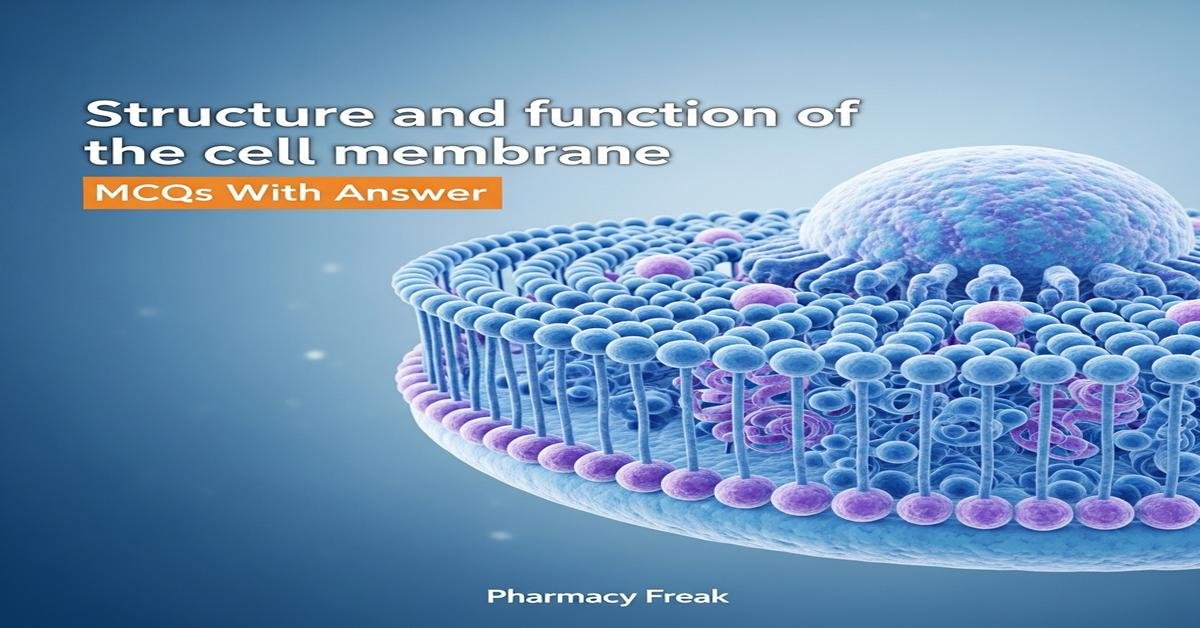
The structure and function of the cell membrane are foundational for B.Pharm students studying drug action, transport and pharmacokinetics. This topic covers the fluid mosaic model, lipid bilayer composition (phospholipids, cholesterol, glycolipids), membrane proteins (integral, peripheral, receptors, ion channels), membrane permeability, passive and active transport, endocytosis/exocytosis, and membrane dynamics like lipid rafts and membrane asymmetry. Understanding membrane transport mechanisms, pH partitioning, efflux pumps (P-glycoprotein) and barriers such as the blood–brain barrier is essential for predicting drug absorption and distribution. Clear grasp of these concepts improves rational drug design and therapeutic strategies. Now let’s test your knowledge with 30 MCQs on this topic.
Q1. Which component primarily provides fluidity to the eukaryotic cell membrane?
- Phospholipid fatty acid unsaturation
- Glycoproteins
- Membrane carbohydrates
- Cytoskeletal filaments
Correct Answer: Phospholipid fatty acid unsaturation
Q2. The fluid mosaic model describes the membrane as:
- A rigid layer of immobile proteins over lipids
- A dynamic bilayer of lipids with embedded proteins
- A single layer of phospholipids with peripheral proteins only
- A homogeneous sheet of carbohydrates and lipids
Correct Answer: A dynamic bilayer of lipids with embedded proteins
Q3. Which membrane protein type spans the bilayer and often forms channels or transporters?
- Peripheral proteins
- Integral transmembrane proteins
- Glycolipids
- Extracellular matrix proteins
Correct Answer: Integral transmembrane proteins
Q4. Cholesterol in the plasma membrane primarily:
- Increases membrane permeability to ions
- Prevents all protein movement
- Modulates fluidity and stabilizes bilayer
- Forms covalent bonds with phospholipids
Correct Answer: Modulates fluidity and stabilizes bilayer
Q5. Which process describes movement of molecules down their concentration gradient through a specific protein without energy input?
- Primary active transport
- Facilitated diffusion
- Endocytosis
- Exocytosis
Correct Answer: Facilitated diffusion
Q6. The Na+/K+ ATPase is an example of:
- Secondary active transport
- Passive diffusion
- Primary active transport
- Ion channel-mediated diffusion
Correct Answer: Primary active transport
Q7. Which statement about lipid rafts is correct?
- They are areas enriched in unsaturated phospholipids only
- They are microdomains rich in cholesterol and sphingolipids
- They are permanent immobile regions in all membranes
- They lack protein components
Correct Answer: They are microdomains rich in cholesterol and sphingolipids
Q8. Which membrane transport is driven by the electrochemical gradient created by primary active transport?
- Endocytosis
- Secondary active transport (symport/antiport)
- Facilitated diffusion via channels
- Passive osmosis
Correct Answer: Secondary active transport (symport/antiport)
Q9. Which feature most influences passive diffusion of a drug across the lipid bilayer?
- Molecular size, lipophilicity and ionization state
- Presence of membrane glycoproteins
- Number of membrane cholesterol molecules
- Rate of endocytosis
Correct Answer: Molecular size, lipophilicity and ionization state
Q10. Aquaporins are membrane proteins that specifically facilitate:
- Glucose transport
- Water transport
- Na+ extrusion
- Lipid flip-flop
Correct Answer: Water transport
Q11. Which mechanism best explains receptor-mediated endocytosis?
- Nonselective engulfment of extracellular fluid
- Selective internalization via ligand-receptor clustering and clathrin-coated pits
- Direct diffusion across the bilayer
- Exocytosis followed by endocytosis
Correct Answer: Selective internalization via ligand-receptor clustering and clathrin-coated pits
Q12. Flippases and scramblases influence membrane behavior by:
- Facilitating lateral diffusion of lipids
- Catalyzing transverse movement (flip-flop) of lipids between leaflets
- Degrading membrane lipids
- Anchoring membrane proteins to the cytoskeleton
Correct Answer: Catalyzing transverse movement (flip-flop) of lipids between leaflets
Q13. The Nernst potential for a single ion depends on:
- Membrane thickness only
- Concentration gradient of that ion and temperature
- Total protein content of the membrane
- Number of transporters for that ion
Correct Answer: Concentration gradient of that ion and temperature
Q14. Which is a characteristic of carrier-mediated transport compared to channel-mediated transport?
- Unlimited rate as gradient increases
- Saturability and specificity
- Always passive and nonselective
- Only moves ions, not solutes
Correct Answer: Saturability and specificity
Q15. Glycocalyx on the cell surface primarily functions in:
- Generating ATP
- Cell recognition, protection and signaling
- Lipid synthesis
- Anchoring DNA to the membrane
Correct Answer: Cell recognition, protection and signaling
Q16. P-glycoprotein (MDR1) affects drug therapy by:
- Increasing drug metabolic activation
- Acting as an efflux pump reducing intracellular drug concentration
- Facilitating passive diffusion of lipophilic drugs
- Breaking down drug molecules enzymatically
Correct Answer: Acting as an efflux pump reducing intracellular drug concentration
Q17. Which statement about membrane asymmetry is true?
- Both leaflets have identical lipid composition
- Inner and outer leaflets differ in lipid and protein composition
- Asymmetry is unrelated to cell signaling
- Only bacterial membranes show asymmetry
Correct Answer: Inner and outer leaflets differ in lipid and protein composition
Q18. Proton pumps in organelle membranes (e.g., lysosomes) primarily create:
- Membrane fluidity
- Electrochemical gradients and pH differences
- Lipid rafts
- Gap junctions
Correct Answer: Electrochemical gradients and pH differences
Q19. Which junction type allows direct electrical and metabolic coupling between adjacent cells?
- Tight junctions
- Desmosomes
- Gap junctions
- Adherens junctions
Correct Answer: Gap junctions
Q20. A weak base drug (pKa 8.5) will be more membrane-permeable in which environment?
- Strongly acidic extracellular fluid (pH 1.5)
- Acidic intracellular vesicle (pH 5.0) where it becomes protonated
- Neutral pH where more remains unprotonated and lipophilic
- Always impermeable regardless of pH
Correct Answer: Neutral pH where more remains unprotonated and lipophilic
Q21. Which is the main driving force for osmosis across a semipermeable membrane?
- Electrical gradients only
- Solute concentration difference creating osmotic pressure
- Membrane protein synthesis
- Cholesterol content
Correct Answer: Solute concentration difference creating osmotic pressure
Q22. Caveolae differ from clathrin-coated pits because caveolae:
- Are coated with clathrin triskelions
- Contain caveolin proteins and are cholesterol-rich invaginations
- Only mediate bulk-phase endocytosis
- Are only found in bacterial membranes
Correct Answer: Contain caveolin proteins and are cholesterol-rich invaginations
Q23. Which property reduces passive permeability of a drug across the BBB?
- High lipophilicity and neutral charge
- Low molecular weight
- P-glycoprotein efflux recognition and high polarity
- High plasma protein binding only
Correct Answer: P-glycoprotein efflux recognition and high polarity
Q24. Which technique measures lateral mobility of membrane proteins or lipids?
- Western blotting
- Fluorescence recovery after photobleaching (FRAP)
- PCR amplification
- Electron microscopy fixation only
Correct Answer: Fluorescence recovery after photobleaching (FRAP)
Q25. The main role of peripheral membrane proteins is to:
- Span the lipid bilayer forming pores
- Associate loosely with membrane surfaces and mediate signaling or structural roles
- Form the hydrophobic core of the bilayer
- Act as lipid flipases exclusively
Correct Answer: Associate loosely with membrane surfaces and mediate signaling or structural roles
Q26. Which statement best describes electrogenic pumps?
- They transport equal numbers of positive and negative ions so no net charge moves
- They move net charge across the membrane contributing to membrane potential
- They only transport neutral solutes
- They are inactive in nerve cells
Correct Answer: They move net charge across the membrane contributing to membrane potential
Q27. In pH partitioning theory, acidic drugs accumulate in which compartment relative to blood plasma?
- More in alkaline compartments where they are ionized
- Preferentially in neutral compartments only
- In lipid droplets only
- They never accumulate due to complete diffusion
Correct Answer: More in alkaline compartments where they are ionized
Q28. Which membrane alteration commonly increases during apoptosis and acts as an “eat-me” signal?
- Externalization of phosphatidylserine to the outer leaflet
- Increased cholesterol concentration in inner leaflet
- Complete loss of all membrane proteins
- Formation of permanent gap junctions
Correct Answer: Externalization of phosphatidylserine to the outer leaflet
Q29. Which drug transporter family primarily uses ATP hydrolysis to export drugs from cells?
- SLC solute carriers
- ABC (ATP-binding cassette) transporters
- Ion channels
- Gap junction proteins
Correct Answer: ABC (ATP-binding cassette) transporters
Q30. Membrane fusion during vesicle exocytosis is mediated by which protein family?
- SNARE proteins
- Integrins
- Flippases
- Clathrins
Correct Answer: SNARE proteins


