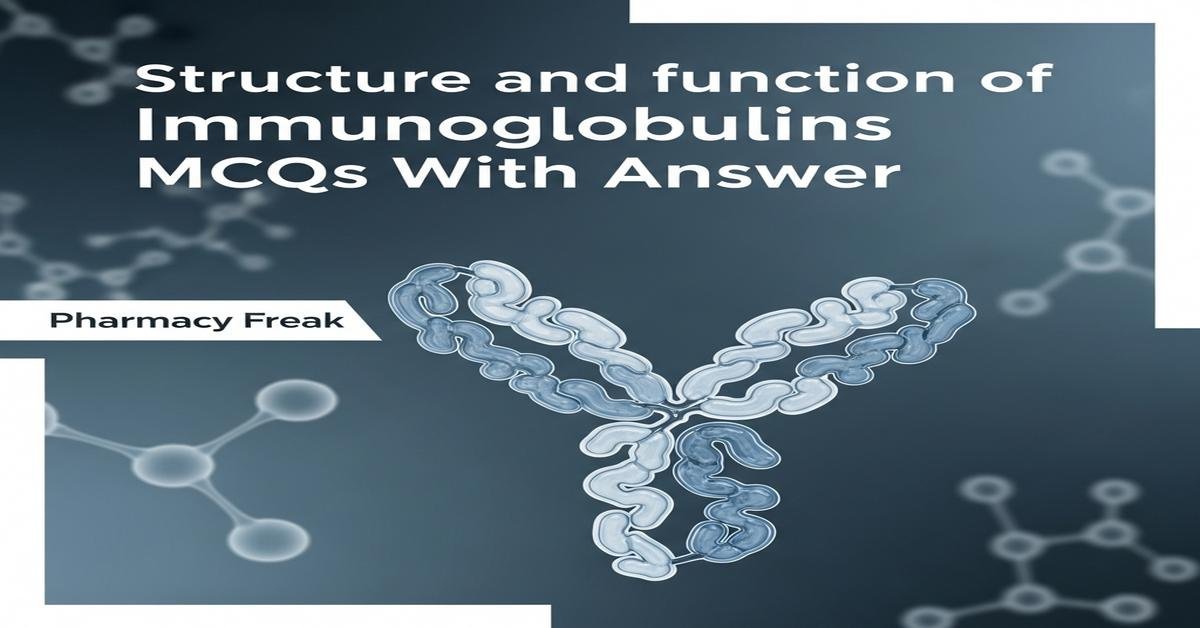
Introduction: This quiz compilation on Structure and Function of Immunoglobulins is tailored for M.Pharm students preparing for advanced immunotechnology topics. It summarizes essential structural features of antibodies — chains, domains, hinge region, glycosylation, and isotype-specific assembly — and links them to key effector functions such as neutralization, opsonization, complement activation, and Fc receptor interactions. Questions probe molecular mechanisms including V(D)J recombination, somatic hypermutation, class switching, and therapeutic antibody engineering. Designed to deepen conceptual understanding and application, the MCQs emphasize biochemical detail, clinical relevance and rationale for antibody-based drug design, aiding both exam preparation and practical comprehension.
Q1. Which of the following best describes the basic quaternary structure of a typical IgG antibody?
- One heavy chain and one light chain linked by noncovalent interactions
- Two identical heavy chains and two identical light chains connected by disulfide bonds
- Four heavy chains arranged as a tetramer without light chains
- Two light chains only connected via a J chain
Correct Answer: Two identical heavy chains and two identical light chains connected by disulfide bonds
Q2. The antigen-binding site (paratope) of an antibody is primarily formed by which regions?
- Constant (C) regions of the heavy and light chains
- Complementarity-determining regions (CDRs) within the variable (V) domains
- Hinge region and CH2 domain glycosylation
- J chain and secretory component
Correct Answer: Complementarity-determining regions (CDRs) within the variable (V) domains
Q3. Which enzymatic cleavage yields two Fab fragments and one Fc fragment?
- Pepsin digestion
- Trypsin digestion
- Papain digestion
- Cell-surface protease cleavage
Correct Answer: Papain digestion
Q4. Which immunoglobulin isotype is most effective at activating the classical complement pathway as a pentamer in serum?
- IgA
- IgM
- IgG4
- IgE
Correct Answer: IgM
Q5. The J (joining) chain is essential for which of the following antibody forms?
- Monomeric IgG in serum
- Dimeric IgA and pentameric IgM polymerization
- Fc fragment formation after papain cleavage
- Somatic hypermutation in germinal centers
Correct Answer: Dimeric IgA and pentameric IgM polymerization
Q6. Which amino acid motif and post-translational modification in the Fc region is critical for IgG interaction with Fcγ receptors and complement C1q?
- Proline-rich hinge and O-linked glycosylation at Ser60
- Asn297 N-linked glycosylation in CH2 domain
- Phosphorylation of tyrosines in CH3 domain
- Methylation of lysines in the variable region
Correct Answer: Asn297 N-linked glycosylation in CH2 domain
Q7. Which IgG subclass in humans has the longest hinge region and is generally most effective at complement activation and Fc receptor binding?
- IgG1
- IgG2
- IgG3
- IgG4
Correct Answer: IgG3
Q8. Affinity maturation of antibody variable regions during a T-dependent response is mainly driven by which process?
- Class switch recombination mediated by activation-induced cytidine deaminase (AID)
- Somatic hypermutation followed by selection in germinal centers
- V(D)J combinatorial rearrangement in mature plasma cells
- Random glycosylation changes in Fc domains
Correct Answer: Somatic hypermutation followed by selection in germinal centers
Q9. Which statement about secretory IgA (sIgA) is correct?
- sIgA is a monomeric serum antibody primarily activating complement
- sIgA is dimeric, contains a J chain and secretory component, and resists proteolysis at mucosal surfaces
- sIgA contains Fc regions that bind Fcγ receptors to mediate ADCC
- sIgA is the main mediator of type I hypersensitivity
Correct Answer: sIgA is dimeric, contains a J chain and secretory component, and resists proteolysis at mucosal surfaces
Q10. Which of the following is a primary functional difference between the Fab and Fc regions?
- Fab mediates effector functions; Fc binds antigen
- Fab provides antigen specificity; Fc mediates recruitment of immune effectors
- Both Fab and Fc equally bind complement C1q
- Fc contains the CDRs responsible for antigen binding
Correct Answer: Fab provides antigen specificity; Fc mediates recruitment of immune effectors
Q11. Which mechanism best explains how IgG is transported across epithelial barriers to provide neonatal immunity?
- Passive diffusion through tight junctions
- FcRn-mediated transcytosis binding the IgG Fc at acidic pH
- Secretory component binding to the Fab region
- Binding to polymeric Ig receptor (pIgR) like IgA
Correct Answer: FcRn-mediated transcytosis binding the IgG Fc at acidic pH
Q12. Class switch recombination (CSR) changes which properties of an antibody molecule?
- Variable region antigen specificity and complementarity-determining regions
- Heavy chain constant region isotype, altering effector functions while preserving antigen specificity
- Light chain V-J gene usage only
- Elimination of glycosylation sites in the variable region
Correct Answer: Heavy chain constant region isotype, altering effector functions while preserving antigen specificity
Q13. Which IgE function is most directly responsible for immediate hypersensitivity reactions?
- Activation of complement via classical pathway
- Binding to high-affinity FcεRI receptors on mast cells and basophils causing degranulation
- Neutralization of bacterial toxins in serum
- Opsonization for phagocytosis by neutrophils
Correct Answer: Binding to high-affinity FcεRI receptors on mast cells and basophils causing degranulation
Q14. Which structural feature allows IgM pentamers to bind multiple antigens and agglutinate pathogens effectively despite low affinity of individual sites?
- High-affinity FcRn binding
- Polymeric structure with ten antigen-binding sites enabling high avidity
- Extensive somatic hypermutation in IgM-producing cells
- Unique O-linked glycans in the variable domain
Correct Answer: Polymeric structure with ten antigen-binding sites enabling high avidity
Q15. What is an idiotype in the context of immunoglobulins?
- The subclass identity such as IgG1 or IgG2
- The unique set of antigenic determinants in the variable region CDRs specific to a clonotype
- The constant region glycosylation pattern
- The J chain association in polymeric antibodies
Correct Answer: The unique set of antigenic determinants in the variable region CDRs specific to a clonotype
Q16. Engineering the Fc region of therapeutic antibodies to enhance ADCC typically involves modifications that affect binding to which receptor?
- FcRn
- FcγRIIIa (CD16a) on NK cells
- Polymeric Ig receptor (pIgR)
- Complement receptor 1 (CR1)
Correct Answer: FcγRIIIa (CD16a) on NK cells
Q17. Which immunoglobulin isotype is predominantly found in mucosal secretions and is critical for immune exclusion at mucosal surfaces?
- IgG
- IgM
- Secretory IgA (sIgA)
- IgD
Correct Answer: Secretory IgA (sIgA)
Q18. The process that assembles diverse V, D and J gene segments in developing B cells to create a variable region is called:
- Somatic hypermutation
- Class switch recombination
- V(D)J recombination mediated by RAG1/2 enzymes
- Isotype switching catalyzed by AID
Correct Answer: V(D)J recombination mediated by RAG1/2 enzymes
Q19. Which IgG subclass is often considered functionally anti-inflammatory because it poorly fixes complement and can undergo Fab-arm exchange?
- IgG1
- IgG2
- IgG3
- IgG4
Correct Answer: IgG4
Q20. Glycosylation at Asn297 in the IgG Fc domain primarily influences which of the following?
- Antigen specificity of the Fab region
- Structural stability of the variable domain only
- Fc conformation affecting Fcγ receptor binding and complement activation
- Polymeric assembly into pentamers
Correct Answer: Fc conformation affecting Fcγ receptor binding and complement activation

