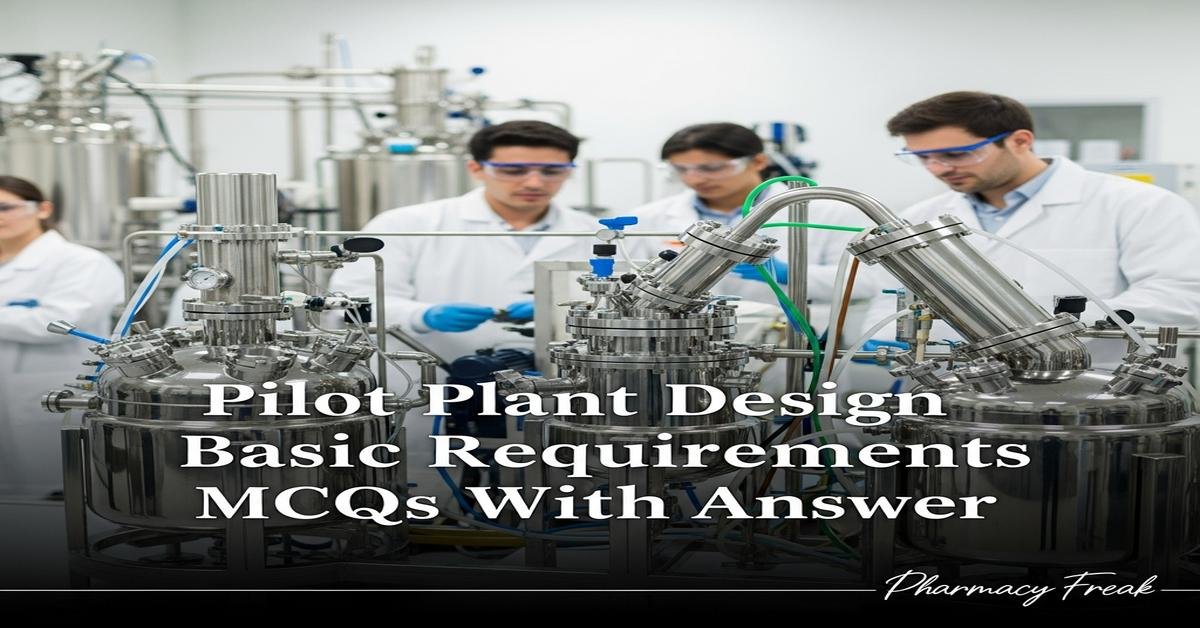
Pilot Plant Design – Basic Requirements MCQs With Answer
This collection of MCQs is tailored for M. Pharm students studying Scale Up & Technology Transfer (MIP 202T). The questions focus on the fundamental design requirements of a pilot plant used in pharmaceutical development: objectives, capacity planning, equipment selection, utilities, layout, containment, process control, validation and regulatory compliance. Each question probes practical decision-making and technical understanding needed when moving from laboratory to pilot scale. These items emphasize real-world considerations such as material flow, cleaning and sampling strategies, environmental control, and flexibility for multiple processes—preparing students for design, commissioning, and quality-driven operation of pilot facilities.
Q1. What is the primary objective of a pharmaceutical pilot plant?
- Mass production of commercial batches
- Validation of full-scale GMP manufacturing lines
- Bridging laboratory development and commercial production by demonstrating process feasibility and scale-up
- Storage of raw materials under controlled conditions
Correct Answer: Bridging laboratory development and commercial production by demonstrating process feasibility and scale-up
Q2. When determining pilot plant batch size, which factor is most critical?
- Availability of raw materials only
- Scale-up similarity to commercial process including equipment geometry and critical process parameters
- Minimizing utility usage
- Maximum capacity of the facility’s storage rooms
Correct Answer: Scale-up similarity to commercial process including equipment geometry and critical process parameters
Q3. Which utility is most commonly a limiting factor in pilot plant design for wet processes?
- Compressed air
- Process steam and cooling capacity (heat transfer utilities)
- Potable water for drinking
- Vacuum packaging lines
Correct Answer: Process steam and cooling capacity (heat transfer utilities)
Q4. What is the key reason for designing a pilot plant with flexible modular equipment?
- To reduce initial capital expenditure only
- To allow testing of multiple formulations and processes with minimal downtime and easier reconfiguration
- To eliminate the need for validation
- To maximize fixed piping work
Correct Answer: To allow testing of multiple formulations and processes with minimal downtime and easier reconfiguration
Q5. In pilot plant layout, what principle ensures unidirectional material flow to prevent cross-contamination?
- Randomized flow paths
- Circular process routing
- Linear workflow from raw material receipt to finished goods exit
- Shared entry and exit points for raw and finished products
Correct Answer: Linear workflow from raw material receipt to finished goods exit
Q6. For containment of potent compounds in a pilot plant, which design element is most important?
- Open mixing areas for easy access
- Local exhaust ventilation, closed transfers and negative pressure suites
- Maximizing natural ventilation through windows
- Placement of HVAC intakes near product lines
Correct Answer: Local exhaust ventilation, closed transfers and negative pressure suites
Q7. What documentation is essential before pilot plant commissioning?
- Only purchase orders for equipment
- Installation (IQ), Operational (OQ) and Performance Qualification (PQ) protocols and SOPs
- Only marketing brochures for the product
- Informal notes by the operator
Correct Answer: Installation (IQ), Operational (OQ) and Performance Qualification (PQ) protocols and SOPs
Q8. Which design consideration minimizes the risk of cleaning validation failures in a pilot plant?
- Using fixed non-accessible piping runs
- Material and surface finishes that support cleanability and designing for ease of inspection
- Complex manifolds with dead legs
- Porous sealing materials in product contact areas
Correct Answer: Material and surface finishes that support cleanability and designing for ease of inspection
Q9. Which instrumentation is most crucial for maintaining critical process parameters during scale-up trials?
- Decorative lighting controls
- Accurate temperature, pressure, flow and pH sensors with calibrated transmitters
- Only manual thermometers
- Passive visual observation with no recording
Correct Answer: Accurate temperature, pressure, flow and pH sensors with calibrated transmitters
Q10. Why is traceability of materials and process records emphasized in pilot plants?
- To create extra paperwork for staff
- To support investigation, reproducibility, regulatory submissions and transfer of technology to manufacturing
- To slow down the process intentionally
- To obscure the origin of raw materials
Correct Answer: To support investigation, reproducibility, regulatory submissions and transfer of technology to manufacturing
Q11. In pilot plant safety design, which feature reduces worker exposure during sampling of hazardous intermediates?
- Open manual sampling ports at operator height
- Closed sampling systems with inert transfer and shielded ports
- Sampling performed only at end of shift
- Using untrained personnel for quicker sampling
Correct Answer: Closed sampling systems with inert transfer and shielded ports
Q12. How does adequate segregation of support areas (e.g., QC labs) from production areas benefit a pilot plant?
- Increases cross-contamination risk
- Improves quality control independence, reduces contamination and streamlines testing turnaround
- Causes duplication of utilities unnecessarily
- Makes waste handling more difficult
Correct Answer: Improves quality control independence, reduces contamination and streamlines testing turnaround
Q13. Which environmental control is vital for sterile or aseptic pilot operations?
- Random air exchange rates
- HEPA-filtered unidirectional airflow, pressure cascades and controlled particle counts
- Open doors during operation to increase cooling
- Window ventilation
Correct Answer: HEPA-filtered unidirectional airflow, pressure cascades and controlled particle counts
Q14. What role does a pilot plant play in process validation strategy?
- It replaces commercial validation entirely
- It generates process data for establishing critical parameters, acceptance criteria and supports commercial validation plans
- It is unrelated to validation activities
- It is used only for marketing scale photos
Correct Answer: It generates process data for establishing critical parameters, acceptance criteria and supports commercial validation plans
Q15. For scale-up of mixing operations, which similarity criterion is commonly considered?
- Color of the impeller
- Geometric similarity and maintaining constant power per unit volume or constant tip speed depending on the process
- Using exactly the same motor brand
- Number of valves in the facility
Correct Answer: Geometric similarity and maintaining constant power per unit volume or constant tip speed depending on the process
Q16. Which waste handling feature is essential in a pilot plant handling hazardous chemical intermediates?
- Discharging to municipal drains without treatment
- Dedicated containment, segregation, neutralization and documented disposal routes compliant with regulations
- Mixing all wastes together to minimize containers
- Storing waste indefinitely on the production floor
Correct Answer: Dedicated containment, segregation, neutralization and documented disposal routes compliant with regulations
Q17. Which attribute of pilot plant equipment aids in generating representative data for technology transfer?
- Non-replicable, custom one-off vessels
- Equipment with scalable geometric similarity, controllable CIP/SIP capabilities and representative hydrodynamics
- Equipment with no instrumentation
- Manual-only control without data logging
Correct Answer: Equipment with scalable geometric similarity, controllable CIP/SIP capabilities and representative hydrodynamics
Q18. During pilot trials, why is rigorous sampling and in-process testing required?
- To generate unnecessary analytical workload
- To monitor critical quality attributes, detect deviations early and provide data for control strategy development
- To delay process decisions
- To replace final product testing entirely
Correct Answer: To monitor critical quality attributes, detect deviations early and provide data for control strategy development
Q19. How should electrical and instrumentation systems be designed in a pilot plant to support scale-up?
- Minimum sensors and no redundant systems
- Robust, scalable control architecture with adequate I/O, data historian and ability to simulate commercial control strategies
- Only manual switches with no automation
- Ad hoc wiring without labeling
Correct Answer: Robust, scalable control architecture with adequate I/O, data historian and ability to simulate commercial control strategies
Q20. Which regulatory consideration is important when designing a pilot plant intended to support global submissions?
- Ignoring international standards since pilot plants are small
- Designing to meet cGMP expectations, electronic record integrity (ALCOA+), and documentation practices consistent with global regulatory requirements
- Only following local building codes without GMP compliance
- Avoiding any formal validation to speed up trials
Correct Answer: Designing to meet cGMP expectations, electronic record integrity (ALCOA+), and documentation practices consistent with global regulatory requirements


I am a Registered Pharmacist under the Pharmacy Act, 1948, and the founder of PharmacyFreak.com. I hold a Bachelor of Pharmacy degree from Rungta College of Pharmaceutical Science and Research. With a strong academic foundation and practical knowledge, I am committed to providing accurate, easy-to-understand content to support pharmacy students and professionals. My aim is to make complex pharmaceutical concepts accessible and useful for real-world application.
Mail- Sachin@pharmacyfreak.com