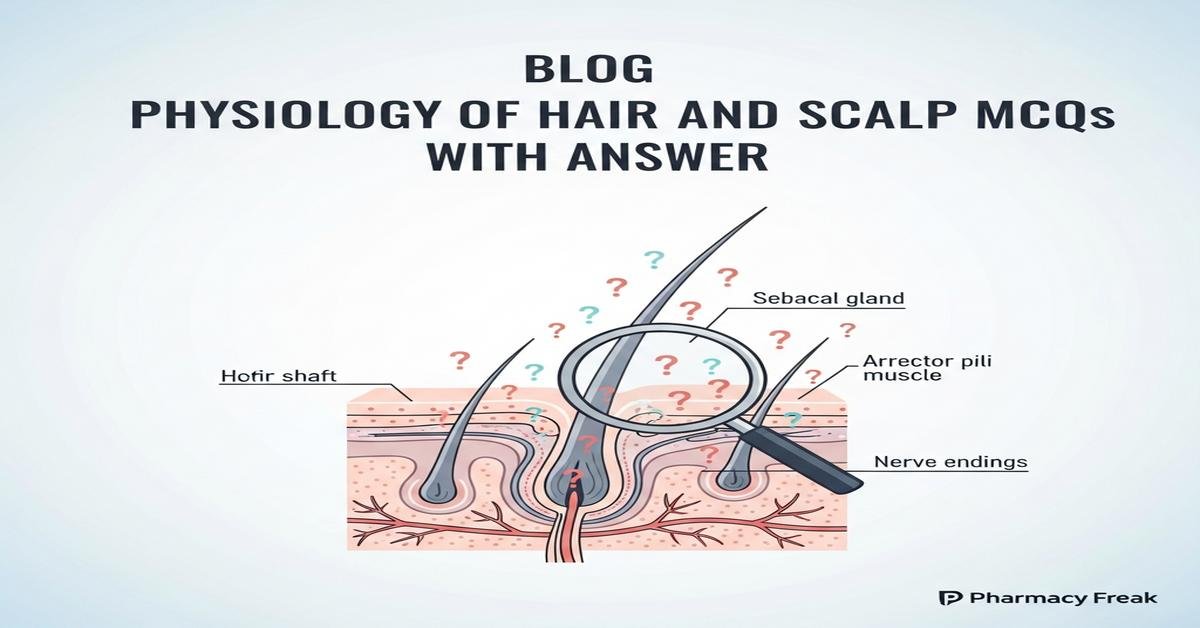
Introduction: This blog presents a focused set of MCQs on the physiology of hair and scalp tailored for M.Pharm students studying Herbal Cosmetics (MPG 204T). It covers core concepts including hair follicle anatomy, growth cycles, keratin and pigment biology, sebaceous and sweat gland physiology, scalp microenvironment, vascular and neural regulation, and signaling molecules that govern hair growth and shedding. Questions emphasize mechanistic understanding relevant to formulation and evaluation of herbal cosmetic agents, such as how scalp pH, microbiome, lipids, and growth factors influence hair health. Each question is followed by options and a clear answer to aid revision and deepen comprehension for advanced academic and practical contexts.
Q1. Which sequence correctly represents the phases of the hair growth cycle?
- Anagen = active growth; Catagen = involution/regression; Telogen = resting/shedding
- Anagen = resting; Catagen = active growth; Telogen = regression
- Anagen = shedding; Catagen = resting; Telogen = active growth
- Anagen = involution; Catagen = active growth; Telogen = resting
Correct Answer: Anagen = active growth; Catagen = involution/regression; Telogen = resting/shedding
Q2. Where are the melanocytes that supply pigment to the hair shaft primarily located?
- Hair matrix melanocytes within the hair bulb
- Sebaceous gland basal cells
- Dermal papilla fibroblasts
- Arrector pili smooth muscle cells
Correct Answer: Hair matrix melanocytes within the hair bulb
Q3. What is the predominant structural protein type in human hair shaft?
- High-sulfur (cysteine-rich) alpha-keratin
- Collagen type I
- Elastin fibers
- Keratan sulfate proteoglycan
Correct Answer: High-sulfur (cysteine-rich) alpha-keratin
Q4. Arrange the layers of the hair shaft from outermost to innermost.
- Cuticle → Cortex → Medulla
- Cortex → Cuticle → Medulla
- Medulla → Cortex → Cuticle
- Cuticle → Medulla → Cortex
Correct Answer: Cuticle → Cortex → Medulla
Q5. Which structure acts as the primary mesenchymal signaling center that regulates hair follicle cycling and hair size?
- Dermal papilla
- Sebaceous gland
- Arrector pili muscle
- Interstitial dermal fibroblast
Correct Answer: Dermal papilla
Q6. The major lipid components of human sebum are primarily:
- Triglycerides and free fatty acids (major components)
- Phospholipids and glycolipids
- Sphingomyelins and ceramides only
- Cholesterol esters exclusively
Correct Answer: Triglycerides and free fatty acids (major components)
Q7. Arrector pili muscles are innervated predominantly by which type of autonomic fibers?
- Sympathetic adrenergic fibers
- Parasympathetic cholinergic fibers
- Sensory C-fibers
- Splanchnic efferent fibers
Correct Answer: Sympathetic adrenergic fibers
Q8. How are melanosomes transferred from melanocytes to keratinocytes in the hair follicle?
- Coupled exocytosis from melanocytes and phagocytosis/endocytosis by keratinocytes
- Direct fusion of melanocyte and keratinocyte membranes without vesicular release
- Passive diffusion of melanin across intercellular space
- Secretion of free melanin monomers absorbed by keratinocytes
Correct Answer: Coupled exocytosis from melanocytes and phagocytosis/endocytosis by keratinocytes
Q9. Approximately what percentage of scalp hairs are in anagen phase in a healthy adult?
- 85–90%
- 10–20%
- 40–50%
- 0–5%
Correct Answer: 85–90%
Q10. What is the average rate of scalp hair growth in healthy adults?
- Approximately 1 cm per month
- Approximately 5 cm per month
- Approximately 0.1 cm per month
- Approximately 10 cm per month
Correct Answer: Approximately 1 cm per month
Q11. Which isoform of 5-alpha reductase is predominantly expressed in hair follicles and implicated in androgenetic effects?
- Type II 5‑alpha reductase (predominant in hair follicles and prostate)
- Type I 5‑alpha reductase (exclusive to liver)
- Type III 5‑alpha reductase (only in sebaceous glands)
- No 5‑alpha reductase is present in hair follicles
Correct Answer: Type II 5‑alpha reductase (predominant in hair follicles and prostate)
Q12. Which microbial genus is most commonly associated with seborrheic dermatitis and dandruff on the scalp?
- Malassezia (lipophilic yeast)
- Staphylococcus aureus
- Candida albicans
- Pseudomonas aeruginosa
Correct Answer: Malassezia (lipophilic yeast)
Q13. The follicular epithelial stem cell niche responsible for re-epithelialization and hair regeneration is located in which region?
- Buldge region of the outer root sheath
- Medulla of the hair shaft
- Center of the sebaceous gland
- Surface epidermis only
Correct Answer: Buldge region of the outer root sheath
Q14. Age-related hair graying is primarily attributed to which cellular mechanism?
- Depletion and dysfunction of melanocyte stem cells in the bulge
- Hyperproliferation of melanocytes increasing oxidative stress
- Increased sebum production diluting pigment
- Enhanced activity of dermal papilla fibroblasts
Correct Answer: Depletion and dysfunction of melanocyte stem cells in the bulge
Q15. Which growth factor is well recognized for stimulating hair follicle proliferation and maintaining anagen?
- IGF‑1 (insulin‑like growth factor 1)
- FGF‑5 (fibroblast growth factor 5)
- TGF‑β1 (transforming growth factor beta 1) as a promoter of anagen
- Prolactin as the primary anagen inducer
Correct Answer: IGF‑1 (insulin‑like growth factor 1)
Q16. Normal scalp surface pH is generally:
- Around 5.5 (slightly acidic)
- Around 8.5 (alkaline)
- Neutral at pH 7.0 only
- Highly acidic at pH 2.0
Correct Answer: Around 5.5 (slightly acidic)
Q17. Hair porosity, an important functional characteristic for cosmetic formulation, is best assessed by:
- Water uptake or dye uptake tests reflecting cuticle damage and porosity
- Measuring only hair diameter with calipers
- Counting hair per square centimeter without absorption tests
- Evaluating sebum secretion alone
Correct Answer: Water uptake or dye uptake tests reflecting cuticle damage and porosity
Q18. Telogen effluvium is characterized physiologically by which of the following?
- Diffuse shedding 2–3 months after systemic stress due to premature catagen/telogen transition
- Localized scarring and permanent follicle destruction
- Immediate anagen hair loss within hours of trigger
- Increased anagen entry producing longer hair
Correct Answer: Diffuse shedding 2–3 months after systemic stress due to premature catagen/telogen transition
Q19. The primary vascular supply delivering nutrients and growth signals to the hair bulb is provided by:
- Perifollicular capillary network (capillary loop supplying the dermal papilla)
- Lymphatic vessels exclusively
- Large muscular arteries within the shaft
- Direct diffusion from epidermal surface only
Correct Answer: Perifollicular capillary network (capillary loop supplying the dermal papilla)
Q20. Which layer of the hair shaft primarily determines tensile strength and contains most of the pigment?
- Cortex (gives tensile strength and contains pigment)
- Cuticle (responsible for pigment and tensile strength)
- Medulla (primary pigment and strength provider)
- External sheath (the outermost pigment layer)
Correct Answer: Cortex (gives tensile strength and contains pigment)


I am a Registered Pharmacist under the Pharmacy Act, 1948, and the founder of PharmacyFreak.com. I hold a Bachelor of Pharmacy degree from Rungta College of Pharmaceutical Science and Research. With a strong academic foundation and practical knowledge, I am committed to providing accurate, easy-to-understand content to support pharmacy students and professionals. My aim is to make complex pharmaceutical concepts accessible and useful for real-world application.
Mail- Sachin@pharmacyfreak.com