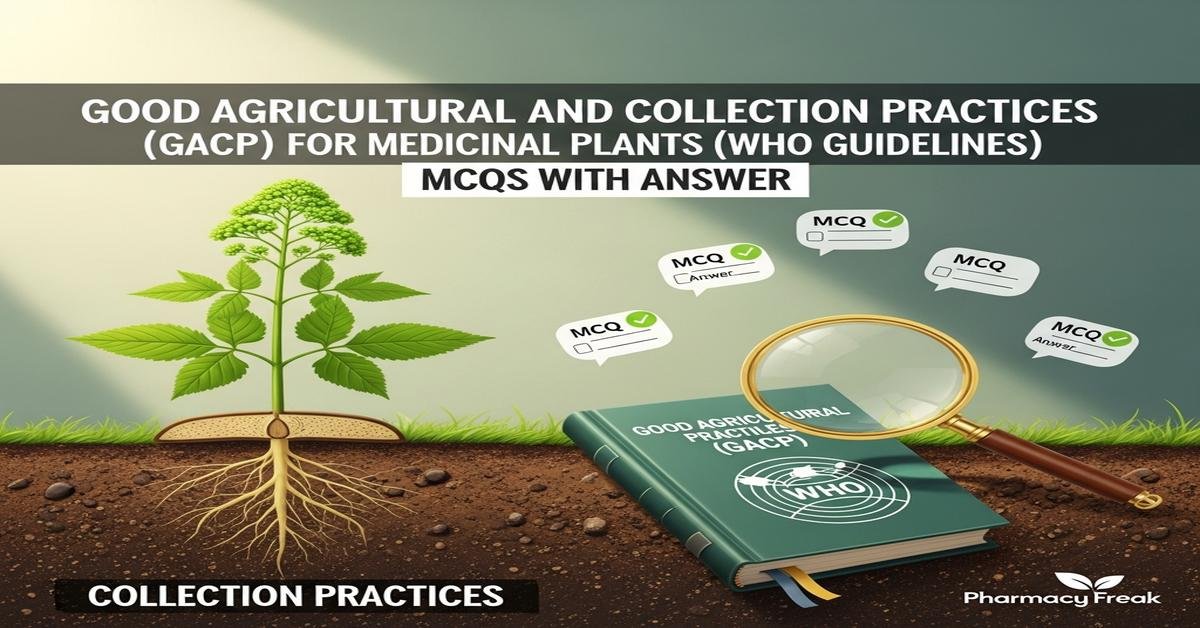
Introduction: Good Agricultural and Collection Practices (GACP) for medicinal plants, as detailed in WHO guidelines, provide standards to ensure quality, safety, and traceability of herbal raw materials. B. Pharm students must understand site selection, certified planting material, sustainable wild collection, harvesting at optimal maturity, post-harvest drying, storage, pesticide and heavy metal control, documentation, and chain-of-custody. GACP links cultivation and collection practices to pharmacopoeial quality requirements and GMP for finished herbal products. Emphasis on botanical authentication, voucher specimens, analytical testing (chromatography/DNA barcoding), and farmer training helps prevent adulteration and contamination. Now let’s test your knowledge with 30 MCQs on this topic.
Q1. Which factor is most critical when selecting a cultivation site under GACP for medicinal plants?
- Proximity to processing facilities
- Selection based on ecological suitability and absence of contaminants
- Lowest land rental cost
- Highest sunlight exposure irrespective of pollution
Correct Answer: Selection based on ecological suitability and absence of contaminants
Q2. What is the primary objective of WHO GACP for medicinal plants?
- Maximize crop yield at any cost
- Ensure consistent quality, safety and traceability of herbal raw materials
- Promote industrial chemical fertilizers
- Standardize finished herbal formulations
Correct Answer: Ensure consistent quality, safety and traceability of herbal raw materials
Q3. Which stages are explicitly covered by GACP guidelines?
- Only cultivation and irrigation
- Seed production only
- Cultivation, collection, harvesting, post-harvest handling and documentation
- Manufacturing and marketing
Correct Answer: Cultivation, collection, harvesting, post-harvest handling and documentation
Q4. How does GACP differ from general Good Agricultural Practices (GAP)?
- GACP applies only to food crops
- GACP is specific to medicinal plants with emphasis on botanical identity and safety
- GACP ignores post-harvest issues
- GAP is only for export crops
Correct Answer: GACP is specific to medicinal plants with emphasis on botanical identity and safety
Q5. What is the recommended source of planting material under GACP?
- Seeds/propagules from local markets without records
- Certified disease-free planting material with traceable provenance
- Any visually healthy plant material
- Imported material without documentation
Correct Answer: Certified disease-free planting material with traceable provenance
Q6. Which practice ensures correct botanical identity of harvested material?
- Relying on local common names
- Botanical authentication and voucher specimens linked to batches
- Visual inspection only by untrained workers
- Testing only after processing
Correct Answer: Botanical authentication and voucher specimens linked to batches
Q7. What soil assessment is essential before establishing a medicinal plant crop?
- Only pH measurement
- Pre-planting soil testing for nutrients and heavy metals
- Visual soil color check
- Testing after the first harvest
Correct Answer: Pre-planting soil testing for nutrients and heavy metals
Q8. Under GACP, why must irrigation water be monitored?
- To increase water pH only
- To prevent microbial and chemical contamination of plant material
- To ensure water is warm
- Water monitoring is not required
Correct Answer: To prevent microbial and chemical contamination of plant material
Q9. What is the recommended approach to pest control in GACP?
- Routine broad-spectrum pesticide spraying without records
- Integrated Pest Management (IPM) with approved inputs and records
- Use of banned pesticides for better control
- No pest control measures allowed
Correct Answer: Integrated Pest Management (IPM) with approved inputs and records
Q10. When should medicinal plants be harvested according to GACP?
- During off-season only
- At optimal physiological maturity to maximize desired phytoconstituents
- Whenever labor is available
- Only at night to avoid sunlight
Correct Answer: At optimal physiological maturity to maximize desired phytoconstituents
Q11. What is a key principle for post-harvest drying under GACP?
- Rapid uncontrolled sun exposure until brittle
- Controlled drying to prevent microbial growth and preserve active constituents
- Immediate wet storage for convenience
- Drying is optional if processing is delayed
Correct Answer: Controlled drying to prevent microbial growth and preserve active constituents
Q12. Which storage condition is recommended for dried medicinal plant material?
- Open sacks in humid sheds
- Clean, dry, pest-free environment with traceable labeling
- Direct contact with the ground
- Mixed storage with chemical fertilizers
Correct Answer: Clean, dry, pest-free environment with traceable labeling
Q13. What does traceability in GACP require?
- Only batch numbers without records
- Full traceability from field or collection site to finished material with records
- Traceability only for exported batches
- No documentation of source needed
Correct Answer: Full traceability from field or collection site to finished material with records
Q14. Which analytical methods are recommended to detect adulteration and confirm identity?
- Only organoleptic tasting
- Chromatography, microscopy and DNA barcoding combined with macroscopic tests
- Only smell identification
- No testing required if collected traditionally
Correct Answer: Chromatography, microscopy and DNA barcoding combined with macroscopic tests
Q15. Which records are essential under GACP farm documentation?
- Only sales invoices
- Comprehensive records including seed/propagule, field, harvest, pesticide and post-harvest records
- Only GPS coordinates of field
- Only harvest weight logs
Correct Answer: Comprehensive records including seed/propagule, field, harvest, pesticide and post-harvest records
Q16. For wild collection, what additional GACP principle is critical?
- Harvest as much as possible to maximize yield
- Sustainable collection practices with permits and conservation measures
- No documentation is needed for wild plants
- Collectors should ignore seasonal patterns
Correct Answer: Sustainable collection practices with permits and conservation measures
Q17. Why is worker training emphasized in GACP?
- To reduce wages
- To ensure proper identification, hygiene, harvesting technique and documentation practices
- Training is optional under GACP
- Only supervisors need training
Correct Answer: To ensure proper identification, hygiene, harvesting technique and documentation practices
Q18. How does GACP help control heavy metal contamination?
- By washing plants after harvest only
- By site selection, soil testing, avoiding contaminated inputs and regular monitoring
- Heavy metals are not covered by GACP
- Only by chemical remediation after harvest
Correct Answer: By site selection, soil testing, avoiding contaminated inputs and regular monitoring
Q19. Who sets microbial limits for medicinal plant materials?
- GACP sets specific numeric limits globally
- Pharmacopeias and regulatory authorities define limits; GACP ensures practices to meet them
- No limits are required
- Only exporters set microbial limits
Correct Answer: Pharmacopeias and regulatory authorities define limits; GACP ensures practices to meet them
Q20. Which details are essential on labels for batches of raw herbal material?
- Only trade name and price
- Batch number, botanical name, collection/harvest date and origin
- Only collector name
- Only storage instructions
Correct Answer: Batch number, botanical name, collection/harvest date and origin
Q21. What type of audits are recommended to verify GACP compliance?
- No audits; trust is sufficient
- Regular internal and external audits with documented corrective actions
- Only external audits every ten years
- Informal peer inspections without documentation
Correct Answer: Regular internal and external audits with documented corrective actions
Q22. How do GACP and GMP interface in herbal product quality?
- They are unrelated
- GACP ensures quality of raw materials which supports GMP manufacturing and finished product quality
- GMP replaces the need for GACP
- GACP applies only after GMP steps
Correct Answer: GACP ensures quality of raw materials which supports GMP manufacturing and finished product quality
Q23. Which organization published widely accepted GACP guidelines for medicinal plants?
- World Trade Organization (WTO)
- World Health Organization (WHO)
- Food and Agriculture Organization (FAO) only
- International Monetary Fund (IMF)
Correct Answer: World Health Organization (WHO)
Q24. How should pharmacopoeial monographs be used with GACP?
- Monographs replace GACP requirements
- Used alongside GACP to specify identity, purity and assay criteria for raw materials
- Monographs are irrelevant to raw herbal material
- Only used for finished synthetic drugs
Correct Answer: Used alongside GACP to specify identity, purity and assay criteria for raw materials
Q25. Which are common sources of contamination in medicinal plant supply chains?
- Only adulteration by other herbs
- Soil, water, agrochemicals, co-harvested species and contaminated packaging
- Contamination is only from processing plants
- Only intentional chemical additives
Correct Answer: Soil, water, agrochemicals, co-harvested species and contaminated packaging
Q26. What practice promotes sustainable harvesting of wild medicinal plants?
- Clear-cutting collection areas
- Leaving sufficient stock, rotating collection sites and timing collection to allow regeneration
- Collecting all mature plants in one season
- Continuous collection from the same spot annually
Correct Answer: Leaving sufficient stock, rotating collection sites and timing collection to allow regeneration
Q27. Which transport precaution is important for raw herbal consignments?
- Stacking directly on wet floors
- Protecting material from moisture, contamination and maintaining chain-of-custody records
- Mixing lots without documentation
- Using unclean containers to save costs
Correct Answer: Protecting material from moisture, contamination and maintaining chain-of-custody records
Q28. When is chemical residue testing necessary under GACP?
- Never necessary
- When pesticides or agrochemicals have been used or if contamination is suspected
- Only for export to specific countries
- Only after product formulation
Correct Answer: When pesticides or agrochemicals have been used or if contamination is suspected
Q29. Which documentation helps ensure traceability for wild-collected material?
- Anonymous bulk receipts
- Collection permits, GPS coordinates, collector identity and harvest date
- Only verbal reports from collectors
- Only photographs without metadata
Correct Answer: Collection permits, GPS coordinates, collector identity and harvest date
Q30. Who is primarily responsible for implementing GACP measures on a medicinal plant farm?
- Only the national regulator
- The grower/farm manager with support from quality personnel and documented procedures
- Only the final product manufacturer
- Only independent auditors
Correct Answer: The grower/farm manager with support from quality personnel and documented procedures

