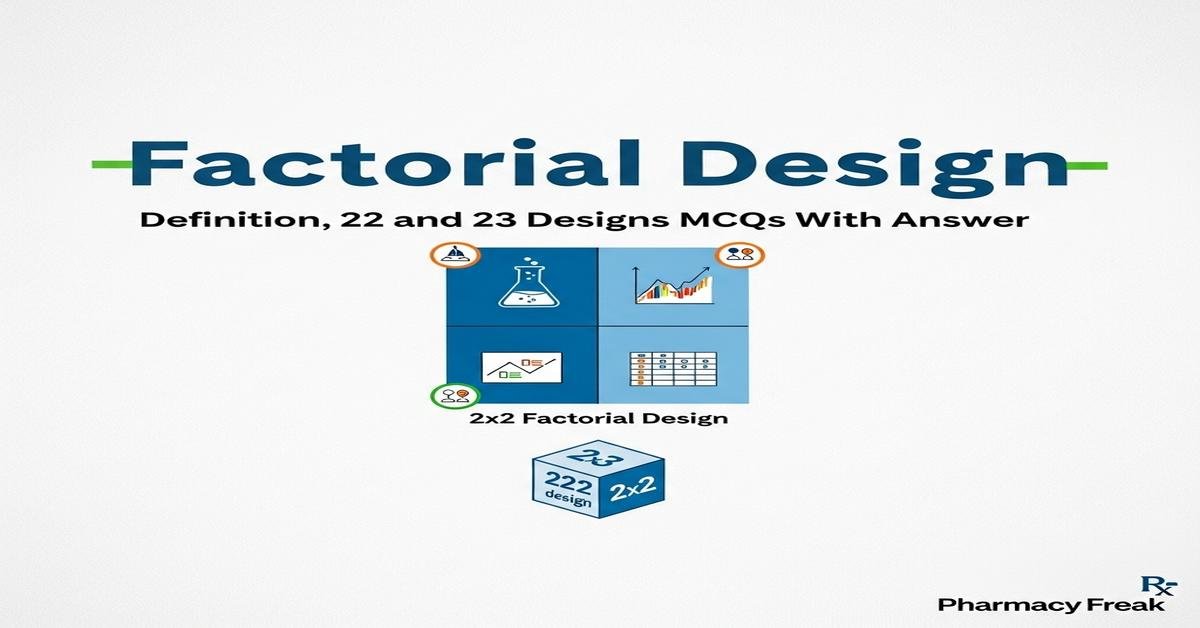
Factorial design is a powerful experimental approach widely used in pharmaceutical research to study the simultaneous effects of multiple formulation and process variables. A factorial design evaluates factors at specified levels to estimate main effects and interactions efficiently. Common two-level full factorials include 2² (four runs) and 2³ (eight runs) designs, which help detect synergistic or antagonistic interactions in tablet formulation, dissolution, and stability studies. Key concepts for B. Pharm students include factors, levels, runs, coding (+1/−1), main effects, interaction effects, aliasing, resolution, Yates’ algorithm, and use of center points or foldover to resolve confounding. Now let’s test your knowledge with 30 MCQs on this topic.
Q1. What best defines a factorial design?
- An experimental plan that studies all possible combinations of levels of two or more factors
- An approach that changes one factor at a time while keeping others constant
- A sequential screening method using many factors but single runs
- A descriptive survey method for clinical data
Correct Answer: An experimental plan that studies all possible combinations of levels of two or more factors
Q2. How many experimental runs are there in a full 2² factorial design with one replicate?
- 2
- 3
- 4
- 8
Correct Answer: 4
Q3. How many runs are required for a full 2³ factorial design (single replicate)?
- 4
- 6
- 8
- 16
Correct Answer: 8
Q4. In a 2² design each factor is tested at how many levels?
- One level
- Two levels
- Three levels
- Four levels
Correct Answer: Two levels
Q5. What is the main effect of a factor?
- The variability due to random error only
- The average change in response when the factor changes from low to high level, averaged over other factors
- The interaction between two factors only
- The sum of squared deviations for the factor
Correct Answer: The average change in response when the factor changes from low to high level, averaged over other factors
Q6. What does an interaction between two factors indicate?
- One factor has no effect on the response
- The effect of one factor depends on the level of the other factor
- Both factors are confounded with error
- The average of factor effects is zero
Correct Answer: The effect of one factor depends on the level of the other factor
Q7. Which coding is commonly used for two-level factors in factorial designs?
- 0 and 1
- -1 and +1
- 1 and 2
- A and B
Correct Answer: -1 and +1
Q8. How is a main effect typically estimated in a two-level factorial?
- Average response at high level minus average response at low level
- Difference between maximum and minimum responses across all runs
- Sum of squared residuals divided by degrees of freedom
- The product of factor levels
Correct Answer: Average response at high level minus average response at low level
Q9. What does orthogonality in a factorial design refer to?
- Factors are physically perpendicular in the laboratory
- Design columns (effects) are uncorrelated, allowing independent estimation of effects
- All effects are zero
- Only main effects can be estimated
Correct Answer: Design columns (effects) are uncorrelated, allowing independent estimation of effects
Q10. What is Yates’ algorithm used for in factorial experiments?
- Randomizing run order
- Computing factorial effects and contrasts efficiently from response data
- Designing mixture experiments
- Performing chromatographic separation
Correct Answer: Computing factorial effects and contrasts efficiently from response data
Q11. In factorial design terminology, what does resolution indicate?
- The number of runs in the experiment
- The degree to which main effects are aliased with interactions
- The magnitude of the largest main effect
- The confidence interval width for effects
Correct Answer: The degree to which main effects are aliased with interactions
Q12. How many two-factor interactions exist in a 2³ full factorial design?
- 1
- 2
- 3
- 4
Correct Answer: 3
Q13. How many runs are in a 2^(3-1) fractional factorial design (one half-fraction)?
- 2
- 4
- 6
- 8
Correct Answer: 4
Q14. In a 2^(3-1) fractional factorial using the generator I = ABC, which effect is aliased with A?
- A is aliased with B
- A is aliased with C
- A is aliased with BC
- A is aliased with ABC only
Correct Answer: A is aliased with BC
Q15. Which is a practical pharmaceutical application of factorial designs?
- Assessing the effect of formulation factors (e.g., binder and lubricant) on tablet hardness and dissolution
- Counting the number of tablets in a bottle
- Recording temperature with no variable manipulation
- Developing a financial budget for a lab
Correct Answer: Assessing the effect of formulation factors (e.g., binder and lubricant) on tablet hardness and dissolution
Q16. What is the purpose of adding center points to a two-level factorial design?
- Reduce the number of runs
- Detect curvature (nonlinearity) in the response surface
- Alias main effects with interactions
- Eliminate the need for randomization
Correct Answer: Detect curvature (nonlinearity) in the response surface
Q17. Why is blocking used in factorial experiments?
- To increase the number of factors
- To control nuisance variables and reduce uncontrolled variation
- To alias all interactions with main effects
- To eliminate the need for replication
Correct Answer: To control nuisance variables and reduce uncontrolled variation
Q18. What is the main purpose of replication in factorial experiments?
- Reduce the number of factors
- Increase the estimate precision of experimental error and enable significance testing
- Guarantee orthogonality
- Change factor levels
Correct Answer: Increase the estimate precision of experimental error and enable significance testing
Q19. What does aliasing refer to in fractional factorial designs?
- Randomizing the order of runs
- Confounding of two or more effects so they cannot be separated by the design
- Centering factor levels
- Adding center points to detect curvature
Correct Answer: Confounding of two or more effects so they cannot be separated by the design
Q20. Which graphical tool helps visualize interactions between two factors?
- Histogram of residuals
- Box plot of single factor levels only
- Interaction plot (profile plot) showing response vs factor levels for each level of the other factor
- Pareto chart of standardized residuals
Correct Answer: Interaction plot (profile plot) showing response vs factor levels for each level of the other factor
Q21. Two-level factorial designs cannot estimate curvature unless which action is taken?
- Use fewer runs
- Add center points or use higher-level factorials
- Eliminate interactions
- Increase the number of factors without changing levels
Correct Answer: Add center points or use higher-level factorials
Q22. In two-level factorials, contrast coefficients used to compute effects are typically:
- 0 and 1
- +1 and -1
- Proportional to the square root of run number
- Randomly assigned
Correct Answer: +1 and -1
Q23. Why is run randomization important in factorial experiments?
- To reduce the number of experimental runs
- To protect against systematic bias due to time trends or uncontrolled factors
- To ensure orthogonality mathematically
- To increase aliasing among effects
Correct Answer: To protect against systematic bias due to time trends or uncontrolled factors
Q24. What is the purpose of a foldover design?
- To halve the number of runs
- To resolve aliasing by adding complementary runs that invert signs of generators
- To eliminate the need for blocking
- To detect heteroscedasticity only
Correct Answer: To resolve aliasing by adding complementary runs that invert signs of generators
Q25. In coded two-level notation, which statement is correct?
- +1 represents the low level and −1 the high level
- +1 represents the high level and −1 the low level
- 0 and 1 are used for main effects only
- Letter codes must be used instead of numeric codes
Correct Answer: +1 represents the high level and −1 the low level
Q26. Compared to the One-Factor-At-a-Time (OFAT) approach, a full factorial design primarily offers which advantage?
- Requires fewer experimental runs for large numbers of factors
- Can detect interactions between factors that OFAT misses
- Always eliminates experimental error
- Does not require statistical analysis
Correct Answer: Can detect interactions between factors that OFAT misses
Q27. For a single-replicate 2² design, what is the total degrees of freedom (DF) for the entire experiment?
- 1
- 2
- 3
- 4
Correct Answer: 3
Q28. A fractional factorial design of resolution III means what?
- Main effects are aliased with other main effects
- Main effects are aliased with two-factor interactions
- Two-factor interactions are all estimable and unaliased
- The design has no aliasing at all
Correct Answer: Main effects are aliased with two-factor interactions
Q29. Which combination of factors might be studied with a 2³ design in stability testing of a tablet?
- Tablet color, company logo, and batch number
- Temperature (high/low), humidity (high/low), and packaging type (A/B)
- Number of operators only
- Marketing region only
Correct Answer: Temperature (high/low), humidity (high/low), and packaging type (A/B)
Q30. Which statistical method is commonly used to test significance of effects in factorial experiments?
- Principal component analysis only
- Regression or analysis of variance (ANOVA)
- Kaplan-Meier survival analysis
- Fisher’s exact test for contingency tables only
Correct Answer: Regression or analysis of variance (ANOVA)


