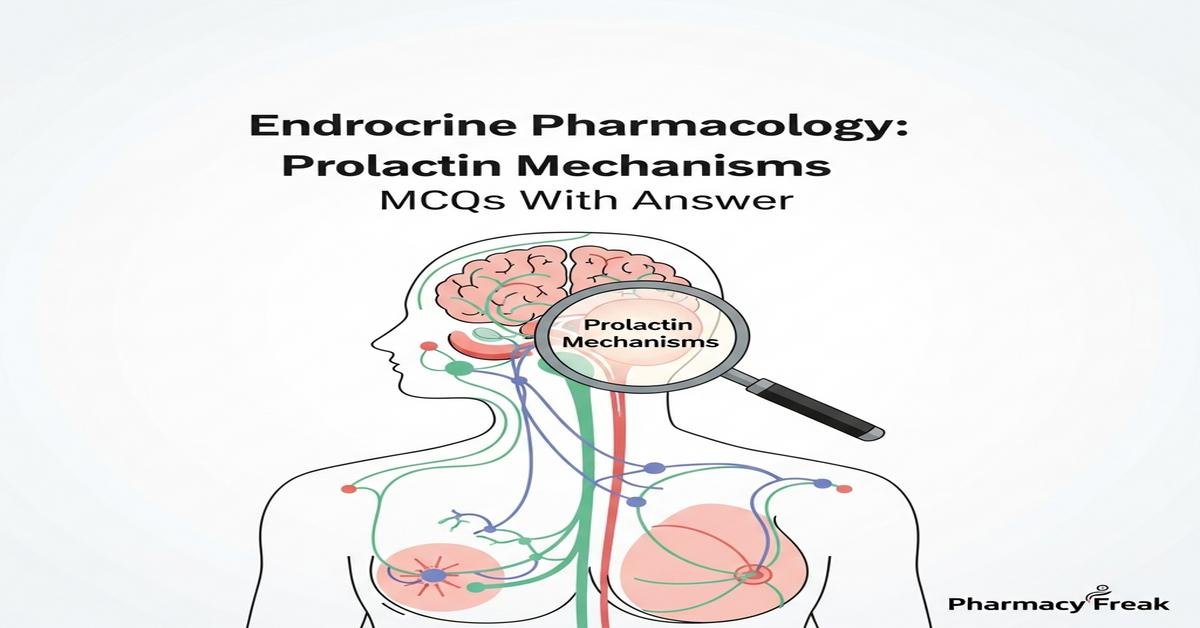
Introduction: This focused quiz set on Endocrine Pharmacology: Prolactin Mechanisms is designed for M.Pharm students preparing for Advanced Pharmacology-II. It reviews the physiology, regulation, receptor signaling, laboratory pitfalls, and pharmacological modulation of prolactin secretion. Questions emphasize molecular mechanisms (dopamine D2 signaling, JAK-STAT via prolactin receptor), clinical correlates (hyperprolactinemia, prolactinomas), common drugs that alter prolactin levels (antipsychotics, metoclopramide, dopamine agonists) and therapeutic strategies including assay considerations like the hook effect and macroprolactin. Use these MCQs to test mechanistic understanding and to reinforce evidence-based approaches to diagnosis and management of prolactin-related disorders.
Q1. Which intracellular signalling pathway is primarily activated by the prolactin receptor in lactotrophs and mammary epithelial cells?
- cAMP/PKA pathway
- MAPK/ERK pathway
- JAK2/STAT5 pathway
- PI3K/Akt pathway
Correct Answer: JAK2/STAT5 pathway
Q2. What is the main physiological inhibitor of prolactin secretion from pituitary lactotrophs?
- Thyrotropin-releasing hormone (TRH)
- Dopamine acting via D2 receptors
- Somatostatin acting via SSTR2
- Oxytocin from the posterior pituitary
Correct Answer: Dopamine acting via D2 receptors
Q3. Which class of drugs most commonly causes drug-induced hyperprolactinemia through blockade of pituitary dopamine receptors?
- Selective serotonin reuptake inhibitors (SSRIs)
- Dopamine D2 receptor antagonists (typical and some atypical antipsychotics)
- Benzodiazepines
- Beta blockers
Correct Answer: Dopamine D2 receptor antagonists (typical and some atypical antipsychotics)
Q4. Which dopamine agonist has the highest affinity and the longest half-life, making it the preferred initial medical therapy for most prolactinomas?
- Bromocriptine
- Cabergoline
- Levodopa
- Pramipexole
Correct Answer: Cabergoline
Q5. Which circulating form of prolactin is considered the bioactive principal species measured in clinical assays?
- Macroprolactin (big-big prolactin)
- Glycosylated prolactin dimers
- Monomeric 23 kDa prolactin
- Prolactin complexed with immunoglobulin G
Correct Answer: Monomeric 23 kDa prolactin
Q6. How does elevated prolactin cause hypogonadism and infertility?
- By directly inhibiting ovarian steroidogenesis enzymes
- By stimulating adrenal androgen production
- By suppressing pulsatile GnRH release, reducing LH and FSH secretion
- By increasing prolactin-induced conversion of testosterone to estrogen
Correct Answer: By suppressing pulsatile GnRH release, reducing LH and FSH secretion
Q7. What effect does estrogen have on prolactin physiology during pregnancy?
- Decreases prolactin synthesis and lactotroph number
- Increases prolactin synthesis and lactotroph proliferation and sensitivity
- Directly blocks prolactin receptor signalling
- Promotes dopamine release to suppress prolactin
Correct Answer: Increases prolactin synthesis and lactotroph proliferation and sensitivity
Q8. Which STAT protein is primarily phosphorylated downstream of the prolactin receptor to mediate milk protein gene transcription?
- STAT1
- STAT3
- STAT5
- STAT6
Correct Answer: STAT5
Q9. Compared with bromocriptine, cabergoline is preferred because it:
- Has more frequent dosing and greater gastrointestinal side effects
- Is less selective and more likely to cause hypotension
- Has a longer half-life and better tolerability with higher rates of tumor shrinkage
- Is available only as an intravenous formulation
Correct Answer: Has a longer half-life and better tolerability with higher rates of tumor shrinkage
Q10. A patient with suspected macroprolactinemia has high total prolactin but no symptoms; which laboratory technique helps detect macroprolactin interference?
- Polyethylene glycol (PEG) precipitation followed by repeat assay
- Serum cortisol measurement
- Direct immunofluorescence of pituitary tissue
- CT scan of the sella without biochemical testing
Correct Answer: Polyethylene glycol (PEG) precipitation followed by repeat assay
Q11. Which serious adverse effect has been associated with long-term, high-dose ergoline-derived dopamine agonists such as cabergoline?
- Renal failure from interstitial nephritis
- Pulmonary embolism due to hypercoagulability
- Valvular heart disease due to fibrotic valvulopathy
- Chordae tendineae rupture
Correct Answer: Valvular heart disease due to fibrotic valvulopathy
Q12. Metoclopramide causes galactorrhea primarily through which mechanism?
- Stimulation of TRH release from the hypothalamus
- Peripheral sensitization of mammary epithelial cells
- Central D2 receptor antagonism in the pituitary removing tonic dopamine inhibition
- Direct agonism at prolactin receptors
Correct Answer: Central D2 receptor antagonism in the pituitary removing tonic dopamine inhibition
Q13. The prolactin receptor belongs to which receptor family?
- G protein-coupled receptor family
- Receptor tyrosine kinase family
- Type I cytokine receptor family (class 1 cytokine receptors)
- Nuclear steroid hormone receptor family
Correct Answer: Type I cytokine receptor family (class 1 cytokine receptors)
Q14. What is the laboratory “hook effect” and how is it addressed in very large pituitary adenomas?
- Assay interference by heterophile antibodies; solved by blocking antibodies
- Very high prolactin saturates both capture and detection antibodies causing falsely low results; solved by serial dilution of the sample
- Cross-reactivity with growth hormone; solved by using a GH-free assay
- Interference from biotin supplements; solved by stopping biotin for 48 hours before testing
Correct Answer: Very high prolactin saturates both capture and detection antibodies causing falsely low results; solved by serial dilution of the sample
Q15. For most patients with symptomatic prolactinoma, the recommended initial management is:
- Immediate transsphenoidal surgery without medical therapy
- Radiotherapy as first-line treatment
- Medical therapy with a dopamine agonist (e.g., cabergoline)
- High-dose estrogen therapy to reduce tumor size
Correct Answer: Medical therapy with a dopamine agonist (e.g., cabergoline)
Q16. Historically which drug was commonly used to suppress postpartum lactation by inhibiting prolactin secretion?
- Oxytocin infusion
- Bromocriptine
- Prolactin receptor antagonist (none available clinically)
- High-dose prolactin injections
Correct Answer: Bromocriptine
Q17. Prolactin promotes milk production by which direct molecular action in mammary epithelial cells?
- Blocking insulin receptor signalling in the breast
- Upregulating milk protein gene transcription via JAK2/STAT5 activation
- Stimulating cAMP-dependent lipolysis to free fatty acids for milk
- Inducing apoptosis of myoepithelial cells to expand alveoli
Correct Answer: Upregulating milk protein gene transcription via JAK2/STAT5 activation
Q18. Which hypothalamic releasing factor reliably increases prolactin secretion when administered, and can be used diagnostically?
- Corticotropin-releasing hormone (CRH)
- Gonadotropin-releasing hormone (GnRH)
- Thyrotropin-releasing hormone (TRH)
- Growth hormone-releasing hormone (GHRH)
Correct Answer: Thyrotropin-releasing hormone (TRH)
Q19. When antipsychotic-induced hyperprolactinemia impairs quality of life in a patient with schizophrenia, a reasonable pharmacological strategy is:
- Add metoclopramide to increase dopamine in the CNS
- Switch to or add aripiprazole (a partial D2 agonist) to reduce prolactin elevation
- Increase the dose of the offending antipsychotic to overcome prolactin rise
- Start high-dose estrogen to counteract prolactin effects
Correct Answer: Switch to or add aripiprazole (a partial D2 agonist) to reduce prolactin elevation
Q20. In men, clinically significant hyperprolactinemia typically presents with which features due to endocrine disruption?
- Gynecomastia with hyperactive libido
- Increased sperm count and polyuria
- Decreased libido, erectile dysfunction, and infertility from suppressed GnRH/LH/testosterone
- Hyperactivity and weight loss due to increased metabolism
Correct Answer: Decreased libido, erectile dysfunction, and infertility from suppressed GnRH/LH/testosterone

