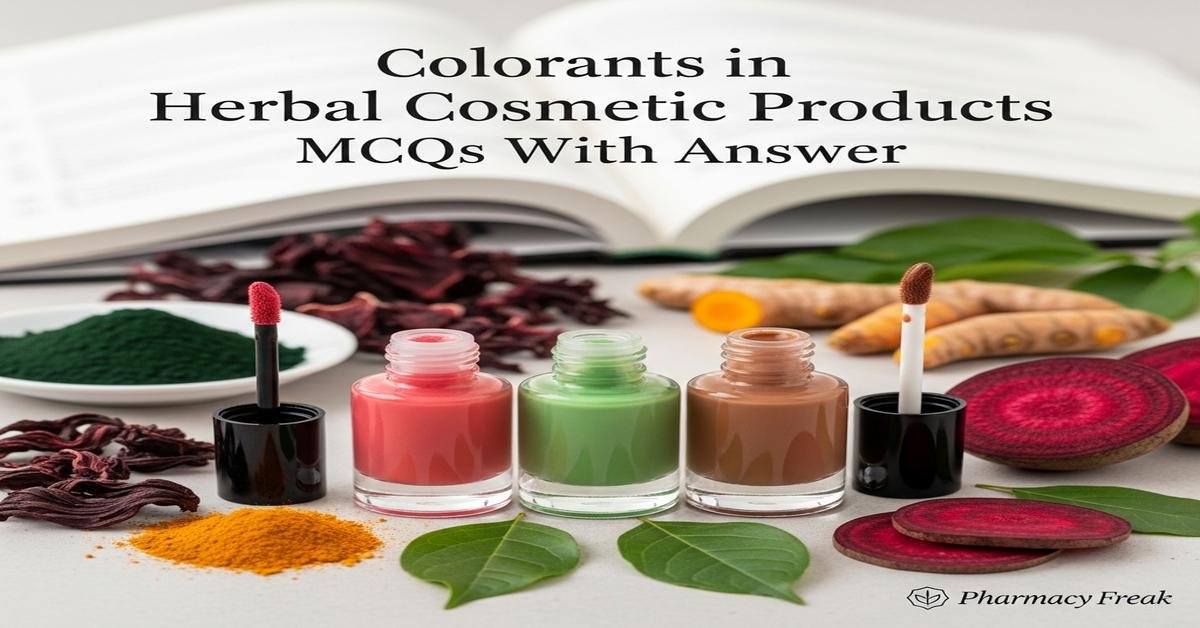
Introduction: Colorants in herbal cosmetic products are integral for aesthetic appeal, consumer acceptance, and functional benefits such as UV protection or antioxidative action. This quiz collection is designed for M.Pharm students studying Herbal Cosmetics (MPG 204T) and focuses on natural pigments (carotenoids, anthocyanins, betalains, chlorophyll), extraction principles, stability challenges, formulation strategies, regulatory considerations, and analytical characterization. Questions emphasize mechanistic understanding—how pH, light, metal ions, solvents, microencapsulation, and emulsification affect colorant performance and safety. These MCQs will test application-level knowledge required for product development, quality control, and regulatory compliance of herbal colorants in creams, lotions, hair dyes, and make-up products.
Q1. Which class of natural colorants is most prone to pH-dependent color changes used as pH indicators in formulations?
- Carotenoids
- Anthocyanins
- Chlorophylls
- Metal-complex lakes
Correct Answer: Anthocyanins
Q2. Which solvent property is most critical when extracting polar plant pigments like anthocyanins from petals?
- High lipophilicity
- High dielectric constant (polarity)
- Low boiling point
- Strong chelating ability
Correct Answer: High dielectric constant (polarity)
Q3. Betalains are primarily obtained from which source commonly used in herbal cosmetics?
- Marigold petals
- Beetroot tubers
- Green tea leaves
- Turmeric rhizome
Correct Answer: Beetroot tubers
Q4. Which strategy is most effective to improve photostability of chlorophyll-derived colorants in topical formulations?
- Formulation in water-rich gel
- Microencapsulation with UV-absorbing polymers
- Adding transition metal salts
- Increasing formulation pH to alkaline range
Correct Answer: Microencapsulation with UV-absorbing polymers
Q5. What analytical technique is most suitable for separating and quantifying individual carotenoid pigments in a herbal extract?
- Gas chromatography with FID
- High-performance liquid chromatography (HPLC)
- Infrared spectroscopy (FTIR)
- Polarimetry
Correct Answer: High-performance liquid chromatography (HPLC)
Q6. Which of the following causes immediate color fading of anthocyanin-rich formulations?
- Addition of mild non-ionic surfactants
- Exposure to alkaline conditions
- Inclusion of natural antioxidants
- Microencapsulation
Correct Answer: Exposure to alkaline conditions
Q7. In creating a water-in-oil emulsion containing a hydrophilic herbal dye, which approach increases color retention in the external oil phase?
- Using a hydrophilic emulsifier only
- Converting the dye to a lipophilic derivative or using an oil-soluble lake
- Raising the formulation pH above 9
- Omitting antioxidants
Correct Answer: Converting the dye to a lipophilic derivative or using an oil-soluble lake
Q8. Metal complexation of chlorophyll (formation of chlorophyllin) primarily changes its:
- Taste profile only
- Solubility and color stability
- Protein binding irreversibly
- Viscosity of the formulation
Correct Answer: Solubility and color stability
Q9. Which preservative compatibility concern is most relevant when formulating with natural colorants in aqueous herbal cosmetics?
- Preservatives universally increase color intensity
- Some preservatives can react and degrade pigments or alter pH
- Preservatives do not partition into emulsions
- All preservatives are inactive against pigment-associated microbes
Correct Answer: Some preservatives can react and degrade pigments or alter pH
Q10. Which antioxidant is commonly added to formulations to inhibit oxidative bleaching of carotenoids?
- Ascorbic acid (vitamin C)
- Sodium lauryl sulfate
- EDTA at high concentration
- Hydrogen peroxide
Correct Answer: Ascorbic acid (vitamin C)
Q11. A natural colorant labeled as a “lake” typically indicates:
- An oil-soluble alkaloid dye
- A pigment precipitated with an inert substrate to form an insoluble, oil-dispersible colorant
- A volatile essential oil with color
- A pure water-soluble anthocyanin extract
Correct Answer: A pigment precipitated with an inert substrate to form an insoluble, oil-dispersible colorant
Q12. Which factor most strongly accelerates oxidative degradation of carotenoids in a cosmetic lotion?
- Storage in dark, cool conditions
- Presence of dissolved oxygen and exposure to light
- Inclusion of chelators like EDTA
- Use of antioxidants
Correct Answer: Presence of dissolved oxygen and exposure to light
Q13. For standardizing a herbal colorant extract, which parameter is essential to report alongside concentration?
- Surface tension only
- Spectral absorption maxima (λmax) and pH stability profile
- Viscosity at 100°C
- Yield in volume only
Correct Answer: Spectral absorption maxima (λmax) and pH stability profile
Q14. Which natural pigment also provides notable anti-inflammatory or antioxidant cosmeceutical benefits aside from coloring?
- Lead chromate
- Curcumin (from turmeric)
- Synthetic azo dyes
- Coal tar derivatives
Correct Answer: Curcumin (from turmeric)
Q15. When evaluating skin-staining potential of a natural dye for a body lotion, which test is most appropriate?
- In vitro dissolution in gastric fluid
- Patch test on human volunteers or validated skin models
- pH titration only
- Determination of odor threshold
Correct Answer: Patch test on human volunteers or validated skin models
Q16. Which ion commonly causes discoloration of anthocyanins by forming complexes and altering hue?
- Potassium
- Aluminum
- Nitrogen gas
- Oxygen
Correct Answer: Aluminum
Q17. To develop a water-soluble hair dye from anthocyanins, formulators should prioritize which approach?
- Oxidative coupling at high pH with hydrogen peroxide
- Stabilizing anthocyanins in mildly acidic buffered systems and using direct adsorption onto hair
- Complexing with heavy metals to fix color irreversibly
- Using only anhydrous silicone carriers
Correct Answer: Stabilizing anthocyanins in mildly acidic buffered systems and using direct adsorption onto hair
Q18. Which analytical method provides structural information and confirmation of specific pigment molecules in herbal extracts?
- UV-Vis spectrophotometry alone
- Mass spectrometry (MS) coupled to HPLC
- Simple colorimetric pH strip
- Refractive index measurement
Correct Answer: Mass spectrometry (MS) coupled to HPLC
Q19. In a sunscreen formulation, adding certain natural colorants can inadvertently affect SPF by:
- Always increasing SPF by absorbing UV only
- Either reducing or enhancing SPF depending on spectral absorption and photostability
- Neutralizing UVA filters chemically to zero activity
- Converting the emulsion into a powder
Correct Answer: Either reducing or enhancing SPF depending on spectral absorption and photostability
Q20. Which formulation practice reduces microbial contamination risk in pigment-rich herbal cosmetics without degrading sensitive natural dyes?
- Autoclaving final product at 121°C
- Using validated low-temperature pasteurization and preservative systems compatible with pigment stability
- Adding strong oxidizing agents like bleach
- Deliberately increasing water activity
Correct Answer: Using validated low-temperature pasteurization and preservative systems compatible with pigment stability


I am a Registered Pharmacist under the Pharmacy Act, 1948, and the founder of PharmacyFreak.com. I hold a Bachelor of Pharmacy degree from Rungta College of Pharmaceutical Science and Research. With a strong academic foundation and practical knowledge, I am committed to providing accurate, easy-to-understand content to support pharmacy students and professionals. My aim is to make complex pharmaceutical concepts accessible and useful for real-world application.
Mail- Sachin@pharmacyfreak.com