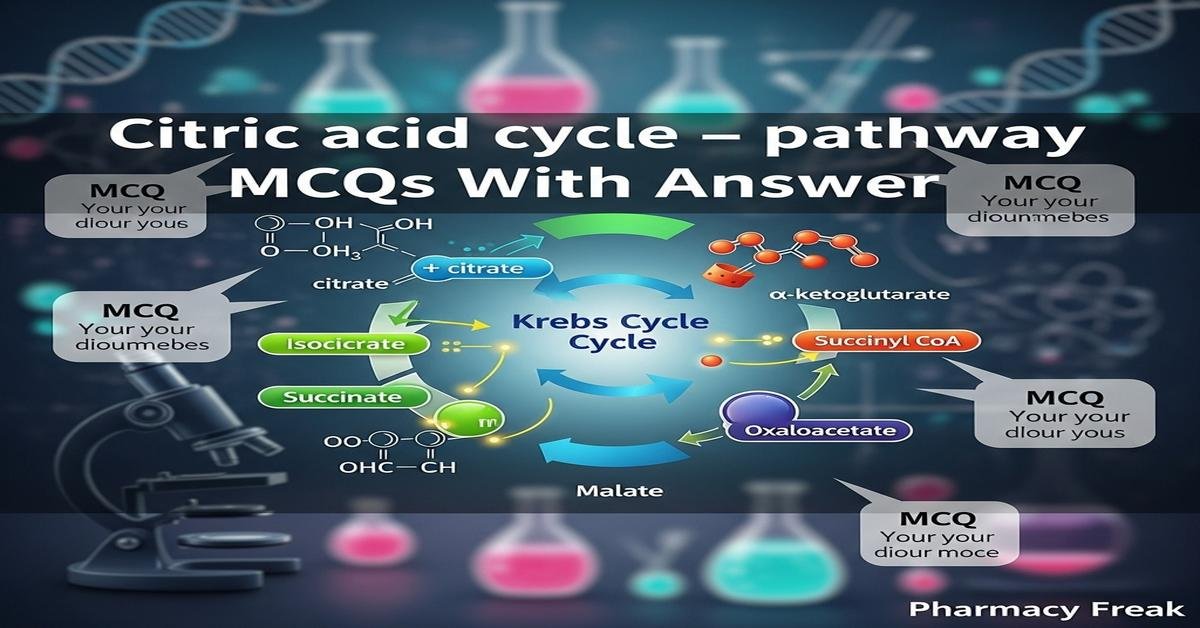
The citric acid cycle, also known as the Krebs cycle or TCA cycle, is a central aerobic metabolic pathway that oxidizes acetyl-CoA to CO2 while generating NADH, FADH2 and GTP/ATP. For B. Pharm students, understanding the cycle’s enzymes, intermediates, regulation, cofactor requirements (NAD+, FAD, CoA, lipoic acid, TPP), and links to electron transport and biosynthesis is essential for pharmacology, toxicology and metabolic disease concepts. Key clinical inhibitors (fluoroacetate, malonate, arsenic) and anaplerotic reactions (pyruvate carboxylase) are important for drug interactions and metabolic modulation. ‘Now let’s test your knowledge with 50 MCQs on this topic.’
Q1. Which enzyme catalyzes the condensation of acetyl-CoA with oxaloacetate to form citrate?
- Citrate synthase
- Aconitase
- Isocitrate dehydrogenase
- Succinyl-CoA synthetase
Correct Answer: Citrate synthase
Q2. Which TCA cycle enzyme directly produces FADH2 during the oxidation of succinate?
- Succinate dehydrogenase
- Fumarase
- Malate dehydrogenase
- Alpha-ketoglutarate dehydrogenase
Correct Answer: Succinate dehydrogenase
Q3. How many CO2 molecules are released per acetyl-CoA oxidized in one turn of the TCA cycle?
- One CO2
- Two CO2
- Three CO2
- Zero CO2
Correct Answer: Two CO2
Q4. Which TCA step generates a molecule of GTP (or ATP) via substrate-level phosphorylation?
- Succinyl-CoA to succinate (succinyl-CoA synthetase)
- Oxaloacetate to citrate (citrate synthase)
- Isocitrate to alpha-ketoglutarate (isocitrate dehydrogenase)
- Malate to oxaloacetate (malate dehydrogenase)
Correct Answer: Succinyl-CoA to succinate (succinyl-CoA synthetase)
Q5. Which enzymes in the TCA cycle are NAD+-dependent dehydrogenases that produce NADH?
- Isocitrate dehydrogenase, alpha-ketoglutarate dehydrogenase, malate dehydrogenase
- Citrate synthase, aconitase, fumarase
- Succinate dehydrogenase, fumarase, aconitase
- Succinyl-CoA synthetase, citrate synthase, malate dehydrogenase
Correct Answer: Isocitrate dehydrogenase, alpha-ketoglutarate dehydrogenase, malate dehydrogenase
Q6. Which vitamin-derived cofactor is essential for the pyruvate dehydrogenase and alpha-ketoglutarate dehydrogenase complexes?
- Thiamine pyrophosphate (TPP)
- Vitamin C (ascorbate)
- Vitamin K
- Biotin
Correct Answer: Thiamine pyrophosphate (TPP)
Q7. Fluoroacetate is toxic because it is converted to fluorocitrate, which inhibits which enzyme?
- Aconitase
- Citrate synthase
- Malate dehydrogenase
- Succinate dehydrogenase
Correct Answer: Aconitase
Q8. Which TCA intermediate is exported to the cytosol and cleaved to provide acetyl-CoA for fatty acid synthesis?
- Citrate
- Succinate
- Alpha-ketoglutarate
- Fumarate
Correct Answer: Citrate
Q9. Which enzyme converts isocitrate to alpha-ketoglutarate and is a major regulatory point in the cycle?
- Isocitrate dehydrogenase
- Aconitase
- Citrate synthase
- Malate dehydrogenase
Correct Answer: Isocitrate dehydrogenase
Q10. Malonate is a competitive inhibitor of which TCA enzyme?
- Succinate dehydrogenase
- Isocitrate dehydrogenase
- Citrate synthase
- Fumarase
Correct Answer: Succinate dehydrogenase
Q11. Which cofactor is tightly bound to succinate dehydrogenase and accepts electrons to form FADH2?
- FAD
- NAD+
- CoA
- Biotin
Correct Answer: FAD
Q12. Which two TCA enzymes release CO2 during the cycle?
- Isocitrate dehydrogenase and alpha-ketoglutarate dehydrogenase
- Citrate synthase and aconitase
- Fumarase and malate dehydrogenase
- Succinyl-CoA synthetase and succinate dehydrogenase
Correct Answer: Isocitrate dehydrogenase and alpha-ketoglutarate dehydrogenase
Q13. The alpha-ketoglutarate dehydrogenase complex requires which of the following prosthetic groups?
- Lipoic acid, TPP, FAD, NAD+
- Heme, biotin, NADP+
- PLP, FMN, CoA
- Biotin, FAD, TPP only
Correct Answer: Lipoic acid, TPP, FAD, NAD+
Q14. Which enzyme catalyzes the reversible hydration of fumarate to malate?
- Fumarase (fumarate hydratase)
- Malate dehydrogenase
- Succinate dehydrogenase
- Aconitase
Correct Answer: Fumarase (fumarate hydratase)
Q15. Pyruvate carboxylase replenishes oxaloacetate in anaplerosis using which cofactor?
- Biotin
- Thiamine pyrophosphate
- FAD
- NADP+
Correct Answer: Biotin
Q16. Which shuttle transfers reducing equivalents from cytosolic NADH into mitochondria efficiently in liver and heart?
- Malate-aspartate shuttle
- Glycerol-3-phosphate shuttle
- Alpha-ketoglutarate shuttle
- Carnitine shuttle
Correct Answer: Malate-aspartate shuttle
Q17. How many NADH molecules are produced per acetyl-CoA oxidized in the TCA cycle?
- Three NADH
- Two NADH
- One NADH
- Four NADH
Correct Answer: Three NADH
Q18. Which complex of the electron transport chain is identical to a TCA enzyme and participates in both pathways?
- Complex II (succinate dehydrogenase)
- Complex I (NADH dehydrogenase)
- Complex III (cytochrome bc1)
- Complex IV (cytochrome c oxidase)
Correct Answer: Complex II (succinate dehydrogenase)
Q19. Which metabolite inhibits phosphofructokinase-1 (PFK-1) and links TCA cycle status to glycolysis?
- Citrate
- Alpha-ketoglutarate
- Oxaloacetate
- Succinate
Correct Answer: Citrate
Q20. The glyoxylate cycle, which bypasses decarboxylation steps of TCA, requires which two specialized enzymes?
- Isocitrate lyase and malate synthase
- Isocitrate dehydrogenase and aconitase
- Succinyl-CoA synthetase and fumarase
- Citrate synthase and malate dehydrogenase
Correct Answer: Isocitrate lyase and malate synthase
Q21. Which ion activates several TCA enzymes (e.g., isocitrate dehydrogenase and alpha-ketoglutarate dehydrogenase) during muscle contraction?
- Calcium (Ca2+)
- Sodium (Na+)
- Magnesium (Mg2+)
- Potassium (K+)
Correct Answer: Calcium (Ca2+)
Q22. Dichloroacetate (DCA) stimulates PDH activity by inhibiting which regulatory enzyme?
- Pyruvate dehydrogenase kinase
- Pyruvate carboxylase
- Pyruvate dehydrogenase phosphatase
- LDH (lactate dehydrogenase)
Correct Answer: Pyruvate dehydrogenase kinase
Q23. Which TCA intermediate is a key nitrogen acceptor/donor in transamination reactions and links to amino acid metabolism?
- Alpha-ketoglutarate
- Succinate
- Citrate
- Fumarate
Correct Answer: Alpha-ketoglutarate
Q24. What is the approximate ATP yield from oxidation of one acetyl-CoA through the TCA cycle and oxidative phosphorylation (using P/O values 2.5 for NADH and 1.5 for FADH2)?
- About 10 ATP
- About 6 ATP
- About 12 ATP
- About 3 ATP
Correct Answer: About 10 ATP
Q25. Which enzyme catalyzes the reversible oxidation of malate to oxaloacetate, producing NADH?
- Malate dehydrogenase
- Fumarase
- Isocitrate dehydrogenase
- Succinate dehydrogenase
Correct Answer: Malate dehydrogenase
Q26. Arsenic poisoning inhibits lipoic acid-dependent enzymes. Which TCA-related enzyme is directly affected?
- Alpha-ketoglutarate dehydrogenase
- Citrate synthase
- Fumarase
- Succinate dehydrogenase
Correct Answer: Alpha-ketoglutarate dehydrogenase
Q27. Which intermediate links the TCA cycle to heme synthesis and the urea cycle (via aspartate)?
- Succinyl-CoA
- Citrate
- Oxaloacetate
- Malate
Correct Answer: Succinyl-CoA
Q28. Which enzyme converts citrate to isocitrate via cis-aconitate?
- Aconitase
- Citrate synthase
- Isocitrate dehydrogenase
- Fumarase
Correct Answer: Aconitase
Q29. Which regulatory signals inhibit isocitrate dehydrogenase activity in mitochondria?
- High ATP and high NADH levels
- High ADP and Ca2+
- Low NADH and low ATP
- High citrate only
Correct Answer: High ATP and high NADH levels
Q30. Which metabolic fate of acetyl-CoA does NOT produce net oxaloacetate and therefore is not anaplerotic?
- Oxidation in the TCA cycle for energy
- Conversion to citrate for fatty acid synthesis (when citrate leaves mitochondria)
- Entry into glyoxylate cycle (in plants/bacteria) to form net C4
- Carboxylation of pyruvate to oxaloacetate (anaplerosis)
Correct Answer: Oxidation in the TCA cycle for energy
Q31. Which enzyme generates citrate from acetyl-CoA and oxaloacetate and is inhibited by high ATP levels?
- Citrate synthase
- Aconitase
- Isocitrate dehydrogenase
- Pyruvate carboxylase
Correct Answer: Citrate synthase
Q32. In the TCA cycle, which step is irreversible under physiological conditions and commits acetyl units to oxidation?
- Oxidative decarboxylation by alpha-ketoglutarate dehydrogenase
- Fumarate to malate
- Succinyl-CoA to succinate
- Citrate to isocitrate
Correct Answer: Oxidative decarboxylation by alpha-ketoglutarate dehydrogenase
Q33. Which metabolic pathway provides acetyl-CoA for the TCA cycle during fasting from fatty acids?
- Beta-oxidation of fatty acids
- Glycolysis
- Pentose phosphate pathway
- Glycogenolysis only
Correct Answer: Beta-oxidation of fatty acids
Q34. Which reaction regenerates oxaloacetate when acetyl-CoA enters the TCA cycle?
- Malate oxidation to oxaloacetate by malate dehydrogenase
- Citrate cleavage by ATP citrate lyase
- Pyruvate to acetyl-CoA via PDH
- Succinate oxidation to fumarate
Correct Answer: Malate oxidation to oxaloacetate by malate dehydrogenase
Q35. Which TCA enzyme has an iron-sulfur center and is sensitive to oxidative damage?
- Aconitase
- Malate dehydrogenase
- Citrate synthase
- Succinyl-CoA synthetase
Correct Answer: Aconitase
Q36. Which metabolite is formed when oxaloacetate condenses with acetyl-CoA and is later isomerized by aconitase?
- Citrate
- Malate
- Succinate
- Fumarate
Correct Answer: Citrate
Q37. Which enzyme catalyzes oxidative decarboxylation of isocitrate to yield NADH and CO2?
- Isocitrate dehydrogenase
- Citrate synthase
- Fumarase
- Malate dehydrogenase
Correct Answer: Isocitrate dehydrogenase
Q38. Which intermediate is directly converted to succinyl-CoA by an oxidative decarboxylation reaction?
- Alpha-ketoglutarate
- Citrate
- Malate
- Isocitrate
Correct Answer: Alpha-ketoglutarate
Q39. Which TCA enzyme activity is measured clinically to assess mitochondrial function often using spectrophotometric assays for NADH production?
- Malate dehydrogenase
- Fumarase
- Succinate dehydrogenase
- Aconitase
Correct Answer: Malate dehydrogenase
Q40. Which coenzyme A (CoA)-linked intermediate is produced when succinyl-CoA synthetase acts in the synthetic direction?
- Succinyl-CoA
- Citrate
- Oxaloacetate
- Fumarate
Correct Answer: Succinyl-CoA
Q41. In many tissues, which enzyme provides oxaloacetate from pyruvate to maintain TCA intermediates during gluconeogenesis?
- Pyruvate carboxylase
- Pyruvate dehydrogenase
- Lactate dehydrogenase
- Pep carboxykinase
Correct Answer: Pyruvate carboxylase
Q42. Which TCA intermediate can be transaminated to form aspartate for nucleotide synthesis?
- Oxaloacetate
- Succinate
- Citrate
- Alpha-ketoglutarate
Correct Answer: Oxaloacetate
Q43. Which statement about the TCA cycle is TRUE?
- It is amphibolic, serving both catabolic and anabolic roles.
- It only functions for energy production and has no biosynthetic roles.
- It occurs in the cytosol of eukaryotic cells.
- It does not require any vitamins as cofactors.
Correct Answer: It is amphibolic, serving both catabolic and anabolic roles.
Q44. Which metabolite accumulates if malate dehydrogenase is inhibited, affecting NAD+/NADH balance?
- Malate
- Succinate
- Citrate
- Alpha-ketoglutarate
Correct Answer: Malate
Q45. Which enzyme converts succinyl-CoA to succinate and couples the reaction to GTP (or ATP) formation?
- Succinyl-CoA synthetase (succinate thiokinase)
- Succinate dehydrogenase
- Succinyl dehydratase
- Succinyl carboxylase
Correct Answer: Succinyl-CoA synthetase (succinate thiokinase)
Q46. Which enzyme is inhibited by high NADH/NAD+ ratio, thereby decreasing TCA flux during hypoxia?
- Isocitrate dehydrogenase
- Fumarase
- Citrate synthase (unaffected by NADH directly)
- Succinyl-CoA synthetase
Correct Answer: Isocitrate dehydrogenase
Q47. Which TCA intermediate can be converted to oxaloacetate via the enzyme malate dehydrogenase?
- Malate
- Succinate
- Citrate
- Alpha-ketoglutarate
Correct Answer: Malate
Q48. Which process describes the overall role of the TCA cycle in cellular metabolism?
- Oxidation of acetyl units to CO2 and generation of reducing equivalents for ATP synthesis
- Direct synthesis of glucose from acetyl-CoA
- Conversion of fatty acids into amino acids primarily
- Generation of oxygen for oxidative phosphorylation
Correct Answer: Oxidation of acetyl units to CO2 and generation of reducing equivalents for ATP synthesis
Q49. Which enzyme interconverts malate and oxaloacetate and is often used in assays because it produces NADH measurable at 340 nm?
- Malate dehydrogenase
- Fumarase
- Aconitase
- Isocitrate dehydrogenase
Correct Answer: Malate dehydrogenase
Q50. Which metabolic condition would most directly decrease TCA cycle activity in mitochondria?
- High ATP/ADP ratio and high NADH levels indicating energy sufficiency
- High ADP and low NADH indicating energy demand
- Increased cytosolic calcium during muscle contraction
- Activation of pyruvate carboxylase during gluconeogenesis
Correct Answer: High ATP/ADP ratio and high NADH levels indicating energy sufficiency


