Introduction
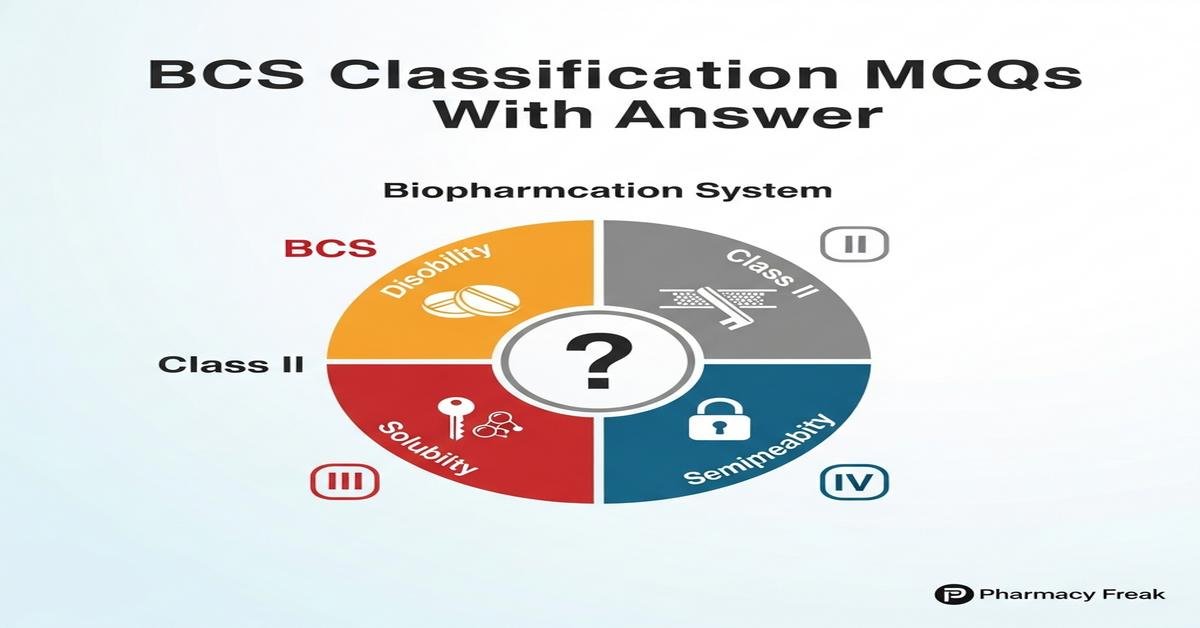
This set of BCS Classification MCQs with answers is designed for M.Pharm students studying Advanced Biopharmaceutics & Pharmacokinetics (MPH 202T). The questions focus on fundamental and applied aspects of the Biopharmaceutics Classification System — solubility and permeability criteria, dose number calculations, dissolution requirements, regulatory biowaiver considerations, experimental methods (human studies, Caco-2, PAMPA), and formulation implications for each BCS class. Questions range from conceptual definitions to practical classification and calculation problems, helping students strengthen reasoning for biowaiver eligibility, formulation strategies and predicting in vivo performance of oral drug products.
Q1. Which BCS class is characterized by high solubility and high intestinal permeability?
- Class I (High solubility, high permeability)
- Class II (Low solubility, high permeability)
- Class III (High solubility, low permeability)
- Class IV (Low solubility, low permeability)
Correct Answer: Class I (High solubility, high permeability)
Q2. According to BCS guidelines, which statement correctly defines ‘high solubility’ for a drug substance?
- The drug is fully soluble in any volume of water at room temperature
- The highest single therapeutic dose is soluble in ≤250 mL of aqueous media across pH 1.0–7.5
- The drug dissolves >85% in 30 minutes in pH 6.8 buffer
- The drug has solubility >1 mg/mL at pH 7.4 only
Correct Answer: The highest single therapeutic dose is soluble in ≤250 mL of aqueous media across pH 1.0–7.5
Q3. Which criterion is commonly used to define ‘high intestinal permeability’ under BCS?
- Permeability measured by PAMPA > 1 × 10⁻⁵ cm/s
- Caco-2 Papp > 1 × 10⁻⁶ cm/s is the only accepted evidence
- Extent of human absorption ≥85% (absolute oral bioavailability or mass balance studies)
- Drug shows passive diffusion in any in vitro model
Correct Answer: Extent of human absorption ≥85% (absolute oral bioavailability or mass balance studies)
Q4. What is the dose number (Do) formula used in BCS solubility assessment?
- Do = Cs / (Dose × 250 mL)
- Do = Dose × Cs × 250 mL
- Do = Dose / (Cs × 250 mL)
- Do = (Dose × 250 mL) / Cs
Correct Answer: Do = Dose / (Cs × 250 mL)
Q5. What dissolution profile is typically required for a drug product to be considered ‘rapidly dissolving’ for a BCS biowaiver?
- At least 50% dissolved in 60 minutes in any medium
- ≥85% dissolved in 30 minutes in specified media (e.g., 0.1 N HCl, pH 4.5 and 6.8)
- No more than 20% dissolved in 15 minutes
- Complete dissolution within 24 hours
Correct Answer: ≥85% dissolved in 30 minutes in specified media (e.g., 0.1 N HCl, pH 4.5 and 6.8)
Q6. Which BCS class is the most straightforward candidate for a regulatory BCS-based biowaiver?
- Class II
- Class I
- Class IV
- Class III
Correct Answer: Class I
Q7. Which BCS class corresponds to low solubility but high permeability?
- Class III (High solubility, low permeability)
- Class II (Low solubility, high permeability)
- Class I (High solubility, high permeability)
- Class IV (Low solubility, low permeability)
Correct Answer: Class II (Low solubility, high permeability)
Q8. For BCS Class II drugs, which process is typically the rate-limiting step controlling oral absorption?
- Hepatic metabolism
- Dissolution of the solid drug in the GI fluids
- Renal excretion
- Intestinal permeability through enterocytes
Correct Answer: Dissolution of the solid drug in the GI fluids
Q9. Which of the following is commonly cited as an example of a BCS Class II drug?
- Metoprolol (Class I)
- Naproxen (Class II)
- Cimetidine (Class III)
- Atenolol (Class III)
Correct Answer: Naproxen (Class II)
Q10. Which experimental approach is considered the most definitive (‘gold standard’) to determine human intestinal absorption for BCS classification?
- Caco-2 cell apparent permeability (Papp) alone
- PAMPA permeability assay
- Human mass balance and absolute oral bioavailability studies
- In situ rat intestinal perfusion
Correct Answer: Human mass balance and absolute oral bioavailability studies
Q11. A drug is a weak base with pKa 6.0. Where is its aqueous solubility expected to be highest, and why might this cause a food effect?
- Highest in the small intestine (pH ~7.4), causing increased solubility and no food effect
- Highest in the stomach (low pH), which can cause precipitation when pH rises in the intestine and lead to food effects
- Same at all GI pH values, so no food effect
- Highest in the colon, leading to colonic absorption
Correct Answer: Highest in the stomach (low pH), which can cause precipitation when pH rises in the intestine and lead to food effects
Q12. Which formulation strategy is most appropriate for BCS Class III drugs to improve oral absorption?
- Enhance dissolution rate by micronization
- Use strong permeability enhancers or prodrugs to increase intestinal permeability
- Use lipid-based formulations to increase solubility only
- Reduce permeability intentionally to slow absorption
Correct Answer: Use strong permeability enhancers or prodrugs to increase intestinal permeability
Q13. Why is a volume of 250 mL used in the BCS solubility criterion?
- Because it is the average volume of gastric fluid in fasting humans
- It represents a standard glass of water typically taken with oral dosage forms
- Arbitrary number with no physiological relevance
- Because intestinal fluid volume is always 250 mL
Correct Answer: It represents a standard glass of water typically taken with oral dosage forms
Q14. For Class III products to qualify for a BCS-based biowaiver, which additional condition is generally required compared with Class I?
- No requirements beyond Class I
- Rapid dissolution plus very similar excipient type and quantities (or justification of excipient differences)
- Complete solubility in 100 mL of water only
- Demonstrated first-pass metabolism
Correct Answer: Rapid dissolution plus very similar excipient type and quantities (or justification of excipient differences)
Q15. What dose number (Do) value is used as the threshold to categorize a drug as ‘high solubility’?
- Do ≥ 10
- Do ≤ 1
- Do = 0
- Do ≥ 1
Correct Answer: Do ≤ 1
Q16. In Caco-2 assays, which apparent permeability (Papp) threshold is commonly used as an indicator of high permeability?
- Papp > 1 × 10⁻⁶ cm/s (commonly used indicator of high permeability)
- Papp < 1 × 10⁻⁸ cm/s
- Papp > 1 × 10⁻³ cm/s
- Papp = 0 (no transport)
Correct Answer: Papp > 1 × 10⁻⁶ cm/s (commonly used indicator of high permeability)
Q17. Which regulatory bodies have issued guidance documents on BCS-based biowaivers and classification?
- FDA only
- WHO only
- FDA, EMA and WHO
- Local hospital formularies only
Correct Answer: FDA, EMA and WHO
Q18. Which statement best describes BCS Class IV drugs in terms of formulation and development risk?
- They have high solubility and high permeability, so low formulation risk
- Low solubility and low permeability, representing the greatest challenge for oral formulation and lowest expected oral bioavailability
- Low solubility but high permeability, easy to formulate
- High solubility but low permeability, no need for permeability testing
Correct Answer: Low solubility and low permeability, representing the greatest challenge for oral formulation and lowest expected oral bioavailability
Q19. A drug dissolves 90% in 20 minutes across pH 1–6.8 but shows only 40% fraction absorbed in humans. How is this drug classified by BCS?
- Class I
- Class II
- Class III
- Class IV
Correct Answer: Class III
Q20. Calculate the dose number and solubility classification: A single therapeutic dose = 500 mg; measured solubility Cs = 2 mg/mL; BCS uses 250 mL for V0. What is Do and does the drug meet the ‘high solubility’ criterion?
- Do = 0.25; not high solubility
- Do = 1; meets high solubility (Do ≤ 1)
- Do = 2; not high solubility
- Do = 500; meets high solubility
Correct Answer: Do = 1; meets high solubility (Do ≤ 1)


I am a Registered Pharmacist under the Pharmacy Act, 1948, and the founder of PharmacyFreak.com. I hold a Bachelor of Pharmacy degree from Rungta College of Pharmaceutical Science and Research. With a strong academic foundation and practical knowledge, I am committed to providing accurate, easy-to-understand content to support pharmacy students and professionals. My aim is to make complex pharmaceutical concepts accessible and useful for real-world application.
Mail- Sachin@pharmacyfreak.com