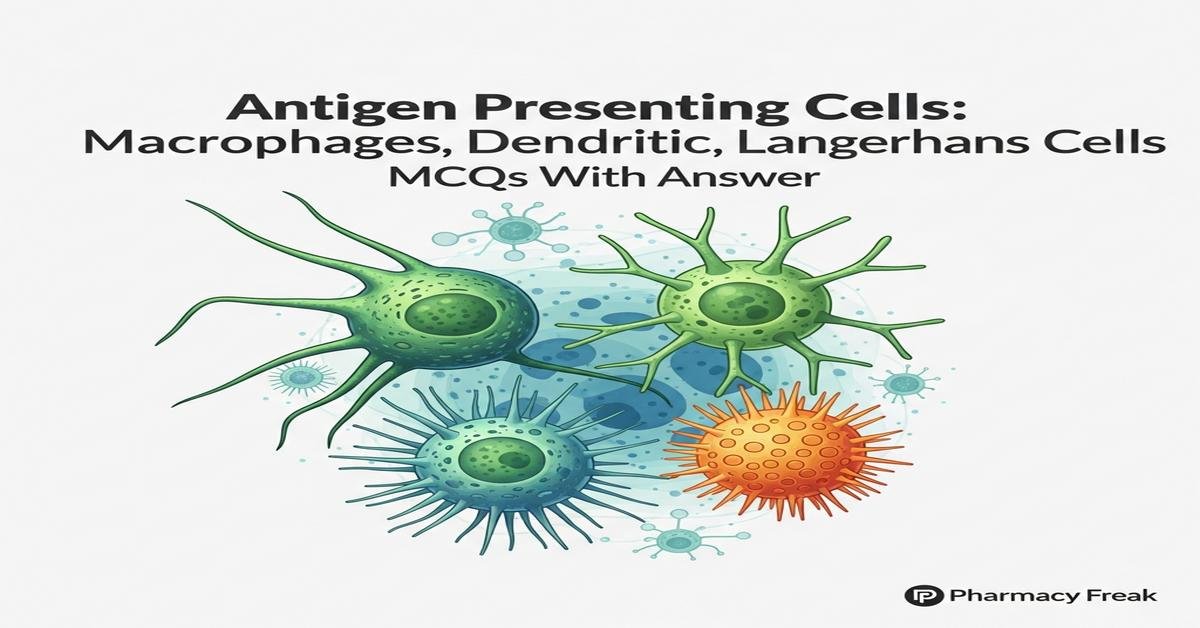
Antigen presenting cells (APCs) are central to adaptive immunity, bridging innate recognition and specific T‑cell responses. This MCQ set focuses on macrophages, dendritic cells (including classical, plasmacytoid and Langerhans subsets) and their antigen‑processing/presentation machinery—MHC pathways, co‑stimulatory molecules, receptors, cytokine milieus, migration and cross‑presentation. Questions are tailored for M.Pharm students to deepen understanding of cellular functions relevant to vaccine design, immunotherapies and diagnostic immunotechnology. Expect items covering intracellular processing (proteasome/TAP, phagolysosomal cathepsins), surface markers (CD1a, Langerin/CD207, CD80/86, CCR7), APC maturation, and the role of adjuvants. Answers are provided to aid rapid self‑assessment and focused revision.
Q1. Which cell type is considered the most potent professional antigen‑presenting cell for priming naïve T cells?
- Macrophages
- B cells
- Dendritic cells
- Neutrophils
Correct Answer: Dendritic cells
Q2. Which surface marker is characteristically expressed on human Langerhans cells?
- CD3
- CD19
- CD1a
- CD14
Correct Answer: CD1a
Q3. Presentation of endogenously synthesized cytosolic peptides on MHC class I molecules primarily depends on which processing pathway?
- Endosomal acid proteases and invariant chain removal
- Proteasomal degradation and TAP‑mediated peptide transport into the endoplasmic reticulum
- Golgi glycosylation and exocytosis
- Autophagy and lysosomal loading onto MHC II
Correct Answer: Proteasomal degradation and TAP‑mediated peptide transport into the endoplasmic reticulum
Q4. Which APC subset is particularly specialized for cross‑presentation of exogenous antigens on MHC class I to CD8+ T cells?
- Macrophages
- B cells
- Dendritic cells (particularly cDC1)
- Eosinophils
Correct Answer: Dendritic cells (particularly cDC1)
Q5. Which pair of co‑stimulatory molecules on APCs provides a primary signal for naïve T‑cell activation via CD28?
- MHC I and MHC II
- CD80/CD86
- ICAM‑1/LFA‑1
- PD‑L1/PD‑1
Correct Answer: CD80/CD86
Q6. Langerhans cells contain a distinctive cytoplasmic organelle often visible by electron microscopy; what is it called?
- Birbeck granules (tennis‑racket structures)
- Secretory lysosomes
- Peroxisomes
- Dense core granules
Correct Answer: Birbeck granules (tennis‑racket structures)
Q7. Classical M1 activation of macrophages is driven primarily by which cytokine environment?
- IL‑4 and IL‑13
- IL‑10 and TGF‑β
- Interferon‑gamma (IFN‑γ) with microbial signals (e.g., LPS)
- IL‑2 and IL‑7
Correct Answer: Interferon‑gamma (IFN‑γ) with microbial signals (e.g., LPS)
Q8. Which chemokine receptor upregulation is crucial for mature dendritic cells to migrate from tissues to draining lymph nodes?
- CCR6
- CCR7
- CXCR1
- CCR3
Correct Answer: CCR7
Q9. Plasmacytoid dendritic cells (pDCs) are specialized for producing which class of molecules in response to viral infection?
- Type I interferons (e.g., IFN‑α)
- Antibodies (IgG)
- Complement components
- Matrix metalloproteinases
Correct Answer: Type I interferons (e.g., IFN‑α)
Q10. Lipid and glycolipid antigens are presented to T cells by which non‑classical antigen presentation molecules?
- MHC class I molecules
- MHC class II molecules
- CD1 family molecules
- Fc receptors
Correct Answer: CD1 family molecules
Q11. Efficient loading of peptides onto MHC class II in APCs requires which intracellular conditions in the endosomal/phagolysosomal compartment?
- Alkalinization and proteasomal cleavage
- Neutral pH and TAP transport
- Acidification and lysosomal proteases (e.g., cathepsins)
- Ubiquitination and proteasome degradation
Correct Answer: Acidification and lysosomal proteases (e.g., cathepsins)
Q12. Which surface molecule is commonly used as a marker of dendritic cell maturation?
- CD83
- CD34
- CD45RA
- CD31
Correct Answer: CD83
Q13. Which professional APC constitutively expresses the highest levels of MHC class II and is specialized for antigen capture and T‑cell priming?
- Red blood cells
- Dendritic cells
- Neurons
- Skeletal muscle cells
Correct Answer: Dendritic cells
Q14. The Langerin (CD207) receptor on Langerhans cells primarily functions to:
- Bind and internalize antigens into Birbeck granules for processing
- Induce immediate antibody secretion
- Trigger necrosis of invading microbes by oxidative burst
- Act as a chemokine to attract neutrophils
Correct Answer: Bind and internalize antigens into Birbeck granules for processing
Q15. Cross‑priming refers to which immunological event?
- Presentation of endogenous antigens on MHC II to CD4+ T cells
- Uptake of antigen by B cells and presentation to macrophages
- Presentation of exogenous antigens on MHC I to CD8+ T cells
- Direct presentation of antigens by NK cells
Correct Answer: Presentation of exogenous antigens on MHC I to CD8+ T cells
Q16. Which Toll‑like receptor (TLR) is primarily responsible for sensing bacterial lipopolysaccharide (LPS) on professional APCs?
- TLR3
- TLR4
- TLR7
- TLR9
Correct Answer: TLR4
Q17. Among APCs listed, which is least capable of initiating a primary naïve T‑cell response in lymph nodes?
- Dendritic cells
- Macrophages
- B cells
- Follicular dendritic cells
Correct Answer: Follicular dendritic cells
Q18. Macrophages typically present antigen preferentially to which T‑cell population during ongoing immune responses?
- Naïve T cells in lymph nodes
- Effector and memory T cells at sites of inflammation
- Central memory T cells exclusively
- Only B cells, not T cells
Correct Answer: Effector and memory T cells at sites of inflammation
Q19. Which intracellular proteolytic complex is induced in APCs to generate peptides optimized for MHC class I presentation?
- Immunoproteasome
- Cathepsin B complex
- Calpain complex
- Lysosomal aspartyl proteases
Correct Answer: Immunoproteasome
Q20. How do vaccine adjuvants typically enhance antigen presentation by dendritic cells?
- By inhibiting MHC molecule expression on APCs
- By providing pattern recognition receptor (PRR) signals that induce DC maturation and co‑stimulatory molecule upregulation
- By degrading antigen into non‑immunogenic fragments
- By blocking CCR7 and preventing lymph node migration
Correct Answer: By providing pattern recognition receptor (PRR) signals that induce DC maturation and co‑stimulatory molecule upregulation

