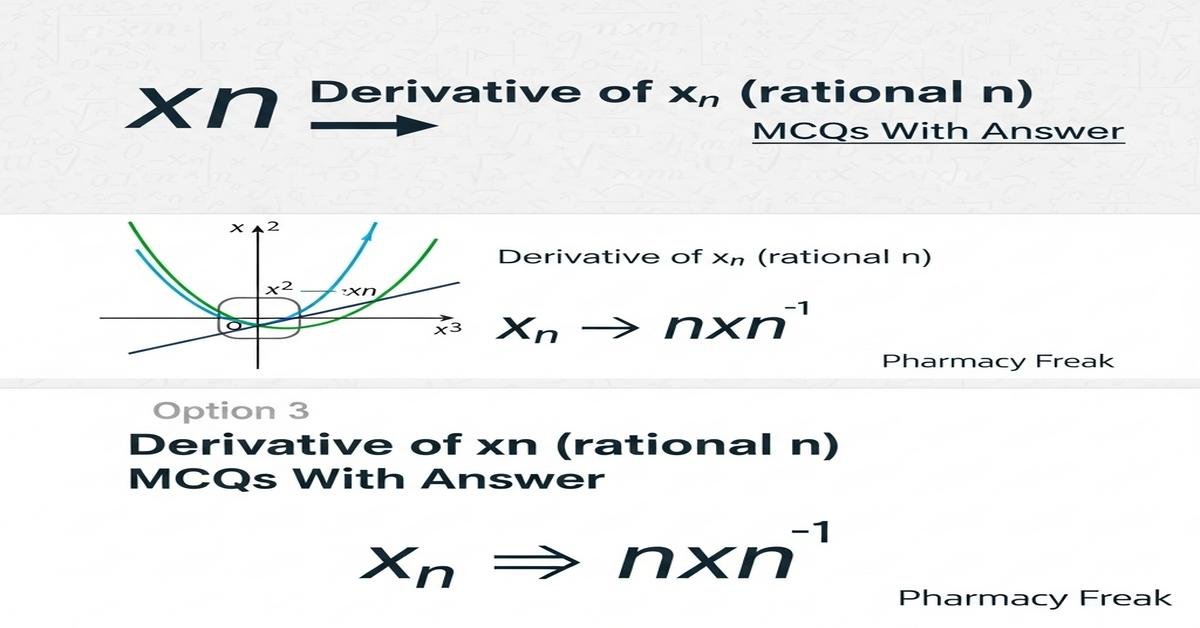
Introduction: Understanding the derivative of xn when n is rational is essential for B. Pharm students who apply calculus to pharmacokinetics, drug dissolution rates, and concentration–time models. The power rule, d/dx[xn] = n xn−1, extends to rational exponents with attention to domain and differentiability at singular points. Practical problems include roots, negative powers, and chain-rule applications for expressions like (ax + b)m/n. Mastery helps simplify rate equations and solve concentration derivatives accurately. This set emphasizes calculation, domain considerations, and common pitfalls for pharmacy applications. ‘Now let’s test your knowledge with 50 MCQs on this topic.’
Q1. What is the derivative of xn for rational n (general power rule)?
- n · xn−1
- xn · ln n
- xn+1 / (n+1)
- n / xn+1
Correct Answer: n · xn−1
Q2. Find d/dx[x3/2].
- (3/2) · x1/2
- (2/3) · x1/2
- (3/2) · x−1/2
- (1/2) · x3/2
Correct Answer: (3/2) · x1/2
Q3. Find d/dx[x−1/3].
- −(1/3) · x−4/3
- (1/3) · x−4/3
- −3 · x2/3
- (−1/3) · x2/3
Correct Answer: −(1/3) · x−4/3
Q4. d/dx[√x] equals:
- 1 / (2√x)
- 1 / √(2x)
- 2√x
- √x / 2
Correct Answer: 1 / (2√x)
Q5. d/dx[∛x] (cube root of x) is:
- 1 / (3 x2/3)
- 1 / (2 x1/2)
- 3 x−1/3
- x−2/3
Correct Answer: 1 / (3 x2/3)
Q6. d/dx[1/x] is:
- −1 / x2
- 1 / x2
- −x
- 0
Correct Answer: −1 / x2
Q7. d/dx[x0] equals:
- 0
- 1
- x
- Undefined
Correct Answer: 0
Q8. d/dx[x5/2] equals:
- (5/2) · x3/2
- (5/2) · x1/2
- (2/5) · x3/2
- 5 · x1/2
Correct Answer: (5/2) · x3/2
Q9. d/dx[(3x)1/2] simplifies to:
- √3 / (2√x)
- 3 / (2√(3x))
- (1/2)(3x)−1/2
- (1/2)√(3x)
Correct Answer: √3 / (2√x)
Q10. Is f(x)=x1/3 differentiable at x=0?
- No, derivative does not exist at 0
- Yes, derivative is 0
- Yes, derivative is 1/3
- Yes, derivative is infinite but considered differentiable
Correct Answer: No, derivative does not exist at 0
Q11. d/dx[x−2] equals:
- −2 x−3
- 2 x−3
- −x−1
- 0
Correct Answer: −2 x−3
Q12. d/dx[ x4/3 ] is:
- (4/3) · x1/3
- (3/4) · x1/3
- (4/3) · x−2/3
- (1/3) · x4/3
Correct Answer: (4/3) · x1/3
Q13. Which statement is true for d/dx[xm/n] when n is even?
- Function is defined for x ≥ 0; differentiation requires x > 0
- Function is defined for all real x; differentiable everywhere
- Function is undefined for x ≥ 0
- Derivative is always zero
Correct Answer: Function is defined for x ≥ 0; differentiation requires x > 0
Q14. d/dx[x2/3] at x=0 is:
- Not defined (vertical tangent)
- 2/3
- 0
- 1
Correct Answer: Not defined (vertical tangent)
Q15. d/dx[(x1/2)(x1/2)] equals:
- 1
- x
- 1/2
- 0
Correct Answer: 1
Q16. If f(x)=xp/q with q odd, domain includes:
- All real x
- Only x ≥ 0
- Only x > 0
- No real x
Correct Answer: All real x
Q17. d/dx[x−1/2] equals:
- −(1/2) x−3/2
- (1/2) x−3/2
- −2 x1/2
- x−1/2
Correct Answer: −(1/2) x−3/2
Q18. d/dx[(x1/2 + x3/2)] is:
- 1/(2√x) + (3/2) x1/2
- √x + x3/2
- 1/(√x) + 3 x1/2
- 0
Correct Answer: 1/(2√x) + (3/2) x1/2
Q19. d/dx[(x21/2] simplifies to (using composition):
- x / √(x2)
- 1 / (2√(x2))
- 2x · (1/2)(x2)−1/2
- Both first and third are equivalent
Correct Answer: Both first and third are equivalent
Q20. d/dx[x7/4] equals:
- (7/4) x3/4
- (4/7) x3/4
- (7/4) x11/4
- (3/4) x7/4
Correct Answer: (7/4) x3/4
Q21. d/dx[(ax)n] (a constant a) equals:
- an n xn−1
- n a xn−1
- a n xn
- a xn−1
Correct Answer: an n xn−1
Q22. d/dx[(2x)3] equals:
- 24 x2
- 12 x2
- 8 x3
- 6 x2
Correct Answer: 24 x2
Q23. d/dx[(5x)1/3] equals (simplified):
- (5/3) · (5x)−2/3 · 1
- (5/3) · 5−2/3 · x−2/3
- (1/3) · (5x)−2/3
- (5/3) · (5x)1/3
Correct Answer: (5/3) · 5−2/3 · x−2/3
Q24. For f(x)=xm·xn, derivative simplifies by first combining powers. f(x)=xm+n. d/dx =
- (m+n) xm+n−1
- m xm−1 + n xn−1
- m n xm+n−2
- xm+n · ln(m+n)
Correct Answer: (m+n) xm+n−1
Q25. d/dx[1/√x] equals:
- −1/(2 x3/2)
- 1/(2 x3/2)
- −1/(2√x)
- 1/(2√x)
Correct Answer: −1/(2 x3/2)
Q26. d/dx[(x + 1)4/3] at x=0 using chain/power rule equals:
- (4/3) · (1)1/3
- 4/3
- 0
- Undefined
Correct Answer: 4/3
Q27. Which is true about the power rule for rational exponents?
- It applies for rational n where the function is defined and differentiable on the domain
- It only applies for integer n
- It never applies to negative n
- It only applies when n is a fraction with odd denominator
Correct Answer: It applies for rational n where the function is defined and differentiable on the domain
Q28. d/dx[x3/5] equals:
- (3/5) x−2/5
- (5/3) x−2/5
- (3/5) x2/5
- (3/5) x−8/5
Correct Answer: (3/5) x−2/5
Q29. d/dx[(x−1 + x1/2)] is:
- −x−2 + 1/(2√x)
- −1/x + 1/(2√x)
- −x + √x /2
- 1/x2 + 1/(2√x)
Correct Answer: −x−2 + 1/(2√x)
Q30. For f(x)=xp/q with p and q integers and q even, which is true?
- f is defined only for x ≥ 0 and derivative at 0 may be undefined
- f is defined for all x and derivative is continuous everywhere
- f is defined only for x ≤ 0
- Derivative is always zero at x=0
Correct Answer: f is defined only for x ≥ 0 and derivative at 0 may be undefined
Q31. d/dx[(x1/2)3] equals:
- (3/2) · x1/2
- 3 x1/2
- (1/2) x3/2
- (3/2) x3/2
Correct Answer: (3/2) · x1/2
Q32. d/dx[x4 · x−3] simplifies to derivative of x1. The derivative is:
- 1
- x
- 0
- 4 − 3
Correct Answer: 1
Q33. d/dx[(2 + x)−1/2] equals:
- −(1/2)(2 + x)−3/2
- (1/2)(2 + x)−3/2
- −(1/2)(2 + x)−1/2
- (1/2)(2 + x)−1/2
Correct Answer: −(1/2)(2 + x)−3/2
Q34. If f(x)=xa and g(x)=xb, then f'(x)/g'(x) simplifies to:
- (a xa−1) / (b xb−1) = (a/b) xa−b
- (a/b) xa+b−2
- (a xa) / (b xb)
- (a − b) xa−b−1
Correct Answer: (a xa−1) / (b xb−1) = (a/b) xa−b
Q35. d/dx[ x−3/2 ] equals:
- −(3/2) x−5/2
- (3/2) x−1/2
- −(2/3) x−5/2
- −(3/2) x−1/2
Correct Answer: −(3/2) x−5/2
Q36. d/dx[ (x2/3) / x ] simplifies to derivative of x−1/3. The derivative is:
- −(1/3) x−4/3
- (−1/3) x−2/3
- (2/3) x−1/3
- 1/3 x−4/3
Correct Answer: −(1/3) x−4/3
Q37. d/dx[(x1/4)(x3/4)] equals derivative of x, so:
- 1
- x
- 0
- 1/4
Correct Answer: 1
Q38. d/dx[(x2)1/3] equals using composition:
- (2/3) x · (x2)−2/3
- (1/3)(x2)−2/3
- (2/3) (x2)1/3
- 2 x−1/3
Correct Answer: (2/3) x · (x2)−2/3
Q39. For f(x)=xp/q, the derivative near x=0 may fail to exist when:
- p/q − 1 < 0 (exponent of x in derivative negative)
- p/q > 1
- p/q = 1
- p = q
Correct Answer: p/q − 1 < 0 (exponent of x in derivative negative)
Q40. d/dx[(4x3/2)] equals:
- 6 x1/2
- 12 x1/2
- 6 x3/2
- 4 x1/2
Correct Answer: 6 x1/2
Q41. d/dx[(x1/2) / (x1/4)] reduces to derivative of x1/4, which is:
- (1/4) x−3/4
- (1/2) x−1/4
- (1/4) x1/4
- (3/4) x−1/4
Correct Answer: (1/4) x−3/4
Q42. Which derivative is correct for f(x)=x−1/3 at x>0?
- −(1/3) x−4/3
- (1/3) x−4/3
- −3 x1/3
- Undefined for x>0
Correct Answer: −(1/3) x−4/3
Q43. d/dx[(x + 2)3/2] equals:
- (3/2)(x + 2)1/2
- (1/2)(x + 2)1/2
- (3/2)(x + 2)3/2
- 3(x + 2)1/2
Correct Answer: (3/2)(x + 2)1/2
Q44. d/dx[ x1/6 ] equals:
- (1/6) x−5/6
- (6) x−5/6
- (1/6) x5/6
- (1/6) x−1/6
Correct Answer: (1/6) x−5/6
Q45. d/dx[(x3/2)/(x)] simplifies to derivative of x1/2. The derivative is:
- 1/(2√x)
- 1/√x
- 1/4 x−3/2
- 0
Correct Answer: 1/(2√x)
Q46. d/dx[(7x)−2/3] equals:
- −(2/3) · 7−2/3 · x−5/3
- −(2/3) · 7 · x−5/3
- (−2/3) · (7x)−5/3
- (2/3) · 7−2/3 · x−5/3
Correct Answer: −(2/3) · 7−2/3 · x−5/3
Q47. If f(x)=xr and r is rational, which condition ensures f is differentiable at x=0?
- r > 1
- r < 1
- r = 0
- r = 1/2
Correct Answer: r > 1
Q48. d/dx[(x2/5 + x−1/5)] equals:
- (2/5) x−3/5 − (1/5) x−6/5
- (2/5) x−3/5 + (1/5) x−6/5
- (2/5) x−1/5 − (1/5) x−1/5
- (2/5 + 1/5) x−1
Correct Answer: (2/5) x−3/5 − (1/5) x−6/5
Q49. d/dx[(x3)1/2] simplifies to:
- (3/2) x1/2
- (1/2) x3/2
- (3/2) x−1/2
- (3/2) x
Correct Answer: (3/2) x1/2
Q50. For pharmaceutical rate models, if concentration C(t) ∝ t−1/2, dC/dt equals:
- −(1/2) t−3/2 times the proportional constant
- (1/2) t−1/2 times the constant
- − t1/2 times the constant
- 0
Correct Answer: −(1/2) t−3/2 times the proportional constant


