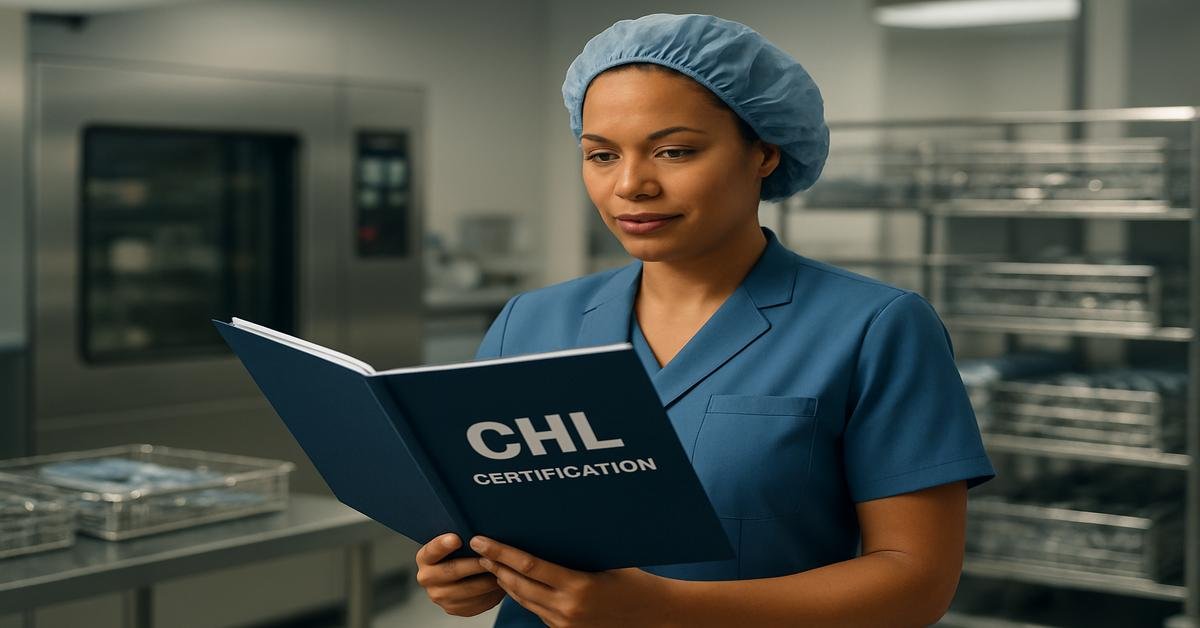
Moving from sterile processing technician to central service manager is a real career step, not just a title change. The work shifts from doing the tasks well to making sure the whole department runs well. That means leading people, protecting quality, handling workflow problems, and making decisions that affect patient safety every day. CHL certification can help with that transition because it shows that you understand the larger leadership side of central service, not only the technical side. If you want to move up, it helps to know what the manager role actually involves, what CHL proves, and how to prepare in a way that makes employers trust you with more responsibility.
What changes when you move into a central service manager role
A sterile processing technician works close to the instruments, equipment, and daily production tasks. A central service manager still cares about those same areas, but the job becomes broader. You are no longer focused only on your own work. You are responsible for the performance of the department.
That difference matters because strong technicians do not always become strong managers automatically. The skills overlap, but they are not the same.
As a manager, you may be expected to:
Supervise technicians, leads, and support staff
Set work priorities across shifts
Monitor instrument turnaround times
Support compliance with standards, policies, and documentation rules
Train staff and address performance problems
Work with the OR, infection prevention, and supply chain teams
Manage budgets, purchasing, and inventory decisions
Prepare for audits and respond to quality concerns
In other words, you stop being judged only on whether trays are correct and sterilizers are loaded properly. You are judged on whether the department is safe, efficient, staffed, organized, and trusted by other departments.
That is why leadership preparation matters. A good manager needs technical credibility, but also communication, judgment, consistency, and the ability to solve system problems instead of only task problems.
What CHL certification means
CHL stands for Certified Healthcare Leader. In the central service setting, this certification is often used to show readiness for leadership responsibility. It signals that you understand the management side of sterile processing and central service operations.
That matters because hospitals and healthcare systems want more than experience alone. They want evidence that a candidate understands leadership principles in a regulated, high-risk environment. Sterile processing affects surgical flow, infection prevention, cost control, and patient outcomes. A manager makes decisions that carry weight.
CHL certification helps show that you are prepared to think at that level.
It can strengthen your position in a few ways:
It shows professional commitment. Employers often see certification as proof that you are serious about advancement.
It supports credibility. Staff are more likely to trust a leader who has both field experience and formal leadership knowledge.
It may help in hiring and promotion decisions. When several candidates have similar experience, certification can separate one applicant from another.
It broadens your knowledge. Preparing for CHL can expose gaps in budgeting, human resources, quality systems, and departmental planning.
The certification itself will not make someone an effective manager. But it can prove readiness and help you build the knowledge base that leadership requires.
Why technical excellence alone is not enough
Many technicians assume that being the best on the floor should naturally lead to management. Sometimes it does. But employers usually need more.
A great technician may be fast, careful, and highly reliable. Those are valuable traits. Still, managing a central service department involves a different set of questions:
Can you coach someone who is underperforming without making the situation worse?
Can you respond calmly when the OR is missing instruments and staff are already overwhelmed?
Can you recognize when a workflow issue is caused by staffing, poor tray design, training gaps, or bad communication between departments?
Can you explain a quality issue to senior leadership in a clear, useful way?
Can you make fair decisions that hold people accountable while keeping morale stable?
These are leadership problems, not just technical ones.
That is where CHL preparation can be useful. It pushes you to study topics that strong technicians may not have learned deeply in their daily roles. For example, you may know decontam and assembly very well, but know less about scheduling, department metrics, cost control, conflict resolution, or policy development. A manager needs all of it.
The knowledge areas you need to master before stepping up
If you want to move into management, start thinking beyond the instrument level. You need to understand how the department works as a system.
Operations and workflow
A manager must understand how work moves from decontamination to inspection, assembly, sterilization, storage, and distribution. That sounds basic, but management requires more than knowing the steps. You need to spot delays, bottlenecks, rework, and preventable errors.
For example, if peel packs are backing up every afternoon, the issue may not be “staff need to work harder.” It could be poor shift overlap, unbalanced assignment design, or a case cart pattern that creates a daily surge. A manager has to diagnose the real cause.
Quality and compliance
Central service managers live close to standards, documentation, and audit readiness. They need to understand why processes exist and where risk enters the system. That includes sterilization monitoring, traceability, competency documentation, policy enforcement, and corrective action processes.
This is not paperwork for its own sake. In sterile processing, weak documentation often means weak control. If a department cannot prove what it did, it may not be able to defend patient safety decisions.
People management
Leadership often becomes difficult here. It is one thing to know the work. It is another to lead a team with different personalities, skill levels, and work habits.
You need to learn how to:
Give clear expectations
Correct problems early
Train consistently
Recognize strong performance
Handle conflict without avoiding it
Build trust while keeping standards firm
Staff usually respect fairness more than friendliness. If one person can ignore the rules and another is held accountable, the team notices. Good managers are steady, not reactive.
Communication across departments
Central service managers work with surgery, endoscopy, infection prevention, risk management, vendors, educators, and supply teams. That means your communication style has to change based on the audience.
For example, an OR director may want a quick explanation of turnaround delays and what corrective action is happening. A technician may need direct coaching and task-level clarity. Senior leadership may want data trends and budget impact. The message changes, but the facts stay consistent.
Budget and resource awareness
Many technicians have little direct exposure to budgets. Managers do not have that luxury. Labor, repairs, missing instruments, rushed purchases, loaners, and damaged sets all affect cost.
You do not need to become an accountant. But you do need to understand how department decisions affect money and service levels. A manager who can connect operational problems to cost and patient care is much more effective than one who only reacts to daily emergencies.
How CHL certification supports the transition
CHL certification gives structure to your preparation. That is helpful because many future managers learn in pieces. They pick up some scheduling here, some policy work there, and some staff coaching when problems arise. That kind of experience helps, but it can leave gaps.
Certification preparation encourages a more complete view of leadership.
It can help you in three main ways.
It helps you think like a department leader
You start looking beyond your station or shift. You begin to ask broader questions. Why are errors increasing on certain trays? Why is turnover higher on one shift? Why is the OR asking for more immediate-use pressure steam sterilization? Why are repairs rising? Managers need that bigger view.
It gives language to skills you may already use
Some technicians are already acting like leaders without the formal title. They train new staff, solve daily problems, calm tense situations, and help coordinate workflow. CHL can help define those abilities in a way that makes sense on a resume, in an interview, and during promotion discussions.
It builds confidence for interviews and higher-level conversations
When you prepare seriously, you are better able to discuss staffing, quality indicators, compliance risk, process improvement, and leadership style. That makes a difference in interviews. Employers often look for people who can explain not just what they do, but why they do it and how they would lead others.
Practical steps to prepare before you apply for management roles
If your goal is to become a central service manager, do not wait for the job posting to start acting like a leader. Build the evidence now.
1. Get strong in the full department, not just one area
If you are excellent in assembly but weak in decontam, sterilization records, case carts, or inventory flow, expand your range. Managers need department-wide understanding. Employers will notice if your experience is too narrow.
2. Ask for lead-level responsibilities
Volunteer for tasks that expose you to coordination and accountability. Examples include helping with daily staffing assignments, onboarding new technicians, auditing trays, organizing competencies, or tracking quality issues. These tasks show that you can handle responsibility beyond production work.
3. Learn the department’s numbers
Start paying attention to metrics. Know your tray error trends, sterilizer loads, turnaround times, late starts tied to instrument issues, peel pack volume, repair rates, and staffing patterns. Managers must speak in facts. Data helps you explain problems and defend solutions.
4. Improve your communication style
A future manager needs calm, direct communication. Practice giving updates clearly. If there is a missing item, explain what happened, what is being done, and when the next update will come. Avoid vague language and blame. Leaders build trust by being accurate and steady, especially under pressure.
5. Study policy and standards, not just routine tasks
Do not stop at “this is how we do it here.” Learn why the process exists and what standard supports it. That helps you make better decisions when exceptions come up. It also prepares you for CHL-level thinking, where leadership depends on understanding risk and compliance, not just habit.
6. Find a manager or educator who will give honest feedback
You need more than encouragement. You need useful critique. Ask where your leadership skills are strong and where you are not ready yet. For example, you may be respected technically but struggle with delegation or difficult conversations. It is better to see that early and work on it.
7. Prepare for CHL with a real plan
Do not treat certification as a last-minute exam. Build a study plan around leadership topics you do not use every day. Review operations, staffing, quality systems, communication, compliance, and financial basics. The goal is not only to pass. The goal is to become more capable.
Common mistakes people make on the way to management
Some career moves stall not because the person lacks potential, but because they misunderstand what leadership roles require.
One common mistake is assuming seniority equals readiness. Experience matters, but years on the job do not automatically build leadership skill. Someone can have ten years of experience and still avoid conflict, resist change, or struggle with accountability.
Another mistake is focusing only on the certification and ignoring behavior. CHL is valuable, but employers also watch how you work now. Do you stay composed under stress? Do others trust your judgment? Do you communicate well? Do you solve problems without creating new ones?
A third mistake is acting like management is about authority. In central service, the best managers are not the loudest people in the room. They create stable systems, support staff development, enforce standards fairly, and protect patient safety even when pressure is high.
Finally, some candidates do not prepare examples from their own work. In interviews, broad statements like “I’m a hard worker” are weak. Specific examples are stronger. For instance: “I helped reduce recurring tray errors by reviewing assembly instructions with staff, updating the count sheet, and tracking issues for three weeks.” That shows leadership in action.
How to show employers you are ready
When you apply for a central service manager role, employers want proof. They want to see that you can step into complexity, not just hope to learn everything later.
Make your readiness visible.
Show your technical foundation across the department
Highlight CHL certification or active preparation for it
List projects where you improved quality, training, workflow, or communication
Describe any lead, preceptor, audit, or coordinator duties you have handled
Use measurable examples when possible
In interviews, talk about real problems you have helped solve. Explain your thinking. For example, if instrument turnaround was causing OR complaints, describe how you looked at the cause, communicated with stakeholders, and helped improve the process. That is much stronger than saying you “work well under pressure.”
The bigger value of becoming a strong central service manager
This career step is not only about pay or title. A strong manager can improve the entire department. That affects staff morale, surgeon trust, case flow, audit performance, and patient safety.
Good leadership in sterile processing often shows up in quiet ways. Fewer missing items. Clearer expectations. Better training. Less confusion between shifts. Faster response to problems. Stronger documentation. More confidence from the OR. These improvements do not happen by accident. They usually come from a leader who understands both the technical work and the system around it.
CHL certification supports that kind of growth because it helps technicians prepare for the wider responsibility. It does not replace experience, judgment, or people skills. But it can strengthen all three when used the right way.
If you want to move from sterile processing tech to central service manager, think of CHL as part of a larger leadership path. Build your department knowledge. Strengthen your communication. Learn the numbers. Take on responsibility before you have the title. Then use certification to show that your experience is backed by leadership preparation. That combination is what makes the transition believable and successful.

