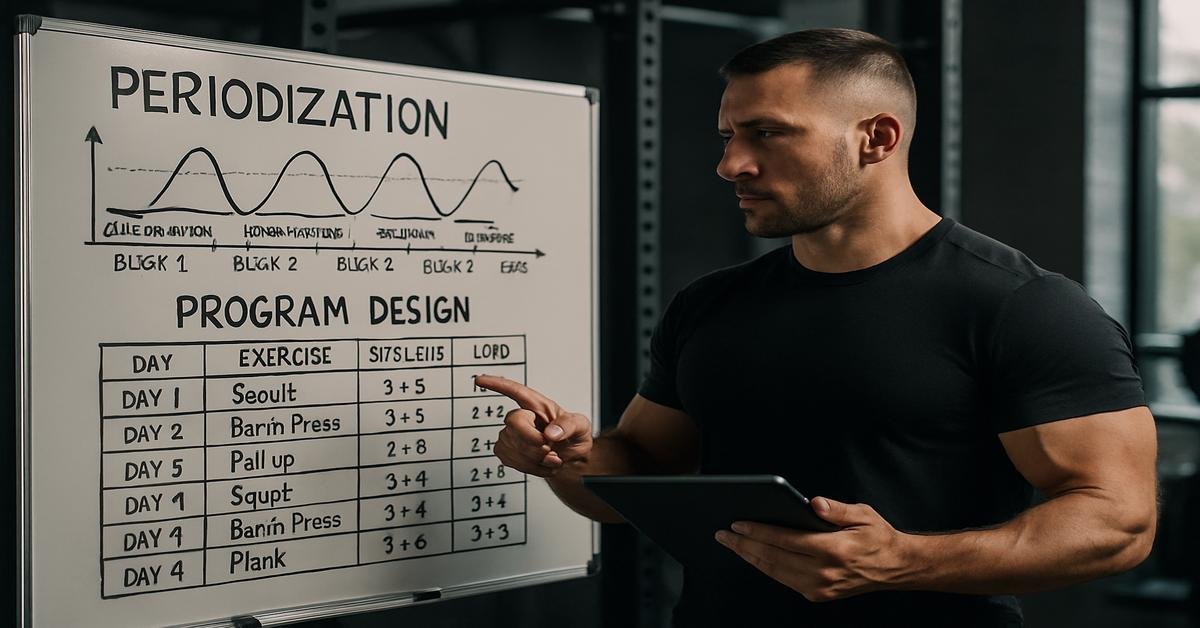
The CSCS exam expects more than memorized definitions. It tests whether you understand how training variables work together and why a coach would choose one approach over another. Periodization and program design are where many candidates get stuck, because the exam mixes physiology, planning logic, and practical coaching decisions. If you want to do well, you need to think like a strength coach solving real problems, not like a student reciting terms. The good news is that this section becomes much easier when you learn a few smart ways to organize the content and connect the science to actual training decisions.
Why periodization and program design feel hard on the CSCS exam
Many exam topics are fact-based. You can memorize muscle actions, energy systems, or testing protocols and pick the right answer if you know the facts. Periodization is different. It asks you to interpret context. You have to look at an athlete’s training status, season, goals, fatigue level, and sport demands, then choose the most logical program structure.
That is why candidates often feel unsure even when they know the vocabulary. They recognize terms like macrocycle, hypertrophy, power, and peaking, but they struggle to decide what comes first, what gets emphasized, and how volume and intensity should change over time.
A better way to study this topic is to focus on the underlying rules:
- Training should match the athlete’s needs. A beginner needs broad development and technique practice. An advanced athlete needs more precise loading and variation.
- Adaptations are specific. If the goal is maximal strength, the program must include heavy loading. If the goal is power, speed of movement and intent matter.
- Fatigue must be managed. Hard training creates adaptation only if the athlete can recover from it.
- The season matters. Off-season, pre-season, in-season, and post-season each change what is realistic and useful.
If you keep these four rules in mind, many test questions become simpler.
Start with the big picture: learn the logic of the training year
Do not begin by trying to memorize every model of periodization. First learn the broad flow of a training year. The CSCS exam often rewards candidates who can identify the right emphasis for the right phase.
In simple terms, a full training plan usually moves from general work to specific work. Early phases build a base. Later phases sharpen the qualities that matter most for competition.
A common pattern looks like this:
- Off-season: Higher volume, more room to build muscle, work capacity, technique, and general strength.
- Pre-season: Shift toward sport-specific strength, power, speed, and reduced volume as intensity rises.
- In-season: Maintain key qualities, manage fatigue, and support performance rather than chase large gains.
- Post-season: Recovery, restoration, and correction of issues built up during the season.
This matters because exam questions often hide the answer in the athlete’s calendar. For example, if a football player is two weeks from the start of competition, a high-volume hypertrophy block is usually a poor fit. The athlete needs freshness, power, and readiness, not accumulated fatigue.
When studying, practice asking one question before looking at answer choices: What should be the main goal in this phase of the year? That one habit can eliminate weak answers fast.
Use a simple framework for every program design question
When you see a question about building or evaluating a program, run through the same mental checklist. This keeps you from getting lost in small details.
Use this order:
- Athlete: beginner, intermediate, advanced, youth, trained adult, injured, in-season?
- Goal: hypertrophy, maximal strength, power, muscular endurance, peaking, maintenance?
- Timing: off-season, pre-season, in-season, post-season?
- Fatigue cost: how much stress can the athlete realistically handle?
- Exercise order and loading: what sequence and intensity make sense for that goal?
Here is a practical example. Suppose the athlete is an experienced volleyball player in pre-season and the goal is explosive performance. That tells you several things right away. The athlete likely does not need a beginner-style full-body hypertrophy plan. The phase suggests moving toward power and sport readiness. Exercise order should place explosive lifts and plyometrics before high-fatigue assistance work. Volume should be controlled so the athlete can still move fast.
This framework works because it mirrors real coaching. Good programming starts with the athlete and context, not with random sets and reps.
Master the relationship between volume and intensity
If there is one area to understand deeply, it is this. Many periodization questions are really questions about how volume and intensity should shift over time.
Volume usually refers to the total amount of work performed. Intensity usually refers to the load lifted relative to maximum effort, though in some contexts it can also refer to effort or training demand. On the CSCS exam, the key point is that these variables often move in opposite directions during a classic progression.
In early training phases, volume is often higher and intensity is lower to moderate. This supports technical practice, work capacity, and tissue tolerance. In later phases, intensity tends to rise while volume drops. This helps the athlete express strength and power without carrying too much fatigue.
Why does this matter? Because the body does not adapt well to maximum demands in all directions at once. Very high volume and very high intensity together are difficult to recover from, especially over time. A good plan emphasizes the quality that matters most while keeping total stress manageable.
To make this easier to remember, think in terms of trade-offs:
- Hypertrophy phases: more total work, moderate loads, shorter rest than maximal strength work.
- Maximal strength phases: heavier loads, lower reps, longer rest, moderate total volume.
- Power phases: fast movement, high intent, lower volume, controlled fatigue, high quality per rep.
- In-season maintenance: enough intensity to preserve strength, but lower volume to protect performance and recovery.
When answer choices look similar, choose the one that best matches the expected volume-intensity pattern for the training goal and phase.
Do not memorize periodization models in isolation
Candidates often try to memorize linear, undulating, block, and step-loading models as separate topics. That is not the best use of study time. Learn what problem each model is trying to solve.
Linear periodization is often presented as a gradual shift from higher volume and lower intensity toward lower volume and higher intensity. It is easy to understand and useful for building a broad progression over time.
Undulating periodization changes volume and intensity more frequently, often within the same week. This can help trained athletes continue adapting and may reduce monotony.
Block periodization emphasizes concentrated phases with a narrower focus, such as accumulation, transmutation, and realization. This can be useful for advanced athletes who need more targeted stimuli.
The exam may ask which model fits a situation best. Instead of asking, “What is the definition of this model?” ask, Why would a coach use it here?
For example:
- A beginner often does well with simple progression because they adapt to almost any sensible program.
- An advanced athlete may need more planned variation because progress comes slower and fatigue is harder to manage.
- An athlete with a long season may need a flexible structure that supports maintenance and repeated performance.
This approach helps because it turns memorization into decision-making.
Learn exercise order as a chain of priorities
Exercise order is one of the most testable parts of program design because it reflects both science and coaching logic. The standard sequence is not arbitrary. It exists to protect movement quality, maximize performance on high-skill tasks, and reduce injury risk.
A common order is:
- Power or explosive exercises first
- Core strength lifts next
- Assistance exercises after that
- Smaller muscle group and single-joint work later
- High-fatigue conditioning or trunk work toward the end
The reason is simple. Explosive movements need precision, speed, and a fresh nervous system. Heavy multi-joint lifts also demand focus and coordination. If these are done after exhausting isolation work, performance drops and technique often gets worse.
A helpful exam shortcut is this: the more technical, explosive, and neurally demanding an exercise is, the earlier it should appear.
There are exceptions based on training goals, but this rule solves most questions.
Understand what changes for beginners versus advanced athletes
This distinction appears often, and it matters more than many people expect. Training age changes what is effective, safe, and necessary.
Beginners usually need:
- More practice with basic movements
- Simpler programming
- Lower complexity
- Moderate loads that allow technique development
- Broad physical development rather than narrow specialization
Advanced athletes usually need:
- More variation and more precise loading
- Careful fatigue management
- More sport-specific planning
- Smaller improvements pursued with greater structure
- Training phases that target distinct qualities at the right time
Why does this show up on the exam so often? Because the same program is not equally appropriate for all athletes. A novice does not need a highly complex block plan with multiple specialized methods. An advanced lifter may not keep improving with a generic beginner progression.
When in doubt, the more experienced the athlete, the more the correct answer usually involves precision, variation, and timing.
Use the SAID principle as your reality check
The SAID principle means Specific Adaptation to Imposed Demands. This is one of the best tools for catching wrong answers. If the program does not match the desired adaptation, it is probably not the best choice.
Examples make this clearer:
- If the goal is maximal strength, very light loads for high reps are not the most direct method.
- If the goal is power, grinding slow reps to fatigue does not fit well.
- If the goal is muscular endurance, very low total volume is unlikely to be enough.
- If the athlete must peak for competition, a program that creates excessive fatigue right before the event is a bad fit.
This principle also helps with sport specificity. A wrestler, sprinter, soccer player, and baseball pitcher do not all need the same emphasis at the same time. Good program design respects the demands of the sport and the role of the athlete.
Train yourself to spot bad answers fast
Strong test-takers do not just know the right answer. They quickly spot why the wrong answers are wrong. In periodization and program design, bad answers often share the same flaws.
Watch for choices that:
- Ignore the season. Example: high fatigue work immediately before key competition.
- Mismatch the goal. Example: endurance-style loading for a pure power objective.
- Ignore training status. Example: overly complex planning for a novice athlete.
- Break exercise order logic. Example: technical power lifts placed after exhausting assistance work.
- Push too many qualities hard at once. Example: trying to maximize strength, endurance, hypertrophy, and power in the same short phase.
If two options both seem possible, choose the one that shows cleaner alignment between goal, phase, athlete level, and recovery demands.
Build your own “program design sheets” while studying
One of the best prep hacks is to stop reading passively and start building comparison sheets. Create a page for each training goal and fill in the main variables from memory. Then check and correct yourself.
Your sheets can include:
- Main goal
- Typical load emphasis
- Rep ranges
- Rest periods
- Volume pattern
- Best phase of year for emphasis
- Common exercise types
- Main mistakes coaches make
This works because it forces active recall. It also helps you compare categories that students often confuse, such as strength versus power, or hypertrophy versus muscular endurance.
You can do the same for periodization models. Make one page that compares when each model is most useful, who benefits most, and what trade-offs come with it.
Practice with mini coaching scenarios, not just flashcards
Flashcards are useful for terminology. They are less useful for program design, because real exam questions are usually situational. A better study method is to create short case scenarios and answer them like a coach.
For example:
- A college basketball player is in-season and reports heavy legs. Should volume rise or fall?
- A novice high school athlete needs a first off-season program. Should complexity be high or low?
- A trained athlete is four weeks out from competition. Should the program become more general or more specific?
Then explain your answer in one or two sentences. This matters because explanation reveals whether you actually understand the programming logic.
If you cannot explain why volume should decrease, or why a power exercise belongs first, you probably do not own the concept yet.
What to remember on exam day
When the exam gives you a periodization or program design question, do not rush to the answer choices. Pause and identify the coaching context first. Ask:
- Who is the athlete?
- What is the goal?
- What phase of the year is this?
- What level of fatigue is acceptable?
- What training quality matters most right now?
Then look for the choice that best aligns with those facts. This method is calm, practical, and reliable. It also protects you from attractive answer choices that sound scientific but do not actually fit the scenario.
The smartest way to prepare for this section is to study like a coach, not like a trivia contestant. Learn the purpose behind each training phase. Understand how volume, intensity, specificity, and fatigue interact. Know why programs differ for beginners and advanced athletes. And practice making simple, defensible decisions in realistic situations.
If you do that, periodization and program design stop feeling like a confusing pile of terms. They start to look like what they really are: a structured way to help athletes improve at the right time, in the right way, for the right reason.

