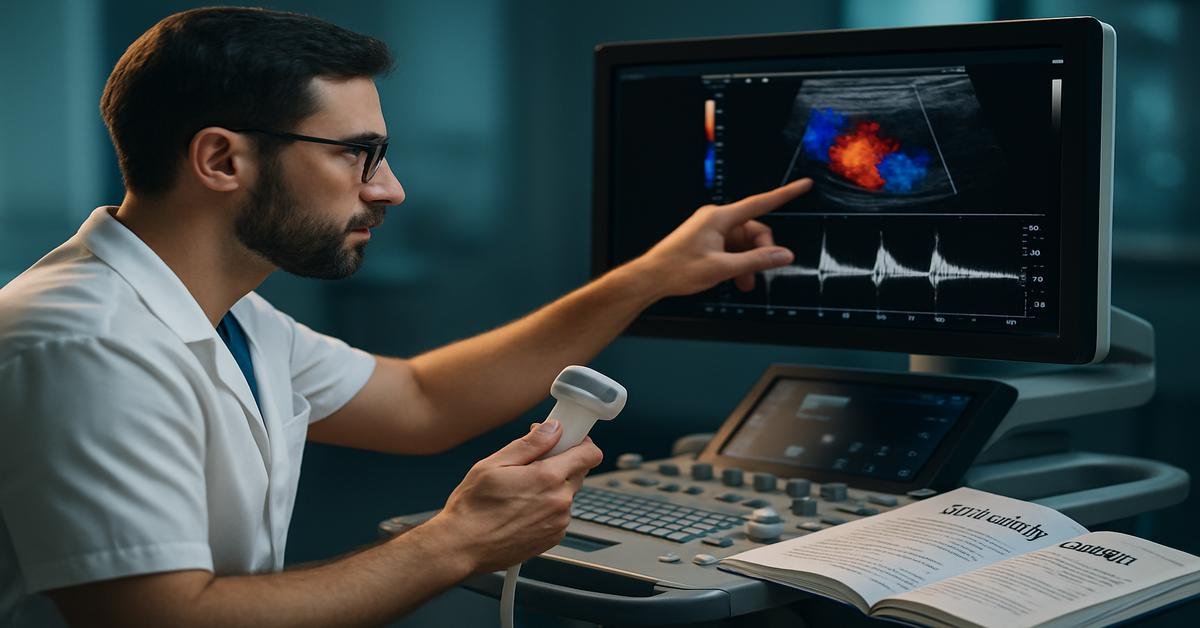
The SPI exam tests how well you understand the physics behind ultrasound, not just how to recognize images. Two areas show up again and again because they matter in daily scanning: hemodynamics and instrumentation. Hemodynamics explains what blood flow is doing and why Doppler looks the way it does. Instrumentation explains how the machine creates, processes, and displays that information. If you know the core rules in both areas, many exam questions become easier because they stop looking like isolated facts. This guide focuses on the high-yield topics sonographers are most likely to see, with attention to the reasoning behind the concepts.
Why hemodynamics matters on the SPI exam
Hemodynamics is the study of blood movement. On the SPI exam, it is not tested like a cardiology or vascular registry, but you still need the physics that explains velocity, pressure, resistance, and flow patterns. The exam often asks you to connect what is happening in the vessel to what appears on spectral, color, or power Doppler.
A simple starting point is this: blood flows because of a pressure gradient. It moves from higher pressure to lower pressure. If the pressure difference increases, flow tends to increase. But blood does not move freely. It meets resistance from vessel walls, branching, blood viscosity, and changes in diameter. That is why flow is never just about pressure alone.
Flow, velocity, and resistance: know the differences
Students often mix up flow and velocity. They are related, but they are not the same.
- Flow is the volume of blood moving through a vessel over time, often written as mL/min.
- Velocity is how fast the blood cells are moving, often written as cm/s.
A vessel can have high velocity without high total flow. For example, if a vessel narrows, blood speeds up through the tight area. Velocity rises because the same volume has to get through a smaller opening. This is why stenosis produces increased Doppler velocities.
Resistance is the opposition to flow. In Doppler waveforms, resistance changes the shape of the tracing.
- High-resistance flow has sharp systolic peaks and relatively low diastolic flow.
- Low-resistance flow has more forward flow throughout diastole.
The reason is physiologic. Organs that need constant perfusion, such as the kidney or brain, usually show lower resistance waveforms. Muscles at rest often show higher resistance patterns.
Poiseuille’s law: the big idea behind vessel diameter
You do not need advanced math to answer most SPI questions on flow, but you do need the concept behind Poiseuille’s law. The key point is that vessel radius has a powerful effect on flow. A small change in radius causes a large change in flow. This matters much more than many students expect.
Why? Because flow is proportional to the fourth power of the radius. That means if the vessel radius decreases, flow drops dramatically unless pressure increases enough to compensate.
This is why stenosis matters so much. Even modest narrowing can greatly affect blood movement. The body often responds by increasing velocity at the narrowed segment. On Doppler, that appears as spectral broadening and elevated peak systolic velocity.
Poiseuille’s law also reminds you that:
- Longer vessels increase resistance.
- Higher blood viscosity increases resistance.
- Larger vessel radius decreases resistance.
For exam purposes, if you see a question asking which factor has the greatest effect on flow, vessel radius is often the best answer.
Laminar, disturbed, and turbulent flow
Laminar flow is the normal streamlined pattern in most vessels. Blood moves in parallel layers. The fastest blood is in the center of the vessel, and the slowest is near the walls because of friction. This creates a velocity profile across the vessel.
With laminar flow, spectral Doppler usually shows a cleaner spectral window, especially in normal arteries.
Disturbed flow happens when the flow pattern becomes less organized. This often occurs near bifurcations, curves, or mild narrowing.
Turbulent flow is more chaotic. It is common distal to significant stenosis. Many different velocities are present at the same time, so the spectral window fills in. This is called spectral broadening.
A common exam trap is treating every filled-in spectrum as machine artifact. Sometimes it is, but often it reflects real flow disturbance. You have to think about the clinical and anatomic setting.
Bernoulli principle and continuity: why velocity rises in stenosis
Two ideas help explain blood acceleration through a narrowed area.
- Continuity principle: as cross-sectional area decreases, velocity must increase to maintain flow.
- Bernoulli principle: when velocity increases, pressure drops.
These ideas are central in Doppler interpretation. In a stenotic vessel, blood speeds up through the narrowed segment. Just beyond it, flow may separate and become disturbed. That explains why aliasing on color Doppler and spectral broadening on pulsed-wave Doppler often appear around stenosis.
On the SPI exam, if a vessel narrows, expect:
- Higher peak velocities in the narrowed segment
- Post-stenotic turbulence
- Possible color bruit or mosaic appearance if settings allow it
Reynolds number: when flow becomes turbulent
Reynolds number predicts the likelihood of turbulence. You do not need to calculate it on most SPI questions, but you should know what increases it:
- Higher velocity
- Larger vessel diameter
- Lower viscosity
As Reynolds number rises, flow is more likely to become turbulent. This is useful because it connects physiology to image appearance. A high-velocity jet through a stenosis is more likely to create disturbed or turbulent flow downstream.
Doppler angle and the cosine effect
This is one of the most tested topics in ultrasound physics. Doppler measures motion along the ultrasound beam, not total motion in all directions. The measured Doppler shift depends on the cosine of the angle between the beam and blood flow.
Important rules:
- At 0 degrees, cosine is 1, so the Doppler shift is maximal.
- At 90 degrees, cosine is 0, so no Doppler shift is detected.
- As the angle gets larger, especially above 60 degrees, velocity error increases quickly.
This is why sonographers try to keep the Doppler angle at or below 60 degrees. A poor angle does not just make the waveform look weak. It can produce inaccurate velocity measurements.
If the exam asks which angle gives the strongest Doppler signal, 0 degrees is the physics answer. If it asks which angle is used clinically for velocity measurement, the practical answer is usually 60 degrees or less.
Aliasing: what it is and how to fix it
Aliasing happens when the Doppler shift exceeds the system’s ability to sample it correctly. This occurs in pulsed-wave Doppler and in color Doppler, but not in continuous-wave Doppler.
The limit is set by the Nyquist limit, which equals one-half the pulse repetition frequency, or PRF.
If blood velocity is too high for the selected PRF, the waveform wraps around the baseline or color reverses abruptly.
Ways to reduce aliasing include:
- Increase PRF or scale
- Shift the baseline
- Use a lower-frequency transducer
- Decrease the Doppler angle if possible
- Use a shallower sample depth
- Switch to continuous-wave Doppler if available and appropriate
The “why” matters here. Increasing PRF raises the Nyquist limit. Lowering frequency reduces the Doppler shift produced by a given velocity. Decreasing depth helps because the system can pulse more often when it does not need to listen as long for returning echoes.
Transducer basics: frequency, bandwidth, and damping
Instrumentation questions often begin at the transducer. The transducer converts electrical energy into sound and returning sound into electrical signals using the piezoelectric effect.
The main high-yield relationship is simple:
- Higher frequency gives better resolution but less penetration.
- Lower frequency gives better penetration but lower resolution.
This tradeoff exists because higher-frequency sound attenuates more quickly in tissue.
Bandwidth is also important. A transducer with a broad bandwidth can operate over a wider range of frequencies. This gives the system more flexibility.
Damping affects pulse length. Stronger damping shortens the pulse, which improves axial resolution because shorter pulses can better separate structures lying close together along the beam path. But damping also lowers sensitivity somewhat. Again, ultrasound is full of tradeoffs.
Resolution: axial, lateral, elevational, and temporal
Resolution means the ability to distinguish two structures as separate.
- Axial resolution is along the beam axis. It depends on spatial pulse length. Shorter pulses improve it.
- Lateral resolution is side by side, perpendicular to the beam. It depends on beam width. Narrower beams improve it.
- Elevational resolution is slice thickness. It depends on the beam dimension out of the image plane.
- Temporal resolution is the ability to show motion accurately over time. It depends largely on frame rate.
These definitions are easy to memorize, but the SPI exam often asks what changes them. For example:
- If damping increases, axial resolution improves because pulse length shortens.
- If focus is placed properly, lateral resolution improves because the beam narrows at the focal zone.
- If line density increases, frame rate drops, so temporal resolution gets worse.
Pulse repetition period, PRF, and depth
Pulse repetition period is the time from the start of one pulse to the start of the next. PRF is how many pulses are sent each second. They are inversely related.
Depth has a major effect here. Imaging deeper structures requires the system to wait longer for echoes to return. That means PRF must decrease. Lower PRF affects Doppler and grayscale performance.
Key effects of increasing depth:
- PRF decreases
- Frame rate may decrease
- Risk of aliasing increases in pulsed Doppler because the Nyquist limit falls
This is a classic exam connection. If a vessel is deep and velocity is high, aliasing becomes more likely in pulsed Doppler.
Power, intensity, and attenuation
Power is the rate of energy transfer. Intensity is power per unit area. As sound travels through tissue, it loses energy. This loss is called attenuation.
Attenuation happens because of:
- Absorption
- Reflection
- Scattering
In soft tissue, attenuation increases with frequency. That is the reason lower-frequency probes penetrate deeper. It is not arbitrary. Lower-frequency sound loses less energy over distance.
Absorption is the main contributor to attenuation in soft tissue. It converts sound energy to heat. That is why output and exposure settings matter, even though diagnostic ultrasound is generally considered safe when used properly.
Common instrumentation artifacts tied to physics
The SPI exam may describe an artifact and ask what caused it. A few are especially high-yield:
- Reverberation: repeated reflections between strong reflectors create multiple equally spaced echoes.
- Mirror image: sound reflects off a strong interface and makes a structure appear duplicated.
- Shadowing: strong attenuation behind a highly attenuating or reflecting structure.
- Enhancement: increased brightness distal to a low-attenuation structure like fluid.
- Refraction: bending of sound at an interface can misplace structures or create edge shadowing.
These are not random image errors. Each follows directly from how sound interacts with tissue. If you understand the mechanism, the artifact is much easier to identify.
Exam-focused patterns worth memorizing
Some relationships are tested so often that they should feel automatic:
- Increase frequency = better resolution, less penetration
- Increase damping = shorter pulse, better axial resolution
- Increase depth = lower PRF, more aliasing risk in pulsed Doppler
- Increase PRF = higher Nyquist limit
- Narrower beam = better lateral resolution
- Smaller vessel diameter in stenosis = higher velocity
- Angle near 90 degrees = little or no Doppler shift
- Continuous-wave Doppler = no aliasing, but poor range specificity
- Pulsed-wave Doppler = range specificity, but aliasing can occur
These are the kinds of principles that let you answer unfamiliar questions. The wording may change, but the physics does not.
How to study these topics efficiently
Do not study hemodynamics and instrumentation as separate piles of facts. Combine them. Ask what the vessel is doing, what the beam is doing, and what the machine is doing with the returning signal.
A practical study method is to use three-step reasoning:
- Identify the physical event. Example: vessel narrows.
- Predict the flow effect. Velocity rises, pressure drops, turbulence may appear distal to the stenosis.
- Predict the ultrasound result. Color aliasing, spectral broadening, elevated peak velocity.
Do the same with instrumentation. For example:
- Change the setting. Increase frequency.
- Predict the sound behavior. More attenuation, shorter wavelength.
- Predict the image effect. Better detail, less depth penetration.
This style of thinking prepares you better than memorizing isolated definitions.
Final takeaway
For SPI success, hemodynamics and ultrasound instrumentation should feel connected, not separate. Blood flow follows predictable physical rules. The ultrasound system follows its own predictable rules. Most exam questions sit where those two sets of rules meet. Focus on pressure gradients, resistance, stenosis effects, Doppler angle, aliasing, PRF, attenuation, and resolution. If you understand why each principle works, you will be able to reason through difficult questions even when the wording is unfamiliar. That is the kind of knowledge the SPI exam rewards, and it is also the kind that makes you stronger at the scanner.

