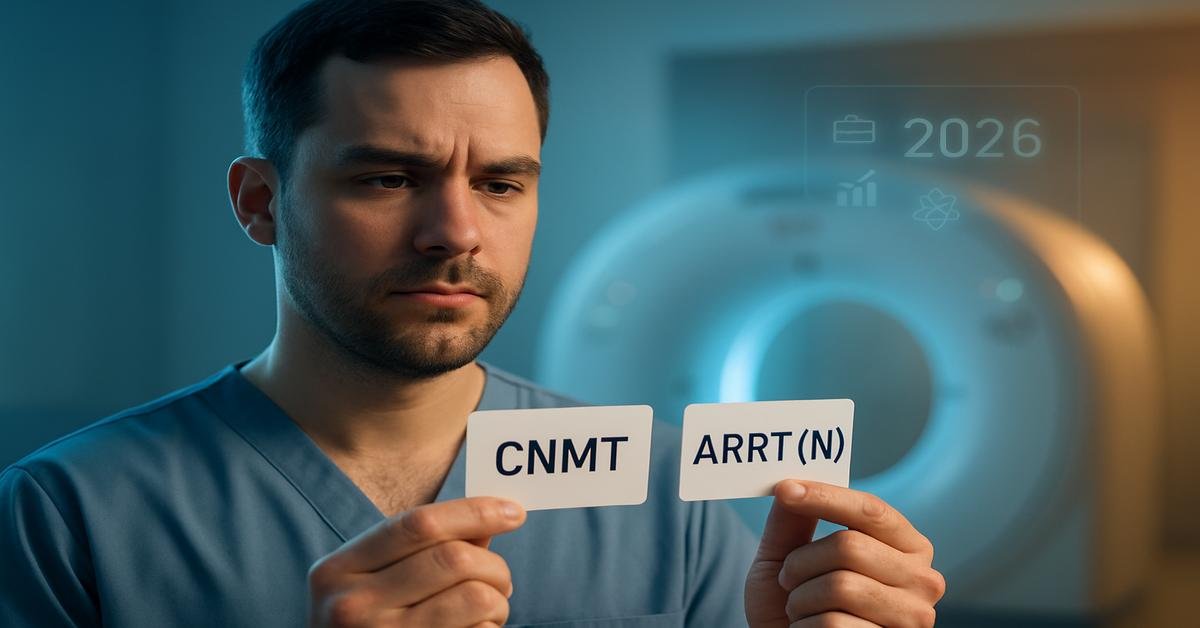
If you want to work in nuclear medicine in 2026, one question comes up fast: should you pursue the CNMT credential or the ARRT (N) credential? Both are respected. Both can help you get hired. And in many workplaces, either one may qualify you for similar roles. But they are not identical. They come from different certifying bodies, follow different eligibility paths, and can shape your career options in slightly different ways. The better choice depends on where you want to work, how you plan to enter the field, and whether you want flexibility across imaging specialties later on.
What CNMT and ARRT (N) actually mean
CNMT stands for Certified Nuclear Medicine Technologist. This credential is awarded by the Nuclear Medicine Technology Certification Board, often called the NMTCB. It is focused specifically on nuclear medicine and closely related advanced areas.
ARRT (N) means certification and registration in Nuclear Medicine Technology through the American Registry of Radiologic Technologists. ARRT is a broader credentialing organization known across medical imaging. It also certifies radiography, MRI, CT, mammography, sonography in some pathways, and other imaging disciplines.
That difference matters. CNMT comes from an organization centered on nuclear medicine. ARRT (N) comes from an organization with wider recognition across imaging departments. Neither is automatically “better” in every case. Each sends a slightly different signal to employers.
How employers usually view these certifications
In many hospitals and imaging centers, hiring managers accept either CNMT or ARRT (N) for nuclear medicine technologist roles. If the job posting says “CNMT or ARRT (N) required” or “registry eligible,” the employer likely sees both as valid ways to prove baseline competence.
Still, there are practical differences in perception:
- CNMT may carry extra weight in nuclear medicine-focused settings. This includes departments with a heavy emphasis on PET, theranostics, cardiac nuclear medicine, or advanced radiopharmaceutical procedures. Why? Because the credentialing body is specialized in this field.
- ARRT (N) may be easier for HR departments to recognize. In larger health systems, ARRT is a familiar name because it covers many imaging professions. That can matter during screening, especially in organizations where recruiters are not nuclear medicine specialists.
- Dual-certified applicants often look strongest. Not because one credential is weak, but because dual certification suggests broader commitment, cleaner mobility across employers, and fewer questions about eligibility.
So if you are asking which one looks better on a résumé, the honest answer is this: CNMT can look stronger to nuclear medicine insiders, while ARRT (N) can look stronger to broad imaging employers.
Eligibility pathways are one of the biggest deciding factors
For many students and working technologists, the “better” certification is the one they can realistically qualify for without wasting time or money.
Eligibility rules can change, so candidates should always verify current requirements before applying. But in general, the two credentials differ in how they structure their pathways.
CNMT pathways have historically offered routes tied closely to nuclear medicine education and clinical experience. This can be attractive if your training is deeply focused on nuclear medicine from the start.
ARRT (N) pathways tend to fit more neatly into the broader ARRT framework of education, ethics, and examination standards. This can be useful if you come from another imaging discipline or plan to add credentials over time.
Here is why this matters in real life:
- If you are a student entering a dedicated nuclear medicine program, either pathway may be open, depending on program design.
- If you are already certified in another imaging field and want to move into nuclear medicine, ARRT may fit more naturally into your longer-term certification strategy.
- If your training is highly specialized and you want your certification to reflect that specialization, CNMT may feel more aligned.
This is one of the most practical parts of the decision. Career planning is not just about prestige. It is about access. A credential is only useful if you can earn it on a timeline that fits your life.
Which certification gives you more career flexibility?
If your goal is to stay in nuclear medicine long term, both credentials can support that. But if you want room to move into other imaging areas, ARRT (N) often has an advantage.
That is because ARRT sits inside a larger imaging certification ecosystem. A technologist who already holds, or later wants, ARRT credentials in other modalities may find the ARRT structure easier to navigate. Employers also understand the ARRT brand across departments.
For example, imagine two technologists:
- Technologist A wants to work only in nuclear medicine and hopes to move into PET/CT-heavy practice, theranostics, or advanced radiopharmaceutical care.
- Technologist B wants nuclear medicine now but may later pivot into CT, management, or a hybrid imaging role in a large radiology department.
Technologist A may feel well served by CNMT. Technologist B may benefit more from ARRT (N), especially if they are building a multi-modality career.
This does not mean CNMT limits your career. Plenty of CNMT-certified professionals build strong, long careers in hospitals, outpatient centers, mobile PET, research settings, and specialty practices. But if flexibility is your main concern, ARRT (N) usually has the edge.
Which one is better for salary and job opportunities in 2026?
In most cases, the credential itself will not create a major salary gap. Employers usually pay based on role, region, experience, call burden, PET skills, CT skills, and shift type more than on whether you hold CNMT or ARRT (N).
What often affects pay more than the base certification:
- PET/CT experience
- Cross-training in CT
- Cardiac nuclear medicine skills
- Theranostics experience
- Willingness to take call, weekends, or rural assignments
- Years of experience in a high-volume department
That said, certification can affect opportunity in smaller ways. A broader-recognition credential may help you get through applicant tracking systems or HR review more easily. A specialty-focused credential may help you stand out to clinical leaders in advanced nuclear medicine teams.
In 2026, the field is likely to keep moving toward more specialized molecular imaging and targeted therapies. That trend makes deep nuclear medicine competence more valuable. At the same time, employers also want staff who can work in hybrid environments and adapt to staffing shortages. That makes cross-functional flexibility more valuable too.
So the market rewards both specialization and adaptability. CNMT leans slightly toward the first. ARRT (N) leans slightly toward the second.
Continuing education and long-term maintenance
A certification is not just an exam. It is also a maintenance commitment. You need to think about what happens after you pass.
Both organizations require ongoing compliance, but the style and structure of maintenance can feel different depending on your career path. Before choosing, ask yourself:
- What continuing education requirements will I need to meet?
- Will this fit my work setting and schedule?
- Do I plan to add more certifications later?
- Will my employer reimburse renewal and CE costs?
This matters more than many students realize. A credential that looks good at graduation may be less convenient if its renewal process does not fit your professional path. If you already expect to stay within the ARRT world across several imaging roles, ARRT (N) may be easier to manage as part of a larger certification plan. If your education and work will remain centered on nuclear medicine, CNMT may feel more direct and relevant.
State licensure can matter as much as certification
One common mistake is to compare CNMT and ARRT (N) without checking state requirements. In some states, the issue is not just which certification employers prefer. It is whether state law recognizes one path, both paths, or additional requirements.
This can affect:
- Your ability to get licensed quickly
- Your eligibility for certain employers
- Your ability to relocate later
If you may move states in the next few years, portability matters. Some candidates choose the credential that creates the least friction when applying across multiple health systems and regulatory environments. In practice, that often pushes people toward the credential with broader institutional recognition. But this is not universal. The key point is simple: do not choose based on reputation alone if state rules could change the answer.
When CNMT is probably the better choice
CNMT may be the better option for your career in 2026 if most of the following are true:
- You want a career centered specifically on nuclear medicine.
- Your education pathway is already aligned with CNMT eligibility.
- You want a credential that signals specialty identity.
- You are interested in advanced nuclear medicine environments such as theranostics, PET-heavy departments, or specialty molecular imaging practice.
- Your target employers actively recognize and value NMTCB credentials.
Why would this be a smart choice? Because it matches your training and professional identity closely. If you know your lane and plan to stay in it, specialization can be an asset.
When ARRT (N) is probably the better choice
ARRT (N) may be the better option for your career in 2026 if these points sound more like you:
- You want broad employer recognition across imaging departments.
- You may add other imaging credentials over time.
- You work in a health system where ARRT credentials are the standard language of hiring.
- You value career flexibility as much as nuclear medicine specialization.
- You want a credential that may travel more easily across multi-modality roles.
This can be the smarter choice if you are still keeping options open. Many strong careers are built not by choosing the most specialized label, but by choosing the path that gives you the most room to adapt.
Is it worth getting both?
For some technologists, yes. Getting both can make sense if you want to remove barriers when applying for jobs, satisfy different employer preferences, or show a high level of commitment to the field.
Dual certification is especially useful if:
- You plan to move between employers or states
- You want maximum résumé strength in competitive markets
- You work in a department where hiring leaders have mixed preferences
- You are aiming for leadership, education, or specialized clinical roles
The downside is obvious: more fees, more paperwork, and more maintenance. So it is not automatically the best move. But if you want long-term flexibility and can manage the cost, dual certification can be a very practical investment.
The best choice for most people in 2026
If you want one simple answer, here it is: ARRT (N) is often the better choice for career flexibility, while CNMT is often the better choice for nuclear medicine specialization.
That is the clearest way to think about it.
Choose CNMT if you want your credential to reflect a strong nuclear medicine identity and you are aiming for a career deeply rooted in that specialty.
Choose ARRT (N) if you want wider recognition, easier alignment with broader imaging careers, and more flexibility if your role changes over time.
If you are still unsure, ask three practical questions:
- Which credential do my target employers ask for most often?
- Which pathway fits my current education and eligibility with the least delay?
- Do I want to specialize deeply, or keep doors open?
Those questions usually lead to a better answer than online debates about prestige.
Final verdict
Neither CNMT nor ARRT (N) is universally better. The stronger credential is the one that matches your training, your local job market, your state requirements, and your long-term plans. In 2026, nuclear medicine will continue to reward both technical specialization and adaptability. That is why the decision is not just about passing an exam. It is about choosing the professional identity you want to build.
If your career goal is clear and narrow, CNMT may be the better fit. If your goal is broad mobility across imaging and healthcare systems, ARRT (N) may serve you better. And if you want maximum flexibility and can support the extra effort, holding both may give you the best of both worlds.

