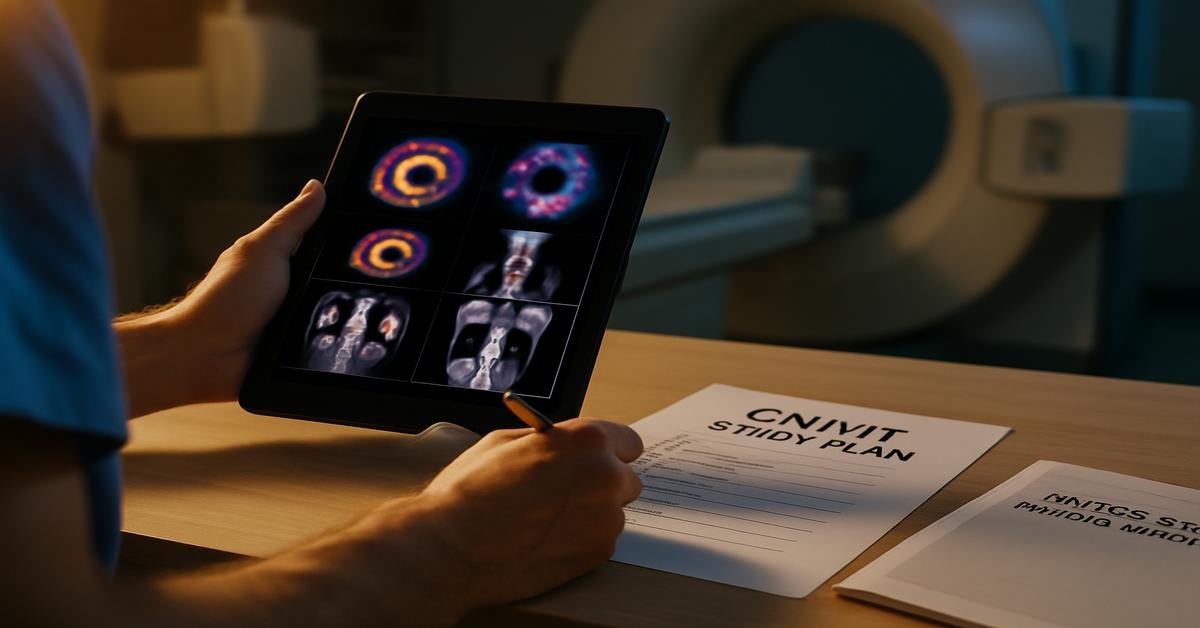
The NMTCB certification exam covers broad nuclear medicine practice, but two areas often decide how confident you feel on test day: nuclear cardiology and nuclear oncology. These topics show up often because they reflect real daily work. They also require more than memorization. You need to understand why a stress image looks different from a rest image, why attenuation correction matters, why FDG uptake is high in one tumor and low in another, and how patient preparation changes image quality. A strong CNMT study plan should focus on the highest-yield concepts, not just long lists of facts. This guide breaks down the cardiology and oncology topics that matter most, explains why they matter, and shows how to study them in a way that sticks.
Why nuclear cardiology and oncology deserve extra study time
These two sections combine anatomy, physiology, radiopharmacy, instrumentation, patient care, and image interpretation. That makes them efficient test targets. When the exam asks about myocardial perfusion imaging, for example, it may also test stress agents, ECG gating, attenuation artifacts, camera positioning, and patient instructions. A PET oncology question may also touch on glucose metabolism, biodistribution, infection versus malignancy, and timing after therapy.
In other words, these topics are dense. If you master them well, you improve performance across multiple content areas at once.
A practical split for many learners is this:
- Nuclear cardiology: heavy focus because it is common and concept-rich
- Nuclear oncology: nearly equal focus because PET/CT and tumor imaging involve many examable decisions
- Smaller time blocks: use for weaker areas such as therapy, instrumentation, and safety
If your exam date is close, spend less time making pretty notes and more time working through image-based scenarios. The CNMT exam rewards applied understanding.
High-yield nuclear cardiology topics to know cold
Nuclear cardiology questions usually center on myocardial perfusion imaging, gated SPECT, stress testing, artifacts, and cardiac function. These are not isolated facts. They work as a system. Study them that way.
1. Myocardial perfusion basics
Know the purpose of perfusion imaging: to evaluate blood flow to the myocardium at stress and rest. The exam may ask you to distinguish ischemia from infarction. This is a core concept.
- Reversible defect: appears on stress, improves or disappears at rest. This suggests ischemia because blood flow becomes inadequate only under stress.
- Fixed defect: present on both stress and rest. This suggests infarct or scar, although severe attenuation can mimic it.
Understand why this matters clinically. A reversible defect points to viable myocardium at risk. A fixed defect points more toward damaged tissue with limited recovery.
2. Coronary artery territories
You should be able to connect perfusion defects with likely coronary artery involvement.
- LAD: anterior wall, septum, apex
- RCA: often inferior wall
- LCX: lateral wall
This is high yield because many interpretation questions are built around location. If a defect is in the inferior wall, the next step may be deciding whether it fits RCA disease or diaphragmatic attenuation.
3. Radiopharmaceuticals used in cardiac imaging
Know the common tracers and why they are used.
- Tc-99m sestamibi and Tc-99m tetrofosmin: common SPECT perfusion agents. Good image quality and practical workflow.
- Thallium-201: older perfusion agent with redistribution properties. Less common than technetium agents, but still testable.
Do not just memorize names. Know the operational differences. Thallium redistributes, so delayed imaging can provide viability information. Technetium agents generally do not redistribute the same way, so separate injections are used for stress and rest studies.
4. Stress testing methods and indications
This is one of the most tested cardiology areas. You should know the difference between exercise stress and pharmacologic stress, when each is used, and major contraindications.
- Exercise stress: preferred when the patient can exercise adequately. It provides functional information such as exercise tolerance, symptoms, blood pressure response, and ECG changes.
- Pharmacologic vasodilator stress: used when the patient cannot exercise enough. Common agents include adenosine, dipyridamole, regadenoson.
- Dobutamine: used when vasodilators are not appropriate, such as some patients with bronchospasm history.
Know why caffeine matters. Caffeine blocks adenosine receptors and can reduce the effect of vasodilator stress agents. That is why patients are told to avoid it before the study.
You should also know common adverse effects and basic responses:
- Flushing, chest discomfort, shortness of breath, headache with vasodilators
- Beta-blockers may affect heart rate response during exercise stress
- Aminophylline may be used to reverse vasodilator side effects in some settings
5. ECG gating and left ventricular function
Gated SPECT adds function to perfusion. This is a favorite exam topic because it connects imaging to cardiac physiology.
Know what gating provides:
- Wall motion
- Wall thickening
- Ejection fraction
- End-diastolic and end-systolic volumes
Understand why this helps. A perfusion defect with normal wall motion may suggest artifact. A defect with abnormal motion or thickening is more likely real. This is an important “why” concept that helps you avoid wrong answers.
6. Common artifacts in myocardial perfusion imaging
Artifact questions are high yield because they test whether you can think like a technologist, not just recall textbook definitions.
- Breast attenuation: often affects the anterior wall
- Diaphragmatic attenuation: often affects the inferior wall
- Patient motion: can create false defects or blur images
- Subdiaphragmatic activity: liver or bowel activity may interfere with inferior wall evaluation
- Arrhythmia during gated imaging: can reduce gating accuracy and distort function data
Know the fixes as well as the problems. Prone imaging, attenuation correction, motion correction software, delayed imaging, and good patient positioning all reduce false positives. The exam often asks what action best improves image quality.
7. Attenuation correction and quality control
Do not treat attenuation correction as a simple buzzword. Understand its role. It helps compensate for soft tissue absorption that can mimic disease. But it must be aligned correctly. Misregistration between emission and transmission data can create artifacts instead of fixing them.
This matters on the exam because “more technology” is not always the right answer. If attenuation correction data are misaligned, the correct response may be to review non-corrected images and fix registration issues.
How to study nuclear cardiology efficiently
Study by pairing image patterns with physiology. Do not memorize defect descriptions in isolation.
A good method is to use a four-step review for each case:
- Locate the defect. Anterior, inferior, lateral, septal, apical.
- Compare stress and rest. Reversible or fixed.
- Check function. Wall motion, wall thickening, ejection fraction.
- Ask if artifact is more likely. Attenuation, motion, extracardiac activity, gating issue.
This habit mirrors real interpretation logic. It also helps with mixed exam questions, where the answer depends on ruling out artifact before calling disease.
High-yield nuclear oncology topics for the CNMT exam
Nuclear oncology study should focus heavily on PET, especially FDG PET/CT, while still reviewing key tumor-imaging principles that apply across tracers and modalities.
1. FDG mechanism and why tumors take it up
FDG is a glucose analog. Many tumors use glucose at a high rate, so they accumulate FDG. That is the basic principle. But the exam often tests the exceptions and limitations.
Know why uptake is not cancer-specific. Infection and inflammation also use more glucose, so they can appear FDG-avid. That is why clinical history matters. A hot lymph node after recent infection is not automatically malignancy.
2. Patient preparation for FDG PET
This is one of the highest-yield oncology areas because poor prep changes the entire study.
- Fasting: reduces competition from circulating glucose and lowers insulin-driven muscle uptake
- Glucose control: hyperglycemia can reduce tumor uptake and degrade study quality
- Minimize strenuous activity: recent exercise increases skeletal muscle uptake
- Keep the patient warm and relaxed: helps reduce brown fat uptake
You should understand why each instruction exists. That makes it easier to answer questions that present an image artifact and ask for the most likely cause. For example, diffuse muscle uptake often points to recent exercise, insulin effects, or tension during uptake time.
3. Normal biodistribution of FDG
You need a clear picture of what normal looks like. Otherwise, every hot structure looks abnormal.
Common normal or expected uptake can be seen in:
- Brain
- Myocardium, variably
- Liver
- Bowel, variably
- Urinary collecting system and bladder
Brown fat is especially important. It can create symmetric uptake in the neck, supraclavicular regions, and upper chest. On the exam, this may be offered as metastatic disease. The clue is the typical pattern and CT correlation.
4. PET/CT correlation and localization
PET alone shows metabolism. CT adds anatomy. The exam often tests whether you can use both together.
Examples:
- A focus of FDG uptake in the neck may be physiologic muscle activity, brown fat, or nodal disease. CT helps sort that out.
- Urinary activity near the pelvis may mimic nodal or pelvic tumor uptake unless you localize it to the ureter or bladder.
This is a core skill because oncology imaging is not only about whether uptake is present. It is about where it is.
5. Response to therapy and timing pitfalls
Many oncology questions involve follow-up imaging after treatment. This is a common trap area.
Inflammation from surgery, radiation, chemotherapy, or immunologic response can increase FDG uptake. If imaging is done too soon, the study may overestimate active disease. You do not need every timing rule memorized perfectly, but you should understand the principle: recent treatment can create false-positive findings.
This also explains why comparison with prior studies and treatment dates matters.
6. Staging, restaging, and recurrence
Know the broad uses of PET in oncology:
- Staging: defining extent of disease before treatment
- Restaging: reassessing disease after treatment or progression
- Detection of recurrence: evaluating suspected return of cancer
- Therapy response assessment: determining whether treatment is working
Why is this important for the exam? Because the same image can be interpreted differently depending on the clinical question. A mildly avid post-treatment site may be expected inflammatory change in one scenario and suspicious recurrence in another.
7. Causes of false positives and false negatives in oncology imaging
This area separates strong test takers from weak ones.
False positives may occur with:
- Infection
- Inflammation
- Recent surgery or radiation
- Brown fat
- Muscle uptake
False negatives may occur with:
- Small lesions below system resolution
- Some low-metabolic tumors
- Hyperglycemia reducing FDG tumor uptake
- Recent therapy altering appearance
Do not study these as random lists. Study the reason behind them. If you understand that FDG reflects glucose metabolism and has limited spatial resolution, most of these pitfalls make sense.
How to study nuclear oncology without getting lost in details
Oncology can feel endless because cancer types vary so much. For CNMT prep, focus less on memorizing every tumor subtype and more on the imaging principles that repeat across cases.
Use this framework:
- What tracer is being used and what does it reflect?
- What is the expected normal biodistribution?
- How was the patient prepared?
- Could this uptake be physiologic, inflammatory, or treatment-related?
- What does CT add to localization?
This approach keeps your attention on the decisions a technologist and interpreter actually make.
A practical weekly CNMT study plan for these two subjects
A good study plan is structured but not rigid. You need repetition, active recall, and image review.
Sample 2-week cycle for cardiology and oncology review:
- Day 1: Cardiac perfusion principles, reversible vs fixed defects, coronary territories
- Day 2: Stress agents, contraindications, patient prep, ECG gating
- Day 3: Cardiac artifacts, attenuation correction, quality control
- Day 4: FDG mechanism, biodistribution, patient prep
- Day 5: PET pitfalls, false positives, false negatives, therapy response
- Day 6: Mixed case review with images and practice questions
- Day 7: Short review of weak points only
Repeat the cycle once, but on the second pass do more questions and less reading.
For each study session, spend your time like this:
- 40% concept review
- 40% practice questions or case interpretation
- 20% error review
Error review matters most. If you missed a question because you confused attenuation with infarct, write down the clue you missed. That is how scores improve.
Common mistakes CNMT candidates make in these sections
- Memorizing without understanding: This fails on scenario-based questions.
- Ignoring artifacts: Many wrong answers result from calling artifact true disease.
- Understudying patient prep: Prep errors are heavily tested because they directly affect image quality.
- Focusing only on interpretation: The exam also tests acquisition, safety, and workflow decisions.
- Not reviewing normal patterns: You cannot identify abnormal findings if normal biodistribution is weak.
A useful rule is simple: if a topic changes image quality, patient safety, or diagnostic accuracy, it is probably high yield.
Final review points to remember before exam day
For nuclear cardiology, know perfusion patterns, stress methods, gated function, and artifacts. For nuclear oncology, know FDG physiology, patient preparation, normal biodistribution, PET/CT localization, and common pitfalls after therapy. These are the topics that appear again and again because they reflect the real logic of nuclear medicine.
When you study, ask “why” every time. Why does caffeine matter? Why does breast attenuation mimic anterior ischemia? Why can inflammation be FDG-avid? Why does gating help distinguish true defect from artifact? If you can answer those questions clearly, you are not just memorizing for the CNMT exam. You are building the kind of understanding that holds up under pressure.
That is the goal of a high-yield study plan: fewer random facts, more connected thinking, and better judgment when the exam gives you a case instead of a definition.

