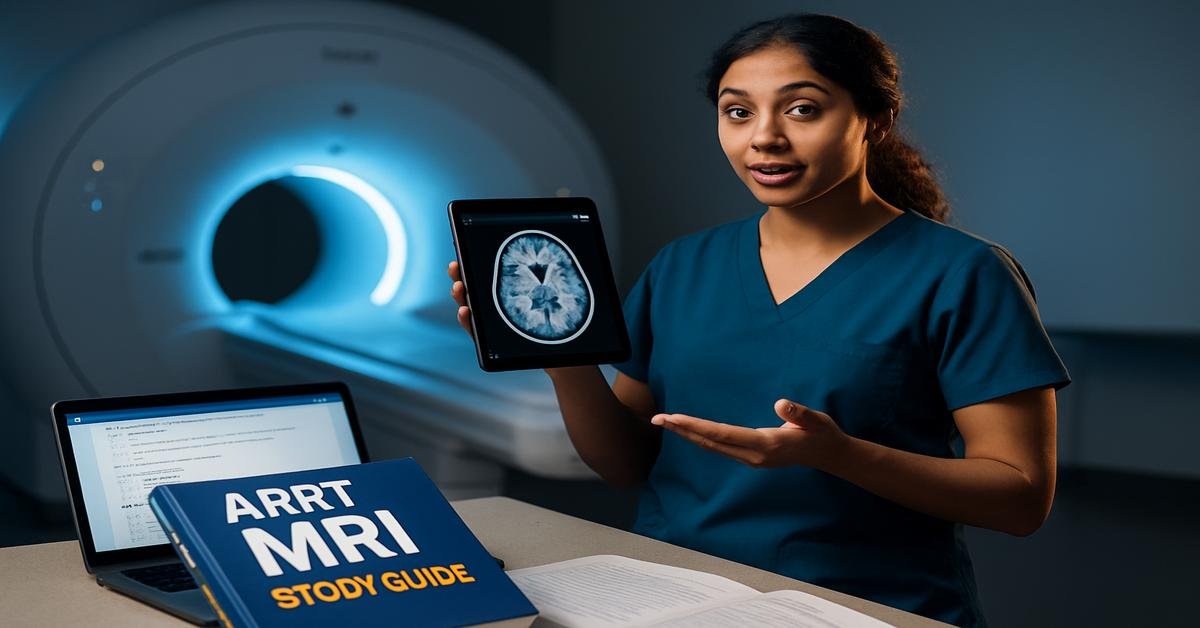
The ARRT MRI registry exam is a big step for anyone who wants to work in magnetic resonance imaging. It tests more than memorized facts. It checks whether you understand how MRI works, how to keep patients safe, and how to produce useful images in real clinical situations. That is why many people find it harder than expected. MRI combines physics, anatomy, patient care, and problem-solving in one exam. The good news is that the test is passable when you study the right way. If you understand the magnet instead of just trying to survive it, the exam becomes much more manageable.
What the ARRT MRI exam is really testing
The MRI registry is not just a physics test. It measures whether you can think like an entry-level MRI technologist. That means the exam expects you to connect ideas, not treat each topic as separate.
For example, a question may look like it is about image quality, but the real issue is your understanding of sequence choice, patient motion, signal-to-noise ratio, and scan time. Another question may seem to focus on anatomy, but it may actually test whether you know the safest way to position the patient or screen for implants.
That is why broad understanding matters. If you only memorize definitions, you may struggle when the exam changes the wording or gives a clinical scenario. If you understand cause and effect, you can reason through unfamiliar questions.
In practical terms, the exam usually covers these core areas:
- Patient care and safety
- Imaging procedures and anatomy
- MRI physics and image production
- Quality control and problem solving
The strongest test-takers do not study these as isolated chapters. They learn how they interact during an actual MRI exam.
Why MRI feels harder than other imaging subjects
MRI is harder for many people because the images are not created in a simple, visible way. In radiography, you can often picture what the x-ray beam is doing. In MRI, much of the action happens at the atomic level. Spins align. Radiofrequency energy excites tissue. Relaxation produces signal. Gradients localize information. The scanner turns all of that into an image.
That process feels abstract at first. But once you simplify it, MRI becomes easier to manage.
Think of MRI in a sequence:
- The magnet aligns hydrogen protons.
- An RF pulse tips them away from alignment.
- As they relax, they release signal.
- Gradients tell the system where the signal came from.
- The computer builds the image.
If you can follow that chain, many topics begin to fit together. T1 and T2 weighting, TR and TE, slice selection, k-space, artifacts, and contrast behavior all make more sense when you know where they belong in the image formation process.
Master the magnet first
If you want to pass the exam, start with the magnet itself. Many students skip this and rush into memorizing pulse sequences. That usually backfires. The magnet is the foundation of everything in MRI, including safety.
You should understand the basic magnetic field terms well enough to explain them in plain language:
- Main magnetic field: The powerful static field that is always on in most MRI systems.
- Precession: The spinning motion of hydrogen nuclei in the magnetic field.
- Larmor frequency: The specific frequency at which hydrogen precesses.
- Resonance: What happens when RF energy matches the Larmor frequency and transfers energy to the protons.
Why does this matter on the exam? Because these ideas explain why RF pulses work, how slice selection happens, and why field strength affects signal. If you understand resonance, you are not just memorizing vocabulary. You are learning the logic of MRI.
Field strength matters too. A higher field strength generally means higher signal-to-noise ratio. That can improve image quality or allow thinner slices or faster scans. But it also affects safety concerns, artifact behavior, and tissue contrast. The exam may ask you to weigh tradeoffs rather than pick the option that sounds strongest.
Safety is not a side topic
Many candidates spend too much time on image weighting and not enough time on safety. That is a mistake. MRI safety is central to the profession, and the exam reflects that.
MRI is unique because the danger is not always obvious. The magnet is silent in one sense because it is always present, even when you are not scanning. A ferromagnetic object does not need to touch the patient to create harm. It can become a projectile. An implanted device can malfunction. A cable can cause a burn. A patient can panic or overheat.
You need a clear mental framework for MRI safety, not just a list of warning words.
Focus on these areas:
- Screening for implants and devices
- Projectile risks from ferromagnetic objects
- RF burns and loop formation
- Gradient-related peripheral nerve stimulation
- Acoustic noise and hearing protection
- Claustrophobia, anxiety, and patient monitoring
- Contrast safety and patient history
Learn to think through examples. If a patient has an implant, do not just ask, “Is it safe?” Ask: What exactly is the device? Is it MR safe, MR conditional, or unsafe? Under what scanning conditions? Do we have documentation? The exam often rewards careful thinking over fast assumptions.
Pay close attention to burns. These questions are common because they reflect real patient harm. Skin-to-skin contact, cables touching the patient, conductive loops, and poor positioning can all create heat injuries. The reason is simple: conductive pathways allow energy concentration. Once you understand that, the prevention steps make sense.
Know the physics, but learn it in clinical language
Physics is where many candidates lose confidence. The problem is often not the content itself. It is the way they study it. If you learn MRI physics as disconnected formulas, it feels impossible. If you learn it as a set of practical cause-and-effect relationships, it becomes useful.
Here are some high-yield examples:
- TR affects T1 weighting. Short TR increases T1 weighting because tissues have less time to recover longitudinal magnetization before the next pulse.
- TE affects T2 weighting. Long TE increases T2 weighting because it allows more transverse decay differences between tissues to appear.
- Increasing NEX improves SNR. But it also increases scan time because you are repeating the acquisition.
- Increasing matrix improves spatial resolution. But it can reduce SNR because each voxel becomes smaller.
- Thicker slices improve SNR. But they reduce anatomic detail because more tissue is averaged into one slice.
- Wider bandwidth reduces chemical shift artifact. But it can lower SNR.
These are the kinds of tradeoffs the exam likes to test. You are often asked what would happen if a parameter changes. The best way to prepare is to stop treating each parameter as a definition and start treating it as a lever with consequences.
If motion artifact is a problem, what can you change? You might shorten scan time, coach the patient better, use gating, or choose a faster sequence. If SNR is too low, what can you change? You might increase NEX, use a larger voxel, use a better coil, or adjust field strength. Every setting solves one problem while creating another. That is the real language of MRI.
Sequences matter because they answer clinical questions
You do not need to become a pulse sequence engineer to pass the exam. But you do need to know what the common sequences do, why they are used, and what kinds of pathology or anatomy they show well.
At a minimum, understand the purpose of:
- Spin echo
- Fast spin echo
- Gradient echo
- Inversion recovery
- STIR
- FLAIR
- Diffusion imaging
- Basic MRA techniques
Do not study these as labels. Ask what problem each one solves.
For example, STIR suppresses fat, which helps edema stand out. FLAIR suppresses CSF, which helps reveal lesions near fluid spaces in the brain. Gradient echo sequences are sensitive to magnetic susceptibility and can be useful, but they can also exaggerate certain artifacts. Diffusion imaging is valuable in acute stroke because it reflects restricted water motion early.
When you learn a sequence, tie it to a body part and a clinical use. That makes recall faster and more accurate on exam day.
Artifacts are easier when you understand their source
Artifact questions can seem random if you try to memorize every image defect by sight. A better method is to group artifacts by cause.
Ask yourself: Is the problem caused by patient motion, hardware, undersampling, magnetic field inhomogeneity, chemical differences, or metal?
Common artifacts to know include:
- Motion artifact
- Aliasing
- Chemical shift
- Susceptibility artifact
- Partial volume artifact
- Zipper artifact
Take aliasing as an example. It happens when the field of view is too small for the anatomy being imaged, causing anatomy from outside the selected area to wrap into the image. If you know the cause, the solutions are easier to remember: increase field of view, use no phase wrap options, or change phase direction when appropriate.
This same pattern works for most artifacts. Learn the mechanism, then the correction steps.
Anatomy and positioning still count
Some candidates focus so much on MRI physics that they neglect anatomy and routine procedures. That can cost points. The exam expects you to know common imaging planes, landmarks, patient positioning basics, and what normal anatomy looks like in MRI terms.
You should be comfortable with:
- Brain and spine anatomy
- Musculoskeletal joint anatomy
- Abdominal and pelvic structures
- Plane selection for standard protocols
- Coil choice and patient setup
This matters because anatomy questions are rarely pure memorization. They often connect anatomy to sequence selection, positioning, pathology visibility, or protocol design.
How to study so the material sticks
The best MRI study plan is active, not passive. Reading notes over and over feels productive, but it often creates false confidence. You need to retrieve information, explain it, and apply it.
A practical study method looks like this:
- Build your foundation first. Learn magnetism, resonance, relaxation, and basic image formation before chasing details.
- Study in systems. Pair physics with image quality, anatomy with protocols, and safety with patient scenarios.
- Use practice questions to diagnose weakness. Do not just count your score. Review why each answer was right or wrong.
- Explain concepts out loud. If you cannot explain T1 weighting or aliasing in plain English, you do not fully know it yet.
- Create comparison charts. For example, compare T1, T2, proton density, STIR, and FLAIR by appearance, uses, and limitations.
- Review often in short sessions. MRI is easier to retain with repeated exposure than with one long cram session.
One of the most effective habits is to ask “what changes if…” for every topic. What changes if TR gets shorter? What changes if slice thickness increases? What changes if bandwidth widens? This trains the exact reasoning style the exam uses.
How to handle practice exams
Practice exams are useful, but only if you use them correctly. They are not just for proving that you are ready. They are tools for exposing weak patterns.
After each test, sort your mistakes into categories:
- Content gap: You did not know the fact or concept.
- Reasoning error: You knew the topic but misunderstood the question.
- Careless mistake: You missed a keyword or answered too fast.
- Test stamina issue: You faded later in the exam.
This matters because each problem needs a different fix. Content gaps need review. Reasoning errors need more application practice. Careless mistakes need slower reading. Stamina issues need full-length timed sessions.
Do not panic if your early scores are not great. MRI understanding often improves in layers. Many people struggle until the concepts finally connect, then their scores rise quickly.
What to do in the final week before the exam
The last week is not the time to relearn MRI from scratch. It is the time to tighten what you already know.
Use the final stretch to review:
- Safety rules and implant screening logic
- TR, TE, TI, bandwidth, matrix, FOV, NEX, slice thickness, and their effects
- Major sequences and when they are used
- Common artifacts and corrections
- Routine anatomy and positioning basics
Avoid the urge to study ten different resources at once. That usually creates confusion. Stick with your strongest notes, your best question bank, and your summary sheets.
Also, protect your focus. Sleep matters. MRI questions often depend on careful reading. Fatigue makes people miss the exact detail that changes the answer.
Exam-day mindset
On exam day, read each question slowly enough to catch qualifiers like first, best, most likely, or except. Those words matter. Many wrong answers are technically related to the topic but do not answer the exact question being asked.
If you get stuck, eliminate what is clearly wrong and choose the answer that best fits MRI logic. Ask yourself what would make sense in a real scan room. The exam is built around practical decision-making.
Do not let one difficult question shake you. MRI exams often include questions that feel unusually specific. That does not mean you are failing. It means the exam is sampling across a wide range of topics.
Passing means thinking like an MRI technologist
The ARRT MRI registry exam is challenging because MRI itself is complex. But the exam becomes less intimidating when you stop seeing it as a pile of facts and start seeing it as a system. The magnet aligns protons. RF excites them. Tissues relax differently. Gradients encode location. Parameters shape image contrast and quality. Safety guides every step.
That is the path to passing. Learn the structure behind the subject. Study the reasons, not just the words. Practice thinking through tradeoffs. When you do that, you are not just preparing for a test. You are building the kind of understanding that helps you work confidently in the MRI suite.

