Introduction
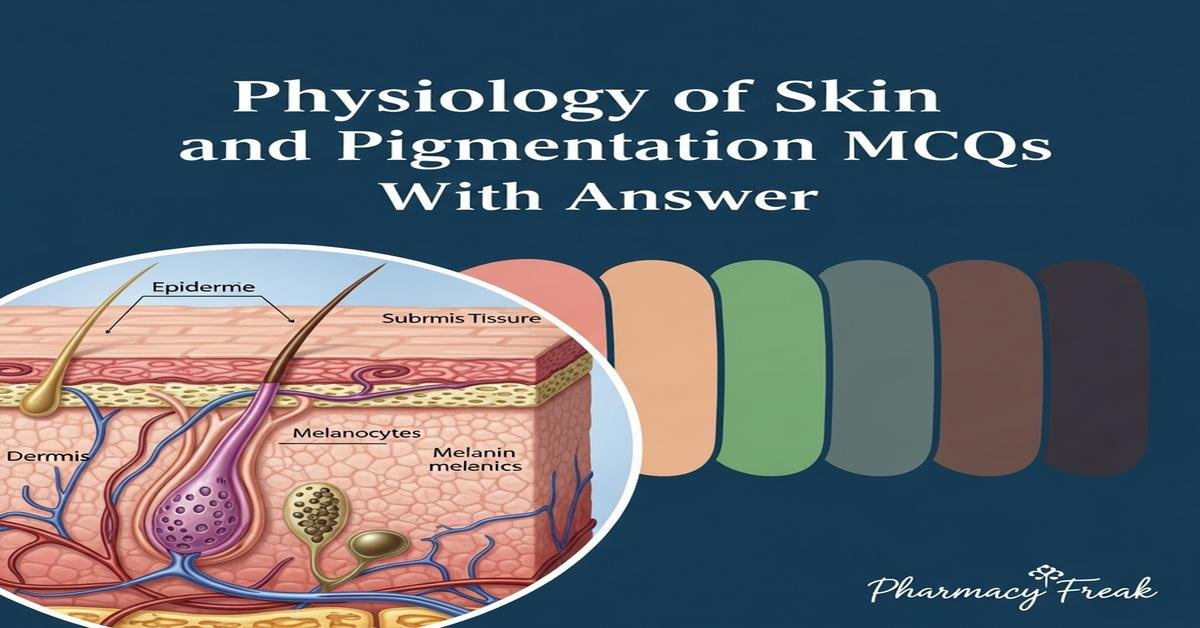
The following question set focuses on the physiology of skin and pigmentation tailored for M.Pharm students specializing in Herbal Cosmetics (MPG 204T). It covers cellular anatomy of the epidermis and dermis, mechanisms of melanogenesis, melanosome biogenesis and transfer, genetic and hormonal regulation of pigmentation, and common pigmentary disorders. Questions emphasize biochemical pathways (tyrosinase and related enzymes), signaling (MC1R, α-MSH, cAMP), photobiology (UV effects, phototypes), and cellular transport relevant to formulation of herbal depigmenting or photoprotective agents. This quiz will help reinforce mechanistic understanding necessary for rational design and evaluation of herbal cosmetic actives targeting skin pigmentation.
Q1. Which embryological origin gives rise to epidermal melanocytes responsible for pigmentation?
- Surface ectoderm
- Neural crest cells
- Mesodermal somites
- Endodermal placodes
Correct Answer: Neural crest cells
Q2. In human epidermis, approximately how many keratinocytes are served by a single melanocyte in the epidermal melanin unit?
- About 5 keratinocytes
- About 10 keratinocytes
- About 36 keratinocytes
- About 100 keratinocytes
Correct Answer: About 36 keratinocytes
Q3. Which enzyme catalyzes the rate-limiting initial steps of melanin synthesis converting L-tyrosine to L-DOPA and DOPAquinone?
- Tyrosinase
- Tyrosinase-related protein 1 (TYRP1)
- DOPA decarboxylase
- Phenylalanine hydroxylase
Correct Answer: Tyrosinase
Q4. The presence of cysteine during melanogenesis favors formation of which type of melanin?
- Eumelanin (brown-black)
- Pheomelanin (yellow-red)
- Neuromelanin
- Allomelanin
Correct Answer: Pheomelanin (yellow-red)
Q5. Which receptor on melanocytes, when activated by α-MSH, increases cAMP and promotes eumelanin synthesis?
- Melanocortin 1 receptor (MC1R)
- Beta-adrenergic receptor
- EGF receptor (EGFR)
- Endothelin B receptor (EDNRB)
Correct Answer: Melanocortin 1 receptor (MC1R)
Q6. Which melanosome stage is characterized by the presence of organized fibrillar matrix and active melanin deposition (intermediate to mature melanosome)?
- Stage I (premelanosome)
- Stage II
- Stage III
- Stage 0 (undifferentiated)
Correct Answer: Stage II
Q7. In darker phototypes, which pattern of melanosome distribution and morphology is typically observed compared to lighter phototypes?
- Smaller, aggregated melanosomes in supranuclear caps
- Larger, singly dispersed melanosomes throughout keratinocytes
- No melanosomes present
- Melanosomes restricted only to dermis
Correct Answer: Larger, singly dispersed melanosomes throughout keratinocytes
Q8. Which cellular motor protein complex is essential for peripheral transport of melanosomes along actin filaments to dendrites?
- Kinesin-1 and tau complex
- Dynein-dynactin complex
- Myosin Va–Rab27a–melanophilin complex
- Clathrin-adaptor complex
Correct Answer: Myosin Va–Rab27a–melanophilin complex
Q9. Immediate pigment darkening (IPD) occurring within minutes of UVA exposure is primarily due to which mechanism?
- De novo synthesis of eumelanin via tyrosinase upregulation
- Photo-oxidation and redistribution of existing melanin or melanosomes
- Proliferation of melanocytes
- Increased keratinocyte desquamation
Correct Answer: Photo-oxidation and redistribution of existing melanin or melanosomes
Q10. Which keratinocyte-derived paracrine factor is known to stimulate melanocyte proliferation and melanogenesis via the c-KIT receptor?
- Endothelin-1 (ET-1)
- Stem cell factor (SCF)
- Interleukin-1 (IL-1)
- Transforming growth factor-beta (TGF-β)
Correct Answer: Stem cell factor (SCF)
Q11. Vitiligo is characterized by which primary pathological change in the epidermis?
- Overproduction of melanin by hyperactive melanocytes
- Autoimmune destruction or loss of melanocytes leading to depigmented patches
- Accumulation of melanin in dermal macrophages
- Hyperkeratosis with retained melanin
Correct Answer: Autoimmune destruction or loss of melanocytes leading to depigmented patches
Q12. Albinism commonly involves mutations affecting which biochemical component of the pigmentation pathway?
- Melanosome transport proteins only
- Tyrosinase or tyrosinase-related processing enzymes leading to deficient melanin synthesis
- Increased melanosome transfer to keratinocytes
- Excessive keratinocyte proliferation
Correct Answer: Tyrosinase or tyrosinase-related processing enzymes leading to deficient melanin synthesis
Q13. Which statement best describes the photoprotective role of epidermal melanin?
- Melanin absorbs and scatters UV radiation, reducing DNA photodamage in keratinocytes
- Melanin promotes UV-induced reactive oxygen species formation
- Melanin increases UV penetration into the dermis to stimulate vitamin D synthesis
- Melanin primarily functions as an antimicrobial peptide
Correct Answer: Melanin absorbs and scatters UV radiation, reducing DNA photodamage in keratinocytes
Q14. Which condition is characterized by hyperpigmented patches often exacerbated by hormonal changes and UV exposure and is common in darker-skinned women?
- Vitiligo
- Melasma
- Albinism
- Psoriasis
Correct Answer: Melasma
Q15. Which intracellular organelle is the site of melanin synthesis and maturation before transfer to keratinocytes?
- Lysosome
- Melanosome
- Peroxisome
- Endoplasmic reticulum
Correct Answer: Melanosome
Q16. Down-regulation or loss-of-function mutations in MC1R typically shift melanin production toward which outcome?
- Increased eumelanin and darker pigmentation
- Predominant pheomelanin leading to red/yellow pigmentation and increased UV sensitivity
- Complete absence of melanin (albino phenotype)
- Unchanged melanin composition but increased melanocyte number
Correct Answer: Predominant pheomelanin leading to red/yellow pigmentation and increased UV sensitivity
Q17. Which process primarily removes melanin from the epidermis, contributing to pigment turnover?
- Endocytosis by Langerhans cells
- Desquamation of pigmented keratinocytes from the stratum corneum
- Migration of melanocytes to dermis
- Exocytosis into sweat ducts
Correct Answer: Desquamation of pigmented keratinocytes from the stratum corneum
Q18. Which factor in the skin microenvironment can increase tyrosinase activity and thereby augment melanogenesis?
- Acidosis (very low pH)
- Elevated UV-induced oxidative stress and increased α-MSH signaling
- High doses of topical retinoids only
- Reduced cAMP levels in melanocytes
Correct Answer: Elevated UV-induced oxidative stress and increased α-MSH signaling
Q19. Which of the following represents a common cellular mechanism for transfer of melanosomes from melanocyte dendrites to adjacent keratinocytes?
- Free diffusion of melanin through tight junctions
- Cytophagocytosis (keratinocyte phagocytosis of melanocyte dendritic tips) and shedding of melanosome-containing vesicles
- Active secretion of whole melanocytes into the stratum corneum
- Synthesis of melanin directly inside keratinocyte mitochondria
Correct Answer: Cytophagocytosis (keratinocyte phagocytosis of melanocyte dendritic tips) and shedding of melanosome-containing vesicles
Q20. Tyrosinase-related protein 2 (DCT/TRP-2) primarily contributes to which aspect of melanin biology?
- Transport of melanosomes along microtubules
- Conversion of dopachrome to DHICA influencing eumelanin synthesis and pigment quality
- Degradation of melanin in lysosomes
- Secretion of α-MSH from keratinocytes
Correct Answer: Conversion of dopachrome to DHICA influencing eumelanin synthesis and pigment quality

