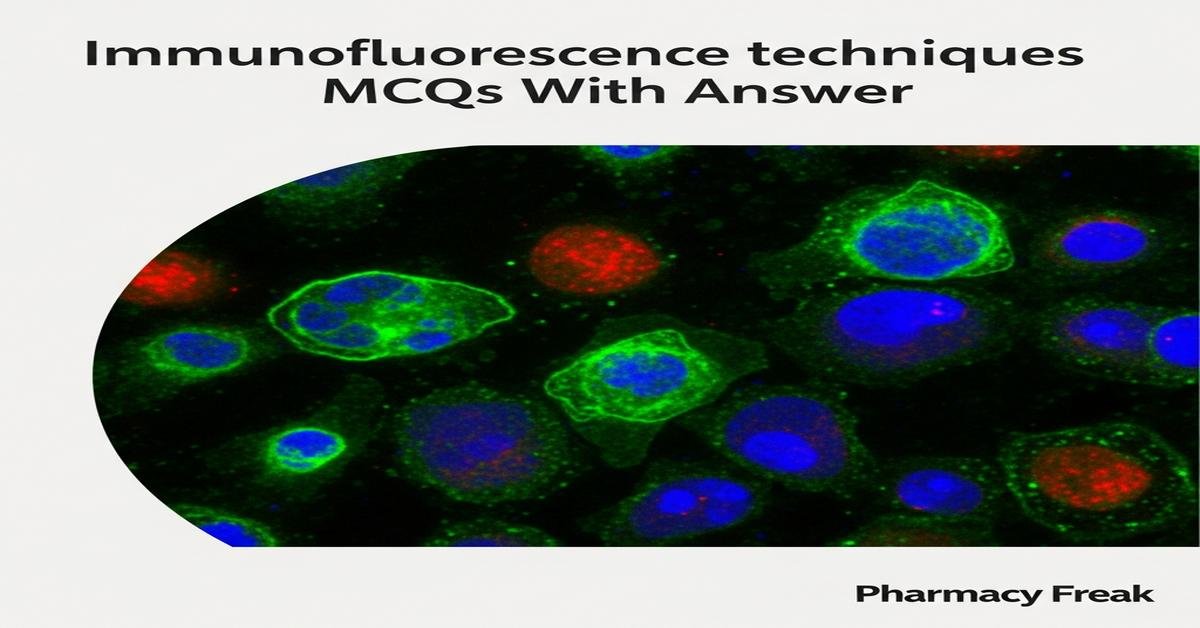
Immunofluorescence techniques MCQs With Answer is a focused quiz collection designed for M.Pharm students to strengthen practical and theoretical understanding of fluorescence-based immunodetection. This set covers core principles such as fluorophore chemistry, direct versus indirect staining, fixation and permeabilization strategies, detector technologies, and advanced topics like confocal imaging, spectral unmixing, FRET, and signal amplification. Each question emphasizes experimental design, troubleshooting, and interpretation — skills essential for research and quality control in pharmaceutical sciences. Use these MCQs for exam preparation, lab discussion, or self-assessment to build confidence in applying immunofluorescence methods to drug delivery, tissue analysis, and biomarker validation.
Q1. Which property of a fluorophore describes the difference between the peak wavelengths of absorption and emission and is critical to minimize signal overlap in multicolor immunofluorescence?
- Extinction coefficient
- Stokes shift
- Quantum yield
- Photostability
Correct Answer: Stokes shift
Q2. In an indirect immunofluorescence assay, what is the main advantage of using an indirect over a direct labeling approach?
- Lower background due to fewer antibody layers
- Faster staining time because only one antibody is used
- Signal amplification because multiple secondary antibodies bind each primary
- No need for species-specific secondary antibodies
Correct Answer: Signal amplification because multiple secondary antibodies bind each primary
Q3. Which fixation method is most suitable when preserving cell surface antigens for immunofluorescence while minimizing membrane permeabilization?
- 100% methanol at -20°C
- 4% paraformaldehyde in PBS (room temperature)
- Acetone fixation at 4°C
- 2% glutaraldehyde in PBS
Correct Answer: 4% paraformaldehyde in PBS (room temperature)
Q4. What is the primary cause of autofluorescence in paraffin-embedded tissue sections and how can it be reduced?
- Residual paraffin; reduce by heating slides to 95°C
- Crosslinked proteins and lipofuscin; reduce with chemical quenchers like Sudan Black B or sodium borohydride
- DNA staining; reduce by RNase treatment
- Endogenous enzymes; reduce by fixation with glutaraldehyde
Correct Answer: Crosslinked proteins and lipofuscin; reduce with chemical quenchers like Sudan Black B or sodium borohydride
Q5. Which detector type is preferred in confocal microscopy for highest sensitivity when imaging low-light fluorescence signals?
- Photomultiplier tube (PMT)
- Charge-coupled device (CCD)
- Electron-multiplying CCD (EMCCD)
- Complementary metal-oxide-semiconductor (CMOS)
Correct Answer: Electron-multiplying CCD (EMCCD)
Q6. What is the main principle behind spectral unmixing in multicolor fluorescence imaging?
- Using narrower pinholes to increase resolution
- Separating overlapping emission spectra computationally using reference spectra
- Physically filtering each fluorophore with distinct emission filters only
- Increasing laser power to distinguish weak signals
Correct Answer: Separating overlapping emission spectra computationally using reference spectra
Q7. Which mounting medium component is commonly used to reduce photobleaching during fluorescence microscopy?
- Glycerol only
- DAPI
- Antifade reagents such as n-propyl gallate or Vectashield
- Formalin
Correct Answer: Antifade reagents such as n-propyl gallate or Vectashield
Q8. When performing intracellular staining of cytoskeletal proteins, which permeabilization agent preserves cytoskeletal structure best while allowing antibody access?
- Triton X-100 (0.1%)
- SDS (0.1%)
- Proteinase K digestion
- EDTA chelation
Correct Answer: Triton X-100 (0.1%)
Q9. FRET (Förster Resonance Energy Transfer) is used in immunofluorescence primarily to measure which of the following?
- Absolute concentration of a protein in tissue
- Proximity (typically 1–10 nm) and interaction between two labeled molecules
- Photobleaching rate of fluorophores
- pH changes in subcellular compartments
Correct Answer: Proximity (typically 1–10 nm) and interaction between two labeled molecules
Q10. Which fluorophore property most directly influences how bright a fluorophore appears under a given excitation?
- Molecular weight
- Quantum yield and extinction coefficient
- Stokes shift only
- Photobleaching half-life only
Correct Answer: Quantum yield and extinction coefficient
Q11. What is the purpose of blocking steps (e.g., with serum or BSA) before applying primary antibodies in immunofluorescence?
- To fix antigens more firmly to the substrate
- To decrease non-specific antibody binding by saturating potential binding sites
- To permeabilize the cell membrane
- To denature target proteins for better antibody access
Correct Answer: To decrease non-specific antibody binding by saturating potential binding sites
Q12. Which imaging parameter must be satisfied according to Nyquist sampling theorem to allow accurate deconvolution and resolution recovery?
- Pixel size must be larger than the optical resolution limit
- Pixel sampling frequency must be at least twice the highest spatial frequency (Nyquist rate)
- Scan speed should be maximal to reduce photobleaching
- Pinhole size should be set to maximum for better sampling
Correct Answer: Pixel sampling frequency must be at least twice the highest spatial frequency (Nyquist rate)
Q13. Which secondary antibody conjugate would you choose for long-term storage of stained slides to minimize loss of signal after months?
- FITC-conjugated secondary
- Alexa Fluor 647-conjugated secondary with antifade mounting medium
- TRITC-conjugated secondary without antifade
- Phycoerythrin (PE) conjugate with glycerol alone
Correct Answer: Alexa Fluor 647-conjugated secondary with antifade mounting medium
Q14. In multiplex immunofluorescence on a single tissue section, which strategy increases the number of detectable targets beyond available distinct fluorophores?
- Sequential staining and fluorophore bleaching or stripping between rounds
- Using only one high-concentration primary antibody
- Reducing incubation times to avoid cross-reactivity
- Switching to enzymatic colorimetric detection only
Correct Answer: Sequential staining and fluorophore bleaching or stripping between rounds
Q15. Which of the following is a hallmark advantage of quantum dots compared to organic dyes for immunofluorescence?
- Smaller size that penetrates tissues better than dyes
- Narrow, tunable emission spectra with high photostability
- No need for excitation light
- Biodegradability in biological samples
Correct Answer: Narrow, tunable emission spectra with high photostability
Q16. When choosing filter sets for a multicolor widefield fluorescence experiment, what is a critical consideration to avoid cross-talk between channels?
- Matching filter excitation and emission bandwidths to each fluorophore’s spectra and minimizing overlap
- Selecting the brightest fluorophore only
- Using the same filter for all channels to standardize imaging
- Using filters with the broadest possible bandwidths
Correct Answer: Matching filter excitation and emission bandwidths to each fluorophore’s spectra and minimizing overlap
Q17. Which chemical treatment is used for antigen retrieval in formalin-fixed paraffin-embedded (FFPE) tissues to expose masked epitopes for antibody binding?
- Proteinase-free blocking solution
- Heat-induced epitope retrieval (HIER) in citrate or Tris-EDTA buffer
- Permeabilization with saponin only
- Direct incubation with secondary antibody
Correct Answer: Heat-induced epitope retrieval (HIER) in citrate or Tris-EDTA buffer
Q18. What is the primary reason for using confocal microscopy instead of widefield fluorescence for thick biological samples?
- Confocal microscopes are cheaper
- Confocal imaging rejects out-of-focus light using a pinhole, improving optical sectioning and contrast
- Widefield has better z-resolution inherently
- Confocal requires no fluorophores
Correct Answer: Confocal imaging rejects out-of-focus light using a pinhole, improving optical sectioning and contrast
Q19. Which approach helps quantify fluorescence intensity reliably across multiple samples to compare antigen expression?
- Using different exposure times for each sample
- Including fluorescent calibration beads or reference controls and keeping imaging settings constant
- Normalizing each image to its maximum pixel value only
- Adjusting brightness/contrast manually for best appearance
Correct Answer: Including fluorescent calibration beads or reference controls and keeping imaging settings constant
Q20. Which reagent or change would you implement to reduce photobleaching during time-lapse live-cell immunofluorescence imaging?
- Increase excitation intensity and reduce exposure time
- Use more UV illumination for higher signal
- Use long-wavelength, more photostable fluorophores, lower excitation intensity, and include antifade agents where compatible
- Remove mounting medium to allow oxygen to dissipate
Correct Answer: Use long-wavelength, more photostable fluorophores, lower excitation intensity, and include antifade agents where compatible

