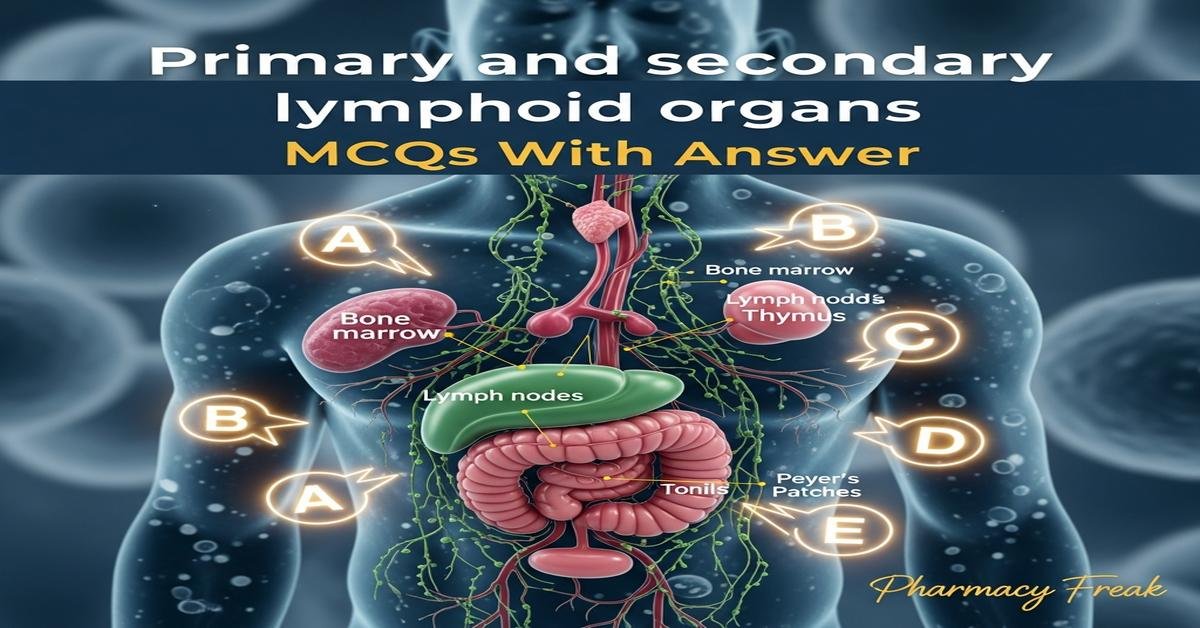
Introduction: This quiz collection on Primary and Secondary Lymphoid Organs is tailored for M.Pharm students preparing for immunotechnology and allied exams. It focuses on the anatomical compartments, cellular constituents, and functional processes that govern lymphocyte development, selection and peripheral immune responses. The questions cover essential concepts such as thymic selection, bone marrow lymphopoiesis, lymph node and spleen microanatomy, germinal center reactions, chemokine-guided homing, and clinical correlations like asplenia and DiGeorge syndrome. Each MCQ emphasizes mechanistic understanding useful for pharmacological modulation, vaccine responses and interpretation of immunological assays. Use these items to test and deepen your applied knowledge for advanced coursework and practical therapeutics.
Q1. Which pair of organs are considered the primary lymphoid organs where B and T lymphocytes mature?
- Thymus and bone marrow
- Spleen and lymph node
- Thymus and spleen
- Bone marrow and spleen
Correct Answer: Thymus and bone marrow
Q2. Which thymic cells mediate positive selection of developing T cells by presenting self-peptide–MHC complexes?
- Cortical thymic epithelial cells (cTECs)
- Medullary thymic epithelial cells (mTECs)
- Follicular dendritic cells (FDCs)
- Marginal zone macrophages
Correct Answer: Cortical thymic epithelial cells (cTECs)
Q3. Expression of tissue-restricted antigens in the thymus for central tolerance is driven primarily by which molecule?
- AIRE (autoimmune regulator)
- FOXP3
- CCR7
- BAFF
Correct Answer: AIRE (autoimmune regulator)
Q4. Where in the lymph node are naive T cells primarily localized?
- Paracortex
- Cortex (B-cell follicles)
- Medullary cords
- Subcapsular sinus
Correct Answer: Paracortex
Q5. High endothelial venules (HEVs) are specialized for lymphocyte entry from blood into which lymphoid structure?
- Lymph node
- Spleen white pulp
Correct Answer: Lymph node
Q6. Which chemokine receptor guides naive T cells and dendritic cells toward lymph node T-cell zones?
- CCR7
- CXCR5
- CCR9
- CXCR4
Correct Answer: CCR7
Q7. Germinal center dark zone is mainly characterized by which of the following processes?
- Proliferation and somatic hypermutation of centroblasts
- Selection of high-affinity B cells by FDCs and Tfh
- Isotype switching facilitated by macrophages
- Antigen capture by HEVs
Correct Answer: Proliferation and somatic hypermutation of centroblasts
Q8. Follicular dendritic cells (FDCs) in germinal centers are specialized for:
- Retaining antigen-antibody complexes on their surface for B-cell selection
- Presenting processed peptides on MHC class II to naive T cells
- Phagocytosing apoptotic thymocytes in the cortex
- Secreting IL-7 for T-cell development
Correct Answer: Retaining antigen-antibody complexes on their surface for B-cell selection
Q9. The spleen’s periarteriolar lymphoid sheath (PALS) primarily contains which lymphocyte type?
- T lymphocytes
- B lymphocytes forming follicles
- Plasma cells in red pulp
- Marginal zone macrophages
Correct Answer: T lymphocytes
Q10. Marginal zone B cells in the spleen are specialized for quick responses to:
- Blood-borne encapsulated bacteria (T-independent antigens)
- Viral peptides presented by MHC I
- Self-antigens for central tolerance
- Commensal microbiota in gut lumen
Correct Answer: Blood-borne encapsulated bacteria (T-independent antigens)
Q11. Which structure primarily prevents blood-derived antigens from entering the thymic cortex, creating a controlled antigen environment?
- Blood–thymus barrier
- High endothelial venules
- Marginal sinus of spleen
- Subcapsular sinus of lymph node
Correct Answer: Blood–thymus barrier
Q12. Positive selection in the thymus ensures thymocytes can:
- Recognize self-MHC molecules with low-to-moderate affinity
- Ignore all self-peptides entirely
- Differentiate into B cells
- Undergo isotype switching
Correct Answer: Recognize self-MHC molecules with low-to-moderate affinity
Q13. Clinical asplenia increases susceptibility principally to which groups of pathogens?
- Encapsulated bacteria such as Streptococcus pneumoniae and Neisseria meningitidis
- Intracellular parasites like Plasmodium falciparum
- Mycobacteria due to impaired granuloma formation
- Fungal opportunists like Candida albicans
Correct Answer: Encapsulated bacteria such as Streptococcus pneumoniae and Neisseria meningitidis
Q14. DiGeorge syndrome (22q11.2 deletion) primarily affects which lymphoid organ leading to T-cell deficiency?
- Thymus (thymic aplasia or hypoplasia)
- Spleen hypoplasia
- Lymph node agenesis
- Peyer’s patch hyperplasia
Correct Answer: Thymus (thymic aplasia or hypoplasia)
Q15. Isotype switching (class switching) in B cells primarily occurs in which microanatomical site?
- Germinal centers of secondary follicles
- Thymic medulla
- Red pulp of spleen
- High endothelial venules
Correct Answer: Germinal centers of secondary follicles
Q16. Which cell type in the thymus contributes to regulatory T cell (Treg) induction via production of TSLP and other mediators?
- Hassall’s corpuscle-associated medullary epithelial cells
- Cortical dendritic cells
- Splenic marginal zone B cells
- Follicular dendritic cells
Correct Answer: Hassall’s corpuscle-associated medullary epithelial cells
Q17. The primary follicle transforms into a secondary follicle upon:
- Antigen encounter and germinal center formation
- Thymic involution with age
- Migration of neutrophils into the sinusoids
- Splenic red pulp expansion
Correct Answer: Antigen encounter and germinal center formation
Q18. Which adhesion receptor on naive lymphocytes binds peripheral node addressin (PNAd) on HEVs to mediate lymph node homing?
- L-selectin (CD62L)
- VLA-4 (α4β1 integrin)
- ICAM-1
- VCAM-1
Correct Answer: L-selectin (CD62L)
Q19. Which secondary lymphoid tissue is most important for generating mucosal IgA responses in the gut?
- Peyer’s patches (gut-associated lymphoid tissue, GALT)
- Palatine tonsils
- Spleen marginal zone
- Thymic medulla
Correct Answer: Peyer’s patches (gut-associated lymphoid tissue, GALT)
Q20. The site of long-lived plasma cells that secrete high amounts of antibody is commonly found in:
- Bone marrow survival niches
- Thymic cortex
- Lymph node subcapsular sinus
- Marginal zone of spleen exclusively
Correct Answer: Bone marrow survival niches

