Introduction:
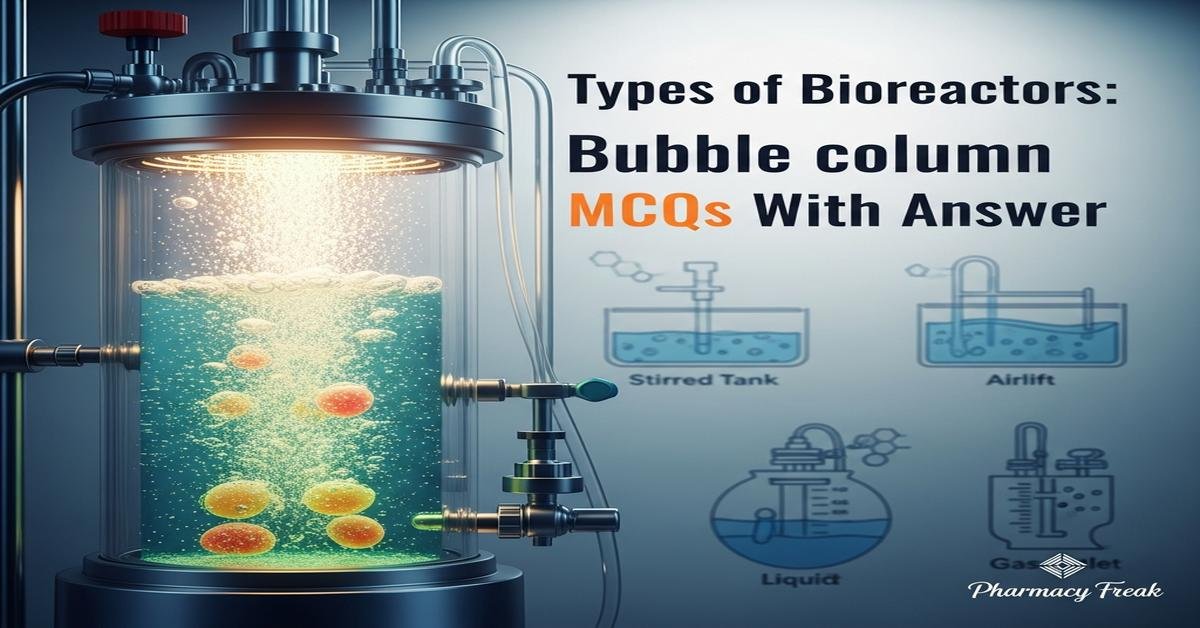
This quiz collection focuses on bubble column bioreactors, a widely used gas–liquid contactor in pharmaceutical bioprocessing for aerobic fermentation, cell culture and gas-liquid catalytic reactions. It is designed for M.Pharm students to deepen understanding of bubble column principles, hydrodynamics, mass transfer, design variations (including internal and external-loop columns), operational regimes and scale-up considerations. Questions emphasize key engineering parameters such as gas holdup, kLa, superficial gas velocity, sparger design, foaming control and advantages/limitations in handling shear-sensitive cultures. The set combines conceptual, calculation-oriented and application-based MCQs to support exam preparation and practical design insight for pharmaceutical bioprocessing.
Q1. What is the primary driving mechanism for mixing in a standard bubble column bioreactor?
- Mechanical agitation by an impeller
- Natural convection due to thermal gradients
- Buoyancy and bubble-induced turbulence
- Magnetic stirring from external coils
Correct Answer: Buoyancy and bubble-induced turbulence
Q2. Which parameter is most commonly used to quantify gas–liquid mass transfer performance in bubble columns?
- Reynolds number (Re)
- Volumetric mass transfer coefficient (kLa)
- Power number (Np)
- Specific heat capacity (Cp)
Correct Answer: Volumetric mass transfer coefficient (kLa)
Q3. In bubble columns, increasing superficial gas velocity typically leads to which immediate effect?
- Decrease in gas holdup
- Increase in gas holdup and kLa up to a point
- Complete suppression of bubble formation
- Reduction in bubble size to molecular scale
Correct Answer: Increase in gas holdup and kLa up to a point
Q4. The homogeneous regime in bubble columns is characterized by:
- Large buoyant gas slugs coalescing and forming a churn regime
- Uniform small bubbles with minimal coalescence and relatively stable flow
- High froth layer dominating the column height
- Presence of a central liquid downflow (looping)
Correct Answer: Uniform small bubbles with minimal coalescence and relatively stable flow
Q5. Which sparger design feature most directly affects initial bubble size distribution in a bubble column?
- Height of the gas outlet nozzle above liquid surface
- Number and diameter of orifices in the sparger
- Color of the sparger material
- Top headspace pressure only
Correct Answer: Number and diameter of orifices in the sparger
Q6. For aerobic bioprocesses in bubble columns, why is low shear considered advantageous?
- It prevents excessive oxygen transfer
- It reduces damage to shear-sensitive cells like mammalian or filamentous organisms
- It increases foaming dramatically
- It lowers volumetric mass transfer coefficient
Correct Answer: It reduces damage to shear-sensitive cells like mammalian or filamentous organisms
Q7. Gas holdup (εg) in a bubble column is defined as:
- The fraction of the column volume occupied by liquid
- The fraction of the column volume occupied by gas
- The ratio of gas flow rate to liquid flow rate
- The superficial gas velocity divided by pressure
Correct Answer: The fraction of the column volume occupied by gas
Q8. Which correlation variable is commonly included in empirical kLa correlations for bubble columns?
- Surface tension only
- Viscosity only
- Superficial gas velocity and liquid properties (viscosity, diffusivity, surface tension)
- Thermal conductivity only
Correct Answer: Superficial gas velocity and liquid properties (viscosity, diffusivity, surface tension)
Q9. Internal-loop and external-loop bubble columns are modified to improve what aspect of reactor performance?
- Electrical conductivity of the medium
- Axial mixing and liquid circulation for enhanced mass transfer
- Color homogeneity for optical monitoring
- Magnetic susceptibility of cells
Correct Answer: Axial mixing and liquid circulation for enhanced mass transfer
Q10. Which of the following is a major limitation of bubble column reactors for high-viscosity fermentation broths?
- Excessive mechanical shear from impellers
- Poor gas dispersion and low mass transfer due to viscous damping of bubble motion
- Too much electrical heating
- Inability to operate at atmospheric pressure
Correct Answer: Poor gas dispersion and low mass transfer due to viscous damping of bubble motion
Q11. In scale-up of bubble columns, which criterion is often used to maintain similar gas–liquid performance?
- Constant geometric similarity only
- Constant superficial gas velocity or constant kLa
- Constant number of bubbles regardless of volume
- Constant headspace height only
Correct Answer: Constant superficial gas velocity or constant kLa
Q12. Which operating change is most effective to increase kLa without changing reactor geometry?
- Decrease gas flow rate
- Add a coalescence-promoting surfactant
- Increase superficial gas velocity or introduce internals to enhance circulation
- Reduce temperature to near freezing
Correct Answer: Increase superficial gas velocity or introduce internals to enhance circulation
Q13. The term “sparging” in the context of bubble columns refers to:
- Removal of cells from the broth
- Introduction of gas into the liquid through a distributor
- Heating the column to sterilize
- Measuring the dissolved oxygen concentration
Correct Answer: Introduction of gas into the liquid through a distributor
Q14. Presence of surfactants in the broth typically affects bubble column performance by:
- Increasing bubble coalescence and decreasing holdup
- Reducing bubble coalescence, stabilizing small bubbles and often increasing holdup and kLa
- Converting the reactor into a stirred tank instantly
- Eliminating the need for oxygen supply
Correct Answer: Reducing bubble coalescence, stabilizing small bubbles and often increasing holdup and kLa
Q15. Which diagnostic measurement gives direct information about the spatial distribution of gas in a bubble column?
- Viscosity measurement at the outlet
- Local gas holdup or void fraction profile measured along the column height
- pH of the broth
- Electrical conductivity of the jacket
Correct Answer: Local gas holdup or void fraction profile measured along the column height
Q16. Churn-turbulent flow regime in a bubble column is associated with:
- Low gas flow rates and small uniform bubbles
- High gas flow rates with large bubbles, strong coalescence and chaotic flow
- Complete laminar flow of liquid with no bubbles
- Only microbubble generation with no turbulence
Correct Answer: High gas flow rates with large bubbles, strong coalescence and chaotic flow
Q17. Which of the following is an advantage of bubble column reactors compared with mechanically stirred tanks for pharmaceutical cell cultures?
- Higher shear stress from impellers
- Lower capital cost, simpler construction and gentler hydrodynamic environment
- Ability to operate at extremely high viscosities without modification
- Better solid suspension for dense particulate systems
Correct Answer: Lower capital cost, simpler construction and gentler hydrodynamic environment
Q18. Axial dispersion models used for bubble column hydrodynamics primarily help to describe:
- Heat transfer through the column wall only
- Residence time distribution and mixing along the column height
- Electrochemical gradients in the broth
- Color change of culture media over time
Correct Answer: Residence time distribution and mixing along the column height
Q19. In a bubble column used for aerobic fermentation, oxygen transfer limitation can be alleviated by:
- Decreasing the gas sparger area
- Increasing pressure, increasing superficial gas velocity, or enriching inlet gas with oxygen
- Removing all dissolved salts from the medium
- Stopping gas flow periodically
Correct Answer: Increasing pressure, increasing superficial gas velocity, or enriching inlet gas with oxygen
Q20. Which phenomenon at the gas–liquid interface can reduce effective gas transfer in bubble columns when foaming is severe?
- Enhanced bubble breakup improving transfer
- Formation of a stable foam layer that increases mass transfer resistance and traps gas
- Complete elimination of surface tension effects
- Immediate dissolution of all gas without resistance
Correct Answer: Formation of a stable foam layer that increases mass transfer resistance and traps gas

