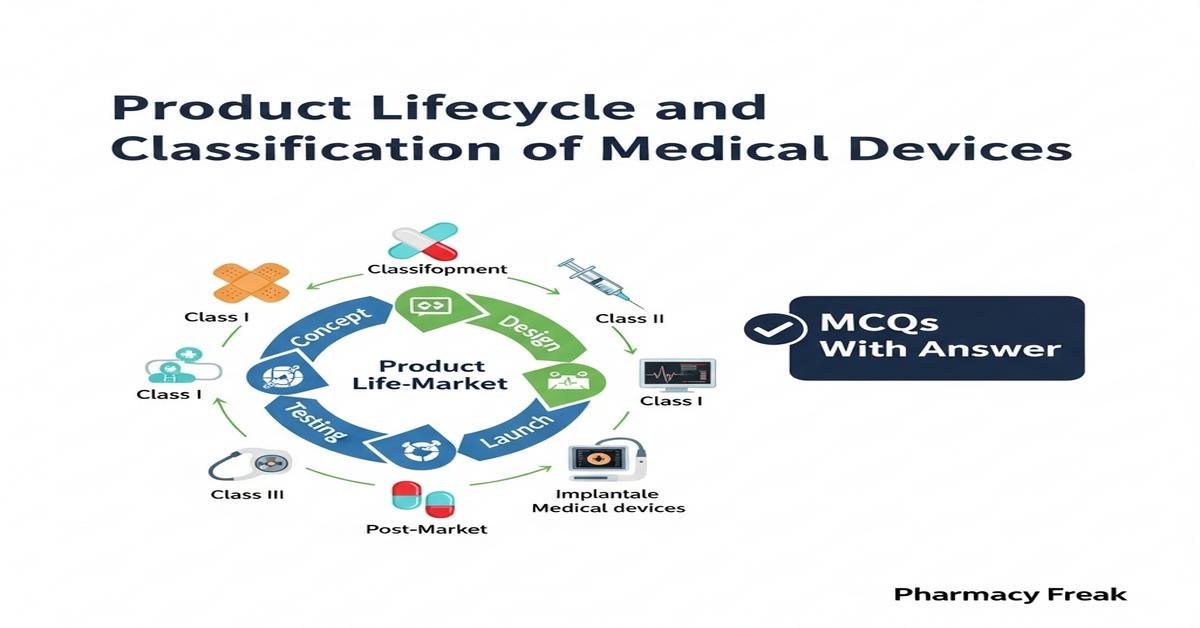
Introduction: This quiz collection on “Product lifecycle and classification of medical devices” is designed specifically for M.Pharm students studying Regulatory Aspects of Medical Devices (MRA203T). It covers detailed concepts from early-stage design and development, regulatory classification systems, risk management, quality management, premarket evidence and post-market surveillance. Each question aims to reinforce understanding of how device classification influences regulatory pathways, clinical evaluation requirements and lifecycle activities such as validation, change control and vigilance reporting. The questions are crafted to reflect practical regulatory scenarios and standards (e.g., ISO 13485, ISO 14971, MDR/FDA frameworks) to help you integrate theoretical knowledge with real-world regulatory decision-making.
Q1. Which of the following best describes the primary purpose of defining the medical device product lifecycle?
- To establish marketing strategies and sales targets
- To provide a structured framework for design, development, production, and post‑market activities
- To determine pricing and reimbursement policies
- To create promotional labeling and advertising campaigns
Correct Answer: To provide a structured framework for design, development, production, and post‑market activities
Q2. In regulatory practice, which lifecycle phase requires formal design verification and validation to ensure the device meets specified requirements?
- Concept generation
- Design and development
- Post-market surveillance
- Commercial distribution
Correct Answer: Design and development
Q3. Which international standard is most directly associated with risk management for medical devices during the product lifecycle?
- ISO 9001
- ISO 13485
- ISO 14971
- IEC 60601
Correct Answer: ISO 14971
Q4. Under the European MDR classification (risk-based), which class typically requires the most stringent conformity assessment (notified body involvement for nearly all aspects)?
- Class I
- Class IIa
- Class IIb
- Class III
Correct Answer: Class III
Q5. According to Indian Medical Device Rules (MDR 2017) classification, which risk class corresponds to devices that present the highest potential risk to patients and users?
- Class A
- Class B
- Class C
- Class D
Correct Answer: Class D
Q6. Which of the following lifecycle activities is primarily concerned with monitoring device performance and safety after it is placed on the market?
- Design verification
- Post-market surveillance and vigilance
- Initial usability testing
- Raw material procurement
Correct Answer: Post-market surveillance and vigilance
Q7. Which regulatory submission pathway in the United States is typically used to demonstrate that a device is substantially equivalent to a legally marketed predicate device?
- Pre‑market Approval (PMA)
- De Novo classification
- 510(k) premarket notification
- Emergency Use Authorization (EUA)
Correct Answer: 510(k) premarket notification
Q8. For a high‑risk implantable device, which of the following lifecycle documents is essential to justify clinical safety and performance for regulatory submission?
- Marketing plan
- Clinical evaluation report or clinical investigation data
- Advertising material
- Sales forecast
Correct Answer: Clinical evaluation report or clinical investigation data
Q9. Which quality management system standard is widely accepted by regulators for demonstrating design and manufacturing controls throughout the device lifecycle?
- ISO 14001
- ISO 13485
- Good Clinical Practice (GCP)
- ICH Q10
Correct Answer: ISO 13485
Q10. Which classification principle most strongly influences the level of regulatory scrutiny and the need for clinical evidence?
- Device cost
- Intended use and potential for harm
- Manufacturer’s country of origin
- Duration of marketing
Correct Answer: Intended use and potential for harm
Q11. Which lifecycle control focuses on systematically evaluating human factors and user interactions to reduce use‑related risks?
- Supply chain management
- Usability engineering (IEC 62366)
- Environmental monitoring
- Financial auditing
Correct Answer: Usability engineering (IEC 62366)
Q12. When a manufacturer implements a change to a device design after initial regulatory approval, which process should be used to assess impact on regulatory status and device safety?
- Routine marketing update
- Change control with risk assessment and regulatory impact assessment
- Immediate cessation of production
- Direct notification to customers only
Correct Answer: Change control with risk assessment and regulatory impact assessment
Q13. In the product lifecycle, which activity establishes and documents the validated manufacturing process for sterile medical devices?
- Design FMEA
- Process validation (including sterilization validation)
- Post-market periodic safety update
- Concept feasibility study
Correct Answer: Process validation (including sterilization validation)
Q14. Which regulatory concept requires unique device identification to improve traceability across the lifecycle?
- Label beautification
- Unique Device Identification (UDI)
- Marketing authorization
- Patent registration
Correct Answer: Unique Device Identification (UDI)
Q15. Under the EU classification rules, a non‑invasive device intended to provide information for diagnosis with high risk to patient management is likely to be classified as:
- Class I
- Class IIa
- Class IIb or III depending on specific rule and risk
- Unclassified
Correct Answer: Class IIb or III depending on specific rule and risk
Q16. Which lifecycle document provides a consolidated analysis of scientific literature, clinical data and post‑market experience to justify device safety and performance?
- Device master file
- Clinical evaluation report (CER)
- Quality manual
- Sales brochure
Correct Answer: Clinical evaluation report (CER)
Q17. Which post‑market regulatory obligation requires manufacturers to report serious incidents and field safety corrective actions to competent authorities?
- Pre‑market notification
- Vigilance reporting and mandatory incident reporting
- Advertising clearance
- Patent disclosure
Correct Answer: Vigilance reporting and mandatory incident reporting
Q18. De Novo classification in the US is most appropriate for which type of device?
- A device identical to a marketed predicate
- A novel, low‑to‑moderate risk device without a predicate that requires a new classification
- An emergency use device
- A high‑risk implant requiring PMA
Correct Answer: A novel, low‑to‑moderate risk device without a predicate that requires a new classification
Q19. Which lifecycle practice ensures continuous improvement based on performance data, complaints and nonconformities?
- Reactive marketing
- Corrective and preventive actions (CAPA)
- Design freeze
- Single batch production
Correct Answer: Corrective and preventive actions (CAPA)
Q20. When determining the classification of a device, which two factors are most critical?
- Manufacturer’s profit margin and market demand
- Intended purpose of the device and the inherent risk to patient/user
- Packaging design and distributor location
- Color of the device and advertising claims
Correct Answer: Intended purpose of the device and the inherent risk to patient/user

