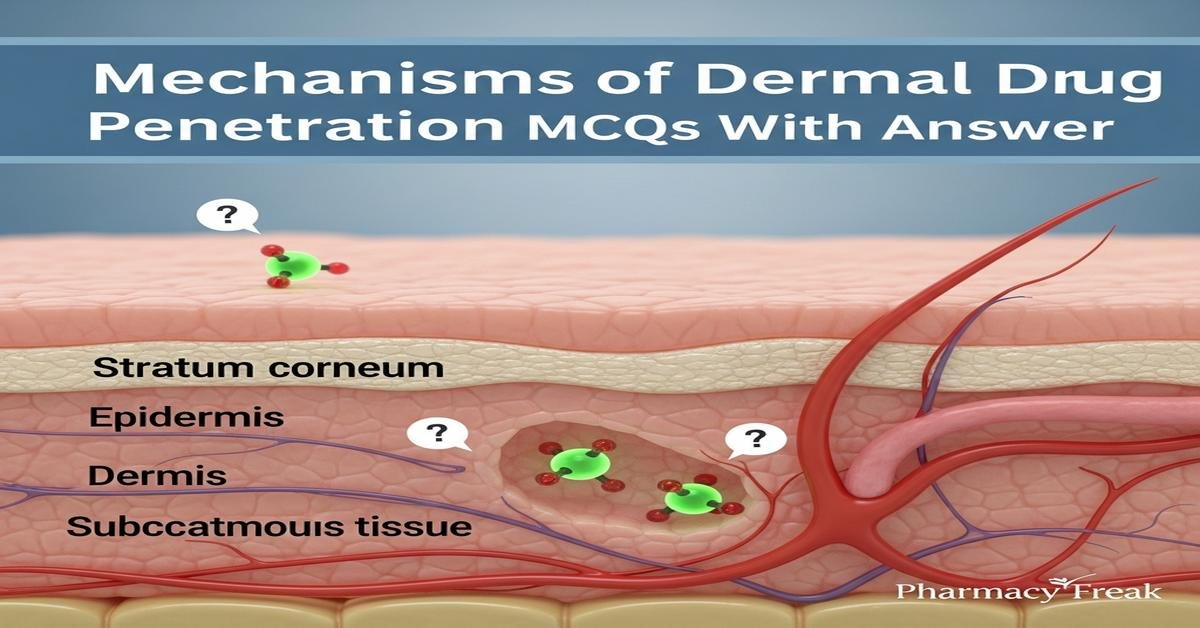
Mechanisms of dermal drug penetration MCQs With Answer
The mechanisms of dermal drug penetration describe how drugs cross the skin barrier — mainly the stratum corneum — via transcellular, intercellular and appendageal routes. Understanding factors such as lipophilicity, molecular size, partition coefficient (K), diffusion coefficient (D), Fick’s law, lag time and skin metabolism is essential for formulation design and transdermal delivery. Practical topics include permeation enhancers, vehicle effects, occlusion, tape-stripping, in vitro methods (Franz diffusion cells), and advanced techniques like microneedles and iontophoresis. This concise, keyword-rich overview prepares B. Pharm students for applied problems in dermal pharmacokinetics and formulation. Now let’s test your knowledge with 30 MCQs on this topic.
Q1. Which pathway primarily involves drug movement between corneocytes through lipid domains of the stratum corneum?
- Transcellular route through keratinocytes
- Intercellular route through lipid matrix
- Appendageal route via hair follicles
- Transappendageal route via sweat ducts
Correct Answer: Intercellular route through lipid matrix
Q2. Fick’s first law of diffusion for steady-state flux through a membrane is best represented by which expression (assuming constant donor concentration and sink conditions)?
- J = -D (dC/dx)
- J = (D × K × C0) / h
- tL = h^2 / (6D)
- K = Cmembrane / Cvehicle
Correct Answer: J = (D × K × C0) / h
Q3. Which parameter describes the drug’s preference for partitioning into the stratum corneum relative to the vehicle?
- Diffusion coefficient (D)
- Partition coefficient (K)
- Lag time (tL)
- Permeation enhancer potency
Correct Answer: Partition coefficient (K)
Q4. The lag time (tL) during dermal permeation is most directly related to which property?
- Steady-state flux (Jss)
- Vehicle viscosity
- Diffusion coefficient (D) and membrane thickness (h)
- Permeation enhancer concentration
Correct Answer: Diffusion coefficient (D) and membrane thickness (h)
Q5. Which statement about molecular weight and skin penetration is correct?
- Compounds >500 Da generally penetrate the intact stratum corneum poorly
- Molecular weight has no effect if compound is highly lipophilic
- Only molecules <50 Da can penetrate skin
- Higher molecular weight always increases flux
Correct Answer: Compounds >500 Da generally penetrate the intact stratum corneum poorly
Q6. Which technique is commonly used in vitro to measure percutaneous absorption and steady-state flux?
- Tape-stripping
- Franz diffusion cell
- Mass spectrometry imaging
- Skin biopsy histology
Correct Answer: Franz diffusion cell
Q7. A highly lipophilic drug (very high log P) is likely to show which behavior in dermal delivery?
- No partition into stratum corneum lipids
- Excellent systemic absorption regardless of vehicle
- Good partitioning into stratum corneum but possible poor release into aqueous receptor (forming a reservoir)
- Immediate ionization in the skin leading to rapid flux
Correct Answer: Good partitioning into stratum corneum but possible poor release into aqueous receptor (forming a reservoir)
Q8. Which of the following is an appendageal route enhancer of dermal penetration?
- Occlusion increasing skin hydration
- Use of microneedles to bypass stratum corneum
- Applying oil-based emollients
- Lowering formulation pH
Correct Answer: Use of microneedles to bypass stratum corneum
Q9. Tape-stripping of the stratum corneum is used experimentally to:
- Increase transepidermal water loss measurements only
- Remove SC layers to study depth-dependent drug distribution and barrier function
- Measure hair follicle density
- Create a transdermal patch adhesive
Correct Answer: Remove SC layers to study depth-dependent drug distribution and barrier function
Q10. Which class of chemical permeation enhancers works primarily by disrupting lipid packing in the stratum corneum?
- Humectants (e.g., glycerin)
- Surfactants and short-chain alcohols
- Enzyme inhibitors
- Buffers that change pH
Correct Answer: Surfactants and short-chain alcohols
Q11. Iontophoresis enhances dermal delivery primarily by which mechanism?
- Generating ultrasound cavitation to open lipid domains
- Applying a mild electric current to drive charged molecules across the skin
- Heating skin to increase diffusion coefficient only
- Using microneedles to create microchannels
Correct Answer: Applying a mild electric current to drive charged molecules across the skin
Q12. Which factor would most likely increase steady-state flux (Jss) of a drug through the skin?
- Increasing membrane thickness (h)
- Decreasing diffusion coefficient (D)
- Increasing donor concentration (C0) while maintaining sink conditions
- Reducing partition coefficient (K)
Correct Answer: Increasing donor concentration (C0) while maintaining sink conditions
Q13. The term “reservoir effect” in skin pharmacokinetics refers to:
- Drug remaining in the vehicle without entering skin
- Drug trapped within the stratum corneum or viable epidermis that releases slowly over time
- Drugs accumulating in subcutaneous fat exclusively
- Drug binding irreversibly to keratin
Correct Answer: Drug trapped within the stratum corneum or viable epidermis that releases slowly over time
Q14. Which of the following vehicles would generally enhance hydration of stratum corneum and thereby increase permeability?
- Anhydrous silicone oil
- Occlusive ointment base
- Volatile solvent that rapidly evaporates
- Dry powder formulation
Correct Answer: Occlusive ointment base
Q15. What is the most important barrier layer of the skin for percutaneous absorption?
- Dermis
- Viable epidermis
- Stratum corneum
- Subcutaneous fat
Correct Answer: Stratum corneum
Q16. Which physical enhancement technique uses focused ultrasound to increase skin permeability?
- Iontophoresis
- Sonophoresis
- Electroporation
- Dermabrasion
Correct Answer: Sonophoresis
Q17. A prodrug designed for dermal delivery is primarily intended to:
- Be inactive in skin and activated systemically only
- Improve skin permeability and then be converted to the active drug in skin or systemic circulation
- Prevent any absorption and act only topically without effect
- Increase molecular weight to reduce penetration
Correct Answer: Improve skin permeability and then be converted to the active drug in skin or systemic circulation
Q18. Which of the following best describes the transcellular route across the stratum corneum?
- Drug travels entirely through follicular openings
- Drug passes through corneocytes and multiple lipid bilayers, requiring repeated partitioning and diffusion steps
- Drug diffuses exclusively within the lipid matrix without entering corneocytes
- Drug is actively transported by skin enzymes
Correct Answer: Drug passes through corneocytes and multiple lipid bilayers, requiring repeated partitioning and diffusion steps
Q19. Which of these is a commonly used small-molecule chemical permeation enhancer?
- Terpenes (e.g., menthol)
- Insulin peptides
- Large polysaccharides
- Neutral liposomes only
Correct Answer: Terpenes (e.g., menthol)
Q20. Which skin property most directly affects ionization state of weak acids and bases and thereby their partitioning into the stratum corneum?
- Stratum corneum lipid content
- Skin surface pH
- Melanin concentration
- Hair follicle density
Correct Answer: Skin surface pH
Q21. Electroporation enhances transdermal transport by:
- Physical abrasion of stratum corneum
- Creating transient aqueous pores in lipid bilayers using short high-voltage pulses
- Increasing temperature only
- Replacing lipids with solvents
Correct Answer: Creating transient aqueous pores in lipid bilayers using short high-voltage pulses
Q22. Which measurement indicates the agreement with sink conditions during an in vitro skin permeation experiment?
- Constantly rising receptor concentration without sampling
- Receptor concentration maintained significantly lower than donor concentration by frequent sampling or large receptor volume
- Equal concentrations in donor and receptor compartments
- No sampling during experiment
Correct Answer: Receptor concentration maintained significantly lower than donor concentration by frequent sampling or large receptor volume
Q23. Which factor is least likely to enhance transdermal drug delivery?
- Using a permeation enhancer that fluidizes SC lipids
- Applying occlusion to increase hydration
- Increasing molecular size intentionally
- Employing microneedles to create microchannels
Correct Answer: Increasing molecular size intentionally
Q24. The viable epidermis differs from the stratum corneum in that it:
- Is composed of dead, flattened corneocytes
- Contains living keratinocytes and is more aqueous, affecting diffusion characteristics
- Has richer lipid matrix than SC
- Is the primary location for drug binding to keratin
Correct Answer: Contains living keratinocytes and is more aqueous, affecting diffusion characteristics
Q25. In the context of dermal absorption, log P (octanol-water partition coefficient) is used to predict:
- Chemical stability in formulation only
- Lipophilicity and likelihood of partitioning into stratum corneum lipids versus aqueous layers
- Exact permeation rate without diffusion data
- The drug’s ability to ionize in skin
Correct Answer: Lipophilicity and likelihood of partitioning into stratum corneum lipids versus aqueous layers
Q26. Which formulation approach can improve delivery of a hydrophilic drug through the skin?
- Use of lipophilic oil without enhancer
- Incorporation into hydrophilic vehicle with iontophoresis
- Increasing drug crystallinity in formulation
- Using high molecular weight polymers to increase viscosity
Correct Answer: Incorporation into hydrophilic vehicle with iontophoresis
Q27. Which experimental method can quantify drug retained specifically within stratum corneum layers after application?
- Franz cell receptor sampling only
- Sequential tape-stripping followed by extraction and analysis
- Macroscopic visual inspection
- Standard HPLC of whole-skin homogenate without separation
Correct Answer: Sequential tape-stripping followed by extraction and analysis
Q28. Which device or method primarily creates microscopic channels to enhance drug transport across the skin?
- Sonophoresis
- Microneedles
- Topical lip balm
- Occlusive dressing alone
Correct Answer: Microneedles
Q29. Skin metabolism can influence topical drug action by:
- Having no enzymatic activity relevant to xenobiotics
- Metabolizing drugs into inactive or active metabolites within viable epidermis and dermis
- Only storing drugs without chemical change
- Preventing any systemic absorption through active transporters
Correct Answer: Metabolizing drugs into inactive or active metabolites within viable epidermis and dermis
Q30. Which statement correctly links vehicle choice to dermal drug penetration?
- Vehicle composition does not affect partition coefficient K
- Hydrophilic vehicles always maximize penetration of lipophilic drugs
- Vehicle can modulate drug thermodynamic activity and partitioning into skin, thereby altering flux
- Thicker vehicles always reduce drug flux regardless of composition
Correct Answer: Vehicle can modulate drug thermodynamic activity and partitioning into skin, thereby altering flux


