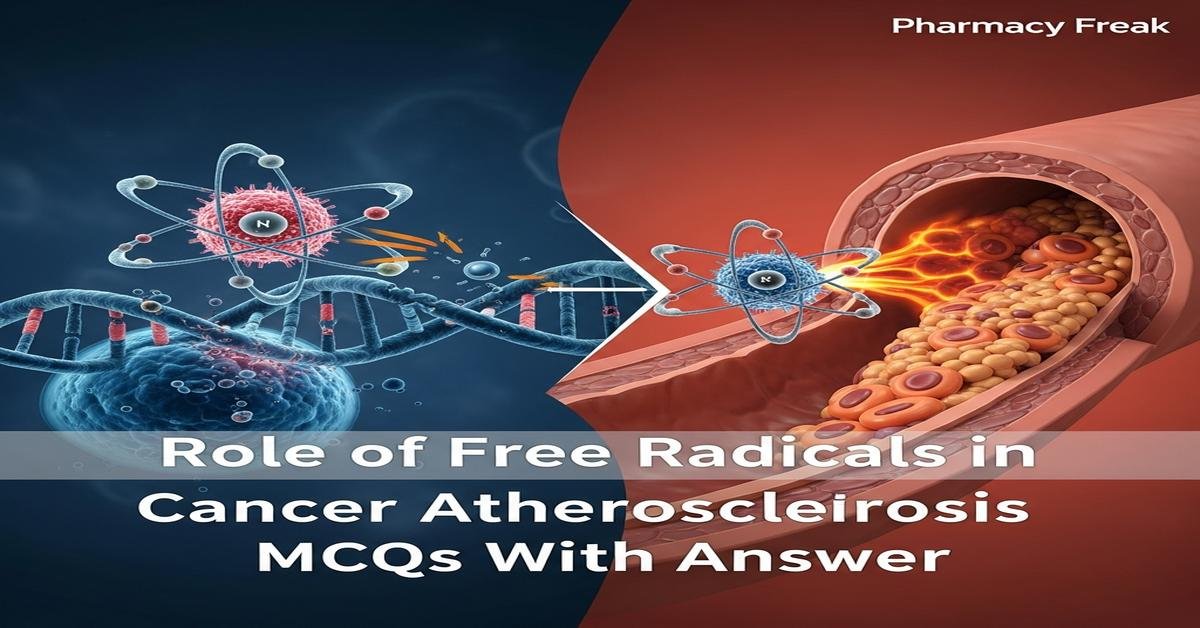
Free radicals and reactive oxygen species (ROS) play central roles in the pathogenesis of cancer and atherosclerosis. Oxidative stress from excess ROS/RNS causes DNA damage, lipid peroxidation, protein oxidation, endothelial dysfunction, and chronic inflammation, driving carcinogenesis and plaque formation. Key concepts for B. Pharm students include sources of ROS (mitochondria, NADPH oxidase, xanthine oxidase), biomarkers (MDA, 8-oxo-dG), antioxidant defenses (SOD, catalase, glutathione), and pharmacological modulators (NAC, SOD mimetics, NADPH oxidase inhibitors). Understanding these mechanisms links pathophysiology to therapeutic strategies and drug design. Now let’s test your knowledge with 30 MCQs on this topic.
Q1. Which species is the primary free radical produced by the mitochondrial electron transport chain?
- Superoxide radical (O2•−)
- Hydrogen peroxide (H2O2)
- Hydroxyl radical (•OH)
- Nitric oxide (NO•)
Correct Answer: Superoxide radical (O2•−)
Q2. The most reactive oxygen species that causes immediate and irreversible macromolecular damage via the Fenton reaction is:
- Hydrogen peroxide (H2O2)
- Superoxide radical (O2•−)
- Hydroxyl radical (•OH)
- Singlet oxygen (1O2)
Correct Answer: Hydroxyl radical (•OH)
Q3. Which enzyme complex is a major regulated source of superoxide in phagocytes and vascular cells contributing to atherosclerosis?
- Nitric oxide synthase (NOS)
- NADPH oxidase (NOX)
- Xanthine oxidase
- Mitochondrial complex I
Correct Answer: NADPH oxidase (NOX)
Q4. Superoxide dismutase (SOD) catalyzes which reaction?
- Conversion of hydrogen peroxide to water and oxygen
- Reduction of lipid hydroperoxides to alcohols
- Dismutation of superoxide to hydrogen peroxide
- Regeneration of reduced glutathione from GSSG
Correct Answer: Dismutation of superoxide to hydrogen peroxide
Q5. The enzyme that directly decomposes hydrogen peroxide into water and oxygen is:
- Glutathione peroxidase
- Catalase
- Superoxide dismutase
- Peroxiredoxin
Correct Answer: Catalase
Q6. Which biomarker is commonly measured as an index of lipid peroxidation in oxidative stress studies?
- 8-oxo-deoxyguanosine (8-oxo-dG)
- Malondialdehyde (MDA)
- C-reactive protein (CRP)
- Total antioxidant capacity (TAC)
Correct Answer: Malondialdehyde (MDA)
Q7. Oxidized LDL contributes to atherosclerotic plaque formation primarily by:
- Directly causing thrombus formation without inflammation
- Being taken up by macrophage scavenger receptors to form foam cells
- Enhancing HDL-mediated cholesterol efflux
- Activating endothelial nitric oxide synthase to increase NO production
Correct Answer: Being taken up by macrophage scavenger receptors to form foam cells
Q8. In carcinogenesis, one major consequence of ROS-induced DNA damage is:
- Stabilization of telomeres preventing senescence
- DNA mutations and genomic instability promoting tumor initiation
- Immediate necrosis of transformed cells preventing tumor growth
- Specific repair of oncogenes only
Correct Answer: DNA mutations and genomic instability promoting tumor initiation
Q9. Which of the following is a widely used biomarker of oxidative DNA damage?
- Malondialdehyde (MDA)
- 8-oxo-deoxyguanosine (8-oxo-dG)
- F2-isoprostanes
- Protein carbonyls
Correct Answer: 8-oxo-deoxyguanosine (8-oxo-dG)
Q10. Which antioxidant vitamin can regenerate the tocopheroxyl radical of vitamin E, restoring its activity?
- Vitamin A
- Vitamin C (ascorbic acid)
- Vitamin D
- Vitamin K
Correct Answer: Vitamin C (ascorbic acid)
Q11. The tripeptide that serves as a major intracellular redox buffer and is required for glutathione peroxidase activity is:
- Cysteine
- Glutathione (GSH)
- Thioredoxin
- Coenzyme Q
Correct Answer: Glutathione (GSH)
Q12. A pharmacological SOD mimetic would be expected to:
- Convert hydrogen peroxide to water and oxygen
- Scavenge hydroxyl radicals selectively
- Convert superoxide to hydrogen peroxide
- Directly reduce oxidized DNA bases
Correct Answer: Convert superoxide to hydrogen peroxide
Q13. Endothelial dysfunction in early atherosclerosis is chiefly associated with which ROS-related mechanism?
- Upregulation of HDL synthesis by hepatocytes
- Excess ROS decreasing nitric oxide bioavailability
- Increased catalase activity enhancing vasodilation
- Activation of plasminogen to plasmin
Correct Answer: Excess ROS decreasing nitric oxide bioavailability
Q14. Chronic inflammation links ROS generation to plaque progression primarily through:
- Suppression of macrophage recruitment to lesions
- Activation of proteases and cytokines that destabilize plaques
- Direct repair of oxidized LDL
- Decrease in smooth muscle cell proliferation
Correct Answer: Activation of proteases and cytokines that destabilize plaques
Q15. Which stress-inducible enzyme is upregulated by oxidative stress and has cytoprotective, anti-inflammatory effects relevant to cardiovascular disease?
- Heme oxygenase-1 (HO-1)
- Xanthine oxidase
- Alcohol dehydrogenase
- Acetylcholinesterase
Correct Answer: Heme oxygenase-1 (HO-1)
Q16. ROS-mediated activation of NF-κB in cells primarily leads to:
- Suppression of pro-inflammatory gene expression
- Induction of antioxidant enzyme gene silencing
- Upregulation of inflammatory cytokines and adhesion molecules
- Direct inhibition of DNA replication
Correct Answer: Upregulation of inflammatory cytokines and adhesion molecules
Q17. Which DNA repair pathway is most important for removing oxidized bases like 8-oxo-dG?
- Nucleotide excision repair (NER)
- Base excision repair (BER)
- Mismatch repair (MMR)
- Homologous recombination (HR)
Correct Answer: Base excision repair (BER)
Q18. The TBARS assay is commonly used to estimate which oxidative stress marker?
- Protein carbonyl content
- 8-oxo-dG levels
- Malondialdehyde (MDA) as a measure of lipid peroxidation
- Total glutathione concentration
Correct Answer: Malondialdehyde (MDA) as a measure of lipid peroxidation
Q19. Which pharmacological agent is a precursor for intracellular glutathione synthesis and is used to replenish GSH levels?
- Ascorbic acid
- N-acetylcysteine (NAC)
- Alpha-tocopherol
- Selenium
Correct Answer: N-acetylcysteine (NAC)
Q20. Mitochondrial dysfunction contributes to ROS production mainly because of:
- Excessive catalase activity in the matrix
- Leakage of electrons from the electron transport chain forming superoxide
- Increased mitochondrial DNA repair efficiency
- Overproduction of nitric oxide inside mitochondria
Correct Answer: Leakage of electrons from the electron transport chain forming superoxide
Q21. Which anticancer agent is known to generate ROS as part of its cytotoxic mechanism?
- Doxorubicin
- Methotrexate
- Cisplatin (no ROS generation)
- Imatinib
Correct Answer: Doxorubicin
Q22. Scavenger receptors on macrophages that mediate uptake of oxidized LDL include:
- LDL receptor (LDLR)
- CD36 and SR-A (scavenger receptor A)
- HDL receptor (SR-BI)
- Insulin receptor
Correct Answer: CD36 and SR-A (scavenger receptor A)
Q23. A promising pharmacological approach to reduce vascular ROS generation is inhibition of:
- Matrix metalloproteinases (MMPs)
- NADPH oxidase (NOX) enzymes
- Acetylcholinesterase
- Prolyl hydroxylase
Correct Answer: NADPH oxidase (NOX) enzymes
Q24. Oxidative modification of proteins commonly results in the formation of which stable marker?
- S-nitrosothiols
- Protein carbonyls
- Peptidyl methionine sulfoxide exclusively
- Ubiquitinylation without degradation
Correct Answer: Protein carbonyls
Q25. Glutathione peroxidase reduces hydrogen peroxide using which cofactor/substrate?
- Glutathione (GSH)
- Vitamin C
- NADPH directly
- Iron-sulfur clusters
Correct Answer: Glutathione (GSH)
Q26. During lipid peroxidation, the chain-propagating radical species is the:
- Lipid alkoxyl radical (LO•)
- Lipid peroxyl radical (LOO•)
- Hydroxyl radical (•OH)
- Superoxide radical (O2•−)
Correct Answer: Lipid peroxyl radical (LOO•)
Q27. Excessive ROS can trigger the intrinsic apoptotic pathway by promoting release of:
- Growth hormone from mitochondria
- Cytochrome c from mitochondria
- Endothelin from endothelial cells
- ATP from lysosomes
Correct Answer: Cytochrome c from mitochondria
Q28. In the context of chemotherapy and antioxidants, which statement is most accurate?
- Antioxidant supplements always improve chemotherapy efficacy
- Antioxidants have no effect on ROS-generating chemotherapies
- Antioxidants can protect normal tissues but may reduce efficacy of ROS-dependent drugs
- Antioxidants convert all chemotherapeutics into prodrugs
Correct Answer: Antioxidants can protect normal tissues but may reduce efficacy of ROS-dependent drugs
Q29. Peroxynitrite (ONOO−), a reactive nitrogen species implicated in oxidative damage, is formed by the reaction of:
- Nitric oxide (NO•) with hydrogen peroxide (H2O2)
- Nitrite (NO2−) with superoxide dismutase
- Nitric oxide (NO•) with superoxide (O2•−)
- Ammonia with hydroxyl radical
Correct Answer: Nitric oxide (NO•) with superoxide (O2•−)
Q30. Which of the following is an example of a mitochondria-targeted antioxidant designed to reduce mitochondrial ROS?
- Vitamin K
- MitoQ (mitochondria-targeted ubiquinone)
- Acetylsalicylic acid
- Atorvastatin (only lipid-lowering)
Correct Answer: MitoQ (mitochondria-targeted ubiquinone)


