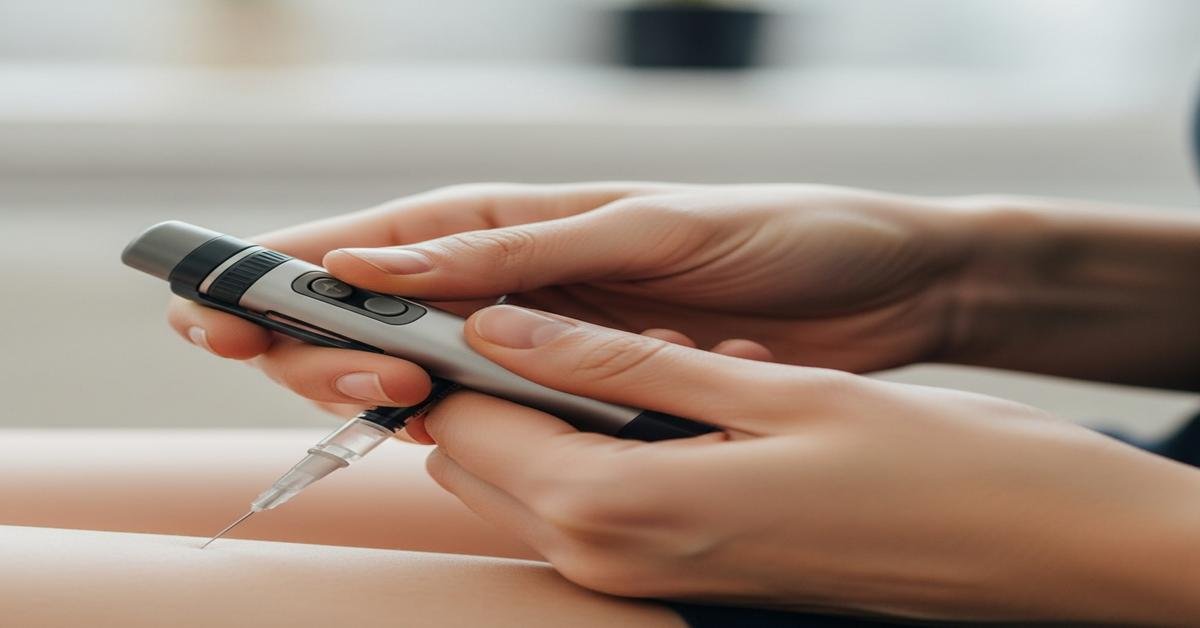
Insulin works only as well as it’s delivered. Even a perfect dose on paper can fail if the pen is used the wrong way. Small technique errors cause big swings in blood glucose, bruising, pain, and lipohypertrophy (fatty lumps). This guide explains the most common mistakes and shows a simple, reliable way to counsel patients so every dose gets where it needs to go: the subcutaneous fat, not the clothing, not the muscle, and not back out onto the skin.
The mistake 90% make: skipping priming and rushing the withdrawal
The two errors I see most often are:
- No priming “air shot.” Patients dial the dose and inject without first pushing out air. Why it matters: pens trap small air bubbles and tiny gaps form between the cartridge and needle. If you don’t prime until you see a steady drop at the needle tip, part of the dose is air, not insulin. The result is an under-dose and higher glucose, especially for small mealtime doses.
- Pulling the needle out too soon. Patients release the button and pull out immediately. Why it matters: insulin is a liquid. It needs a few seconds to leave the pen, expand in the tissue, and stop back-flow along the needle track. Leaving the needle in place for about 10 seconds keeps the full dose under the skin and reduces leakage.
These two fixes alone often stabilize glucose and reduce day-to-day variability.
Why injection technique matters
- Absorption speed depends on site and depth. Abdomen is generally fastest, arm and thigh are slower. Insulin in muscle acts faster and can cause hypos; in fat, it is steadier.
- Dose accuracy depends on priming and needle time under the skin. Skipping either can waste 10–30% of a dose, especially with small doses.
- Skin health affects insulin action. Repeated shots in the same spot cause lumps. Lumpy tissue absorbs unpredictably, making control erratic.
The correct way to use an insulin pen (step by step with the “why”)
- Wash or sanitize hands. Reduces infection risk and keeps the pen clean.
- Inspect the pen. Confirm the right insulin, not expired, clear if it should be clear, and no cracks. Wrong insulin or spoiled insulin equals wrong action.
- Resuspend cloudy insulin (NPH or premix) gently. Roll or tip the pen end-to-end 20 times until uniformly cloudy. Why: crystals settle; uneven mixing gives variable doses.
- Attach a new needle. Screw straight on, not at an angle. A bent hub leaks.
- Prime every time. Dial 2 units, hold the pen with the needle up, tap to move bubbles, and press until you see a steady drop at the tip. If no drop, repeat 2 units until you see one. This clears air and fills the needle with insulin.
- Dial the exact dose. Check the window. Avoid “topping up” after insertion; it encourages button slip.
- Pick the site. Abdomen for meals is reliable; thigh or buttock for background insulin is common. Avoid lumps, bruises, scars, and moles.
- Prepare the skin. If skin is clean, no alcohol is required. If you use alcohol, let it dry fully to reduce sting.
- Angle and grip. With a 4–6 mm needle, inject at 90 degrees without a skinfold for most adults. If thin or using longer needles, lift a gentle skinfold (thumb and forefinger) and inject at 90 degrees into the fold. This keeps the insulin in fat and out of muscle.
- Insert, then push the button smoothly. Inject at a steady pace. Fast ramming hurts and can cause more leakage.
- Count to 10 before removing. Keep the button fully depressed. This reduces back-flow.
- Withdraw straight out. Do not rub the site. Press gently with a clean finger or tissue if needed.
- Remove and discard the needle safely. Replace the pen cap. Leaving the needle on draws air into the cartridge and causes leaks.
- Store properly. In-use pens at room temperature, away from heat and sun. Unopened pens in the refrigerator, never frozen.
Needle length, angle, and the skinfold
- Best default: 4 mm pen needle. It reliably reaches subcutaneous fat in most people without needing a skinfold.
- If using 5–6 mm: Still usually 90 degrees without a fold for many adults. Consider a gentle fold if lean.
- If using 8 mm or longer: Use a skinfold and consider a 45-degree angle to avoid muscle, especially in thin adults or children.
- When to use a skinfold: If the patient is lean, if the needle is ≥6 mm, or if injections into muscle have been suspected (unpredictable hypos, pain, bleeding).
Site selection and rotation that actually works
Rotation prevents lipohypertrophy and keeps absorption predictable.
- Divide each area into zones. For the abdomen, imagine a rectangle avoiding a 2-finger-width circle around the navel. For the thigh, use the outer front. For the buttock, use the upper outer quadrant.
- Move at least one finger-width from the last spot. Think of a grid. Work left-to-right, top-to-bottom, then switch sides.
- Match insulin type to site. Use abdomen for rapid-acting meals; use thigh or buttock for basal for smoother action.
- Never inject into lumps, scars, or bruises. Lumpy tissue gives delayed and erratic absorption.
Mixing matters: clear versus cloudy
- Clear insulins (rapid, short, most long-acting analogs) should be water-clear. If cloudy or flaky, do not use.
- Cloudy insulins (NPH, premix) must be gently resuspended each dose. Without this, one dose may be too weak and the next too strong.
Never reuse pen needles
- Why not: Needles dull after one use, increasing pain and tissue trauma. The silicone coat wears off, the tip bends like a fishhook, and the bore can clog with insulin crystals. Reuse increases lipohypertrophy and infection risk and can cause under-dosing from blockages.
- What to do: One needle per injection. Dispose in a puncture-resistant container. Do not leave needles on the pen between doses.
Troubleshooting common problems
- High sugars despite “correct” doses: Check priming, needle-on time, site rotation, and pen storage. Try injecting in a new, normal-feeling area. Inspect the pen for cracks or leaks.
- Stinging or pain: Let alcohol dry, use room-temperature insulin, inject slower, switch to a 4 mm needle, and avoid scar tissue. Consider a different site.
- Leakage at the site: Keep the needle in for at least 10 seconds. Avoid injecting into very shallow skin. Do not massage after injection.
- Lumps under the skin: Stop using that area for several months. Educate on rotation. Expect glucose to drop when moving from a lumpy site to a healthy site; reduce dose if needed under guidance.
- Hypoglycemia after exercise: Avoid injecting rapid-acting insulin into the limb you will exercise. For example, if you plan a run, inject the abdomen rather than the thigh.
- Pen won’t deliver full dose: Needle may be clogged, the priming was skipped, or the cartridge is empty. Replace the needle, reprime, and redose as advised.
How to counsel a patient: a clear, five-part approach
- 1) Start with their story. Ask: “Show me how you usually take your insulin.” Watch their technique without interrupting. This reveals the real-world steps to correct.
- 2) Focus on the three critical behaviors. Prime until a drop appears. Inject into fat (right angle, right needle, skinfold if needed). Keep the needle in for 10 seconds. Explain the “why” for each in one sentence.
- 3) Demonstrate, then have them do it. Use a demo pen and pad. Then switch: they perform each step while you observe. Correct gently and immediately.
- 4) Use teach-back. Ask: “If your friend just started insulin, how would you explain priming?” and “Where will you inject today and why?” This checks real understanding, not just nodding.
- 5) Personalize and plan. Choose needle length, sites, and rotation that fit their body, routine, and hand strength. Agree on a rotation map. Set a follow-up to recheck technique and skin.
Teach-back prompts you can use verbatim
- “Walk me through your steps from opening the pen to putting it away.”
- “How do you know the pen is ready to deliver insulin before you inject?”
- “Where will you inject rapid insulin for lunch today? Why that spot?”
- “Show me how you hold the skin and angle the pen.”
- “How long do you keep the needle in, and what happens if you don’t?”
- “What will you do if you see a lump or bruise?”
Quick counseling checklist for clinicians
- Confirm insulin type, dosing, and timing against meals and basal schedule.
- Assess needle length; default to 4 mm if appropriate.
- Demonstrate priming to a visible drop; have the patient repeat.
- Review angle, skinfold, and 10-second count.
- Map a rotation plan; mark a starting zone.
- Inspect common sites for lipohypertrophy each visit.
- Discuss needle disposal and one-needle-per-injection rule.
- Review storage: in-use pen at room temp; unopened refrigerated; avoid heat/freezing.
- Set a follow-up date to re-check technique and skin.
Practical tips patients ask about
- Timing with meals: Rapid-acting insulin usually 0–15 minutes before eating unless instructed otherwise. If unsure how much you will eat, some prefer dose during or right after the meal based on carbs eaten.
- Through clothing? No. Fabric fibers, dirt, and unpredictable depth increase infection risk and dosing errors.
- Alcohol swab? Not required on clean skin. If used, let it dry fully.
- Travel and heat: Keep in-use pens at room temperature. Avoid car dashboards, hot yoga rooms, or freezing. Use an insulated pouch. Do not store with the needle attached.
- Missed dose? Follow individualized guidance. For rapid insulin, consider dosing when remembered if still eating; for basal, take as soon as remembered unless close to the next dose. When unsure, ask your care team.
Bottom line
Insulin pens are precise devices, but only if you prime until you see a drop, inject into fat with the right angle and needle, and keep the needle in for about 10 seconds. Rotate sites by a grid, avoid lumps, never reuse needles, and store pens correctly. Patients master these skills fastest when we show, watch, and have them teach back. Do the small things right, and insulin behaves the way it’s meant to—predictable, effective, and far less painful.

