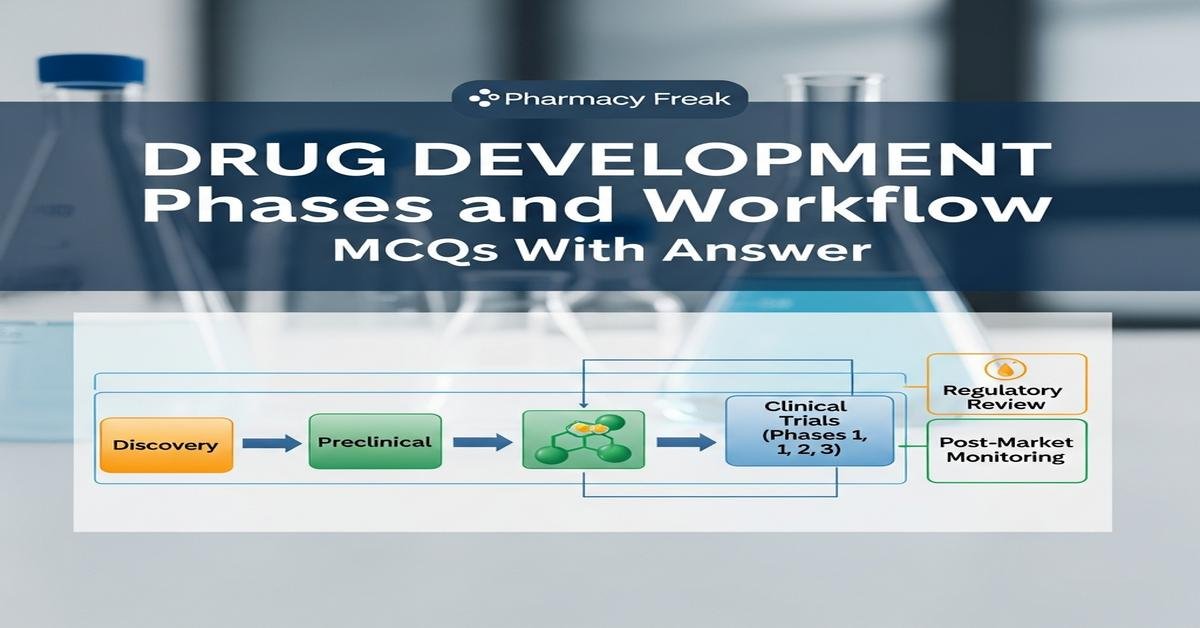
Drug development phases and workflow MCQs With Answer
Understanding drug development phases and workflow is essential for B.Pharm students preparing for careers in pharmaceutical research, clinical trials, regulatory affairs and quality control. This introduction covers key concepts such as preclinical studies, IND/NDA submissions, clinical phases I–IV, ADME, pharmacokinetics/pharmacodynamics (PK/PD), GLP/GMP/GCP compliance, toxicology (NOAEL, MTD), CMC and formulation, stability and bioavailability, trial design, statistics, pharmacovigilance and post-marketing surveillance. Familiarity with ICH and regulatory guidelines, CRO roles, surrogate endpoints and accelerated approval pathways strengthens practical knowledge. Now let’s test your knowledge with 30 MCQs on this topic.
Q1. What is the primary objective of a Phase I clinical trial?
- To assess long-term safety and efficacy in the general population
- To compare the new drug with standard therapy in randomized trials
- To assess safety, tolerability and pharmacokinetics in healthy volunteers
- To monitor adverse events after marketing authorization
Correct Answer: To assess safety, tolerability and pharmacokinetics in healthy volunteers
Q2. Which regulatory submission initiates clinical trials in humans in the United States?
- Biologics License Application (BLA)
- New Drug Application (NDA)
- Investigational New Drug application (IND)
- Abbreviated New Drug Application (ANDA)
Correct Answer: Investigational New Drug application (IND)
Q3. What does NOAEL stand for in toxicology studies?
- National Organization for Adverse Event Logs
- No Observed Adverse Effect Level
- Number Of Animals Exposed to a Lethal dose
- New Observational Assessment of Experimental Limits
Correct Answer: No Observed Adverse Effect Level
Q4. Which phase of clinical trials primarily evaluates efficacy in a target patient population?
- Phase I
- Phase II
- Phase IV
- Phase 0
Correct Answer: Phase II
Q5. Bioequivalence studies for generic drugs most commonly use which study design?
- Parallel-group superiority trial
- Crossover design in healthy volunteers
- Open-label long-term safety study
- Adaptive randomized dose-finding trial
Correct Answer: Crossover design in healthy volunteers
Q6. Which guideline harmonizes technical requirements for pharmaceuticals among major regions?
- GMP
- ICH
- FDA Modernization Act
- EMA Directive 2001/83
Correct Answer: ICH
Q7. In clinical trial terminology, what is a surrogate endpoint?
- An endpoint used only in preclinical animal models
- A laboratory measure or biomarker intended to substitute for a clinical outcome
- A marketing outcome used for labeling claims
- An endpoint measured after drug withdrawal
Correct Answer: A laboratory measure or biomarker intended to substitute for a clinical outcome
Q8. What is the main purpose of Good Manufacturing Practice (GMP) in drug development?
- To regulate clinical protocol design
- To ensure consistent quality, safety and purity in manufacturing
- To assess drug pharmacokinetics in volunteers
- To design preclinical toxicology studies
Correct Answer: To ensure consistent quality, safety and purity in manufacturing
Q9. Which toxicology study is required to support chronic use of a drug?
- Single-dose acute toxicity only
- Genotoxicity battery only
- Subchronic and chronic repeated-dose toxicity studies
- Only in vitro cytotoxicity assays
Correct Answer: Subchronic and chronic repeated-dose toxicity studies
Q10. What does CMC stand for and why is it important?
- Clinical Monitoring Committee; it oversees trial safety
- Chemistry, Manufacturing and Controls; it documents drug composition, manufacture and quality
- Critical Market Clearance; it approves marketing strategy
- Compound Metabolism Chart; it shows metabolic pathways
Correct Answer: Chemistry, Manufacturing and Controls; it documents drug composition, manufacture and quality
Q11. Which study phase primarily assesses long-term safety and rare adverse events after approval?
- Phase I
- Phase II
- Phase III
- Phase IV (post-marketing surveillance)
Correct Answer: Phase IV (post-marketing surveillance)
Q12. What is the Maximum Tolerated Dose (MTD)?
- The dose at which no pharmacologic effect is seen
- The highest dose that does not cause unacceptable toxicity in a population
- The standard marketed dose for all indications
- The dose chosen for bioequivalence studies only
Correct Answer: The highest dose that does not cause unacceptable toxicity in a population
Q13. Which trial design minimizes bias by ensuring neither participants nor investigators know treatment allocation?
- Open-label study
- Single-blind study
- Double-blind randomized controlled trial
- Non-randomized cohort study
Correct Answer: Double-blind randomized controlled trial
Q14. What is adaptive trial design?
- A fixed design that cannot be changed after initiation
- A design allowing prospectively planned modifications based on interim data
- An observational study with no interventions
- A design used exclusively for pharmacovigilance
Correct Answer: A design allowing prospectively planned modifications based on interim data
Q15. Which parameter describes the fraction of an administered dose that reaches systemic circulation unchanged?
- Clearance
- Bioavailability
- Volume of distribution
- Half-life
Correct Answer: Bioavailability
Q16. What is the 3+3 design commonly used for?
- Phase III superiority trials
- Phase I dose-escalation to determine MTD
- Bioequivalence crossover studies
- Phase IV post-marketing surveillance
Correct Answer: Phase I dose-escalation to determine MTD
Q17. Which document summarizes quality, safety and efficacy data to request marketing approval in the US?
- Investigational New Drug application (IND)
- New Drug Application (NDA)
- Clinical Study Report (CSR)
- Common Technical Document (CTD) Module 2 only
Correct Answer: New Drug Application (NDA)
Q18. Which pharmacokinetic parameter indicates how quickly a drug is eliminated from the body?
- Volume of distribution (Vd)
- Bioavailability (F)
- Clearance (CL) and half-life (t1/2)
- Maximum concentration (Cmax) only
Correct Answer: Clearance (CL) and half-life (t1/2)
Q19. What role does a Contract Research Organization (CRO) play in drug development?
- Only manufactures drug substance under GMP
- Provides outsourced support for clinical trials, data management and regulatory services
- Acts as a regulatory authority
- Guarantees drug approval
Correct Answer: Provides outsourced support for clinical trials, data management and regulatory services
Q20. Which stability study condition is commonly required for long-term storage testing?
- 100°C and 80% RH
- 25°C ±2°C/60% RH ±5% RH (typical long-term condition)
- -80°C deep-freeze only
- Room temperature with no humidity control
Correct Answer: 25°C ±2°C/60% RH ±5% RH (typical long-term condition)
Q21. What is the main objective of preclinical ADME studies?
- To establish marketing price
- To evaluate absorption, distribution, metabolism and excretion and predict human PK
- To conduct large-scale safety monitoring after approval
- To test patient-reported outcomes in clinical use
Correct Answer: To evaluate absorption, distribution, metabolism and excretion and predict human PK
Q22. Which regulatory pathway can allow approval based on surrogate endpoints for serious conditions?
- Standard generic approval
- Accelerated approval
- Over-the-counter switch
- Compassionate use only
Correct Answer: Accelerated approval
Q23. In a bioequivalence study, what 90% confidence interval range for AUC and Cmax is typically acceptable?
- 50–150%
- 80–125%
- 95–105%
- 60–140%
Correct Answer: 80–125%
Q24. What is a primary responsibility of a Data Safety Monitoring Board (DSMB)?
- Manage manufacturing quality control
- Independently monitor trial safety and recommend modifications or stopping rules
- Write the final NDA document
- Perform bioanalytical assays
Correct Answer: Independently monitor trial safety and recommend modifications or stopping rules
Q25. Which term describes the dose-response characteristic comparing toxic versus therapeutic effects?
- Absolute bioavailability
- Therapeutic index (safety margin)
- Elimination half-life
- Polymorphism index
Correct Answer: Therapeutic index (safety margin)
Q26. What is the purpose of GLP (Good Laboratory Practice) in preclinical studies?
- To ensure clinical site monitoring quality
- To assure the quality, integrity and reproducibility of nonclinical laboratory studies
- To define marketing materials for a drug
- To regulate drug pricing
Correct Answer: To assure the quality, integrity and reproducibility of nonclinical laboratory studies
Q27. Which factor most influences sample size calculation in clinical trials?
- Color of the dosing tablet
- Desired statistical power, effect size and significance level
- Number of authors on protocol
- Type of syringe used
Correct Answer: Desired statistical power, effect size and significance level
Q28. What is compassionate use (expanded access)?
- Early marketing of a generic drug
- Providing investigational drugs to patients outside clinical trials when no alternatives exist
- Routine supply of over-the-counter supplements
- Mandatory phase IV enrollment
Correct Answer: Providing investigational drugs to patients outside clinical trials when no alternatives exist
Q29. Which phase is often called confirmatory trials to provide definitive evidence of safety and efficacy?
- Phase I
- Phase II
- Phase III
- Phase 0
Correct Answer: Phase III
Q30. What is pharmacovigilance primarily concerned with?
- Developing new synthetic routes for APIs
- Monitoring, detecting and preventing adverse drug reactions after marketing
- Designing clinical trial consent forms
- Optimizing tablet coating aesthetics
Correct Answer: Monitoring, detecting and preventing adverse drug reactions after marketing


