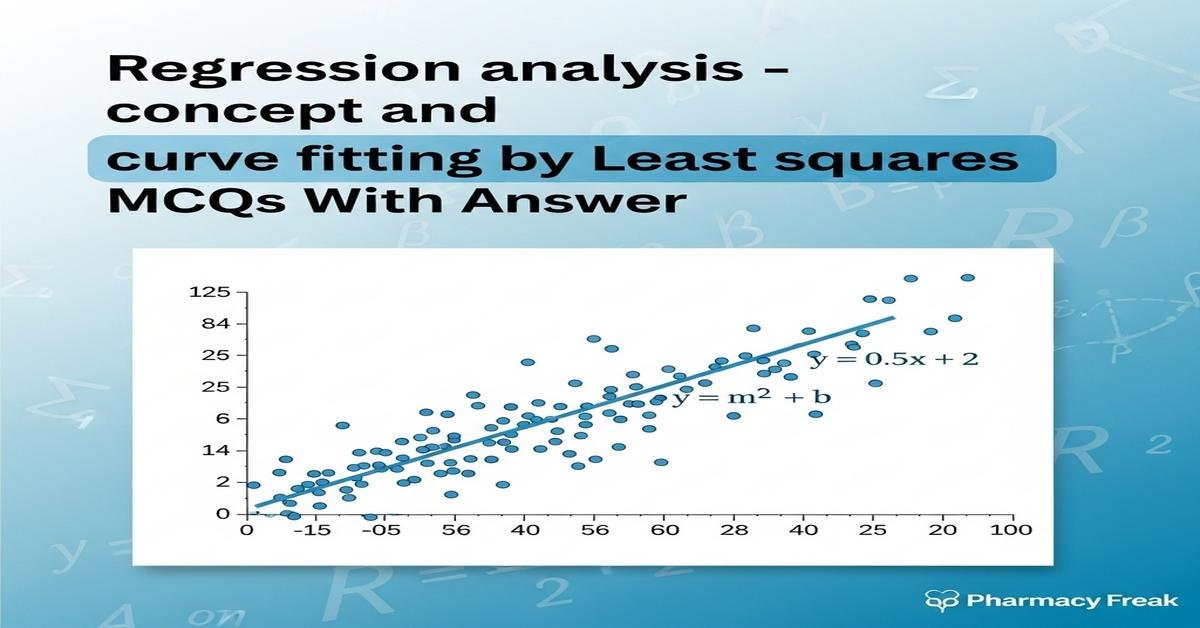
Regression analysis and curve fitting by least squares are essential tools for B.Pharm students analyzing pharmaceutical data. These concepts help you build calibration curves, quantify drug concentrations, assess assay linearity, and model formulation or dissolution profiles. Key terms include linear regression, slope, intercept, residuals, goodness-of-fit, R-squared, weighted least squares, and standard curve validation. Understanding assumptions like homoscedasticity and independence ensures reliable parameter estimates and proper interpretation of analytical results. This topic links statistical theory to practical laboratory applications such as spectrophotometric assays and HPLC calibration. Now let’s test your knowledge with 30 MCQs on this topic.
Q1. What is the main goal of regression analysis in pharmaceutical experiments?
- To determine the mean of a dataset
- To model the relationship between dependent and independent variables
- To calculate the median concentration
- To classify samples into categories
Correct Answer: To model the relationship between dependent and independent variables
Q2. In simple linear regression y = mx + c, what does ‘m’ represent?
- The y-intercept
- The slope or change in y per unit x
- The residual
- The coefficient of determination
Correct Answer: The slope or change in y per unit x
Q3. The least squares method fits a line by minimizing which quantity?
- Sum of absolute errors
- Maximum error
- Sum of squared residuals
- Product of errors
Correct Answer: Sum of squared residuals
Q4. What is a residual in regression?
- The predicted value of y
- The difference between observed and predicted y
- The slope times x
- The average of all y values
Correct Answer: The difference between observed and predicted y
Q5. In a calibration curve for HPLC, why is linear regression important?
- It reduces instrument noise
- It estimates concentration from detector response
- It sterilizes samples
- It replaces the need for standards
Correct Answer: It estimates concentration from detector response
Q6. What does R-squared (coefficient of determination) indicate?
- Proportion of variance in y explained by x
- Average residual size
- Number of data points
- Standard error of slope
Correct Answer: Proportion of variance in y explained by x
Q7. Which assumption is NOT required for ordinary least squares (OLS) linear regression?
- Errors have zero mean
- Errors are independent
- Errors have constant variance (homoscedasticity)
- Predictor variable must be normally distributed
Correct Answer: Predictor variable must be normally distributed
Q8. What effect do outliers generally have on least squares regression?
- No effect at all
- They can disproportionately influence slope and intercept
- They always improve fit
- They make residuals zero
Correct Answer: They can disproportionately influence slope and intercept
Q9. When is weighted least squares preferred in pharmaceutical calibration?
- When errors have constant variance
- When some measurements are missing
- When variance changes with concentration (heteroscedasticity)
- When using categorical predictors
Correct Answer: When variance changes with concentration (heteroscedasticity)
Q10. What does a high residual indicate for a particular data point?
- Model predicts that point very well
- Observed value is close to predicted value
- Large discrepancy between observed and predicted values
- Point should always be removed
Correct Answer: Large discrepancy between observed and predicted values
Q11. In practice, how is a calibration curve typically validated?
- By eyeballing the points
- Using replicate standards, checking linearity, residuals, and R-squared
- By using only one standard concentration
- By assuming instrument is always accurate
Correct Answer: Using replicate standards, checking linearity, residuals, and R-squared
Q12. Which statistic assesses precision of the slope estimate?
- R-squared
- Standard error of the slope
- Residual sum of squares
- Mean of x
Correct Answer: Standard error of the slope
Q13. What is multicollinearity?
- High correlation among independent variables in multiple regression
- Correlation between x and y only
- When residuals are normally distributed
- When there are too few data points
Correct Answer: High correlation among independent variables in multiple regression
Q14. How can you detect heteroscedasticity from a residual plot?
- Residuals form a horizontal band of equal spread
- Residual spread increases or decreases with predicted values
- All residuals are zero
- Residuals are perfectly normally distributed
Correct Answer: Residual spread increases or decreases with predicted values
Q15. For a linear calibration y = mx + c, how do you calculate concentration from measured y?
- Concentration = y * m + c
- Concentration = (y – c) / m
- Concentration = m / (y – c)
- Concentration = y – m – c
Correct Answer: Concentration = (y – c) / m
Q16. What does a negative slope in a regression calibration curve indicate?
- Instrument error only
- Inverse relationship: as x increases, y decreases
- Perfect correlation
- Data are unusable
Correct Answer: Inverse relationship: as x increases, y decreases
Q17. In least squares derivation, setting partial derivatives to zero yields formulas for which parameters?
- Mean and median
- Slope and intercept
- ANOVA F-statistic
- Standard deviation and variance
Correct Answer: Slope and intercept
Q18. The sum of residuals in ordinary least squares linear regression equals:
- A positive number always
- Zero (for model with intercept)
- The sum of y values
- The product of x and y
Correct Answer: Zero (for model with intercept)
Q19. Which transformation might linearize an exponential relationship for regression?
- Square root of y
- Log-transform of y
- Reciprocal of x without reason
- No transformation can help
Correct Answer: Log-transform of y
Q20. In pharmaceutical assays, why is the calibration range important?
- It determines the solvent used
- It ensures predictions are reliable within tested concentrations
- It decides the color of reagents
- It only affects sample volume
Correct Answer: It ensures predictions are reliable within tested concentrations
Q21. What does a correlation coefficient (r) close to 1 indicate?
- No linear relationship
- Strong positive linear relationship
- Strong negative linear relationship
- Perfectly random data
Correct Answer: Strong positive linear relationship
Q22. When fitting a polynomial curve by least squares, what increases with polynomial degree?
- Model bias always
- Risk of overfitting and complexity
- Number of data points needed decreases
- Residuals become zero for any dataset
Correct Answer: Risk of overfitting and complexity
Q23. Which is a practical sign that your calibration model may be overfitted?
- Very high R-squared but large prediction errors for new samples
- Low R-squared and accurate predictions
- Residuals randomly scattered
- Homogeneous residual variance
Correct Answer: Very high R-squared but large prediction errors for new samples
Q24. What is the effect of increasing replicate measurements at each concentration on regression?
- Decreases precision of estimates
- Improves estimate precision and residual assessment
- Always increases bias
- Makes slope zero
Correct Answer: Improves estimate precision and residual assessment
Q25. If slope = 0 in a calibration regression, what does it mean?
- Response is unrelated to concentration
- Perfect linear relationship
- Data are normally distributed
- Intercept must be zero
Correct Answer: Response is unrelated to concentration
Q26. Which test can check if the slope is significantly different from zero?
- T-test for slope
- Chi-square test
- Kolmogorov-Smirnov test
- Fisher exact test
Correct Answer: T-test for slope
Q27. In HPLC calibration, why might you use internal standard regression?
- To ignore instrument variability
- To correct for injection and detector variability
- To avoid preparing calibration standards
- To change the mobile phase composition
Correct Answer: To correct for injection and detector variability
Q28. Which measure describes the average distance of residuals from zero?
- Mean residual
- Root mean square error (RMSE)
- Coefficient of variation of x
- Correlation coefficient squared
Correct Answer: Root mean square error (RMSE)
Q29. In regression, what is leverage?
- A measure of how far an independent variable value is from its mean
- Sum of squared residuals
- Another name for R-squared
- Mean of dependent variable
Correct Answer: A measure of how far an independent variable value is from its mean
Q30. For a calibration curve, what practical step follows obtaining slope and intercept?
- Ignore intercept and use raw signal
- Use the equation to convert sample signals to concentrations and verify with QC samples
- Delete the calibration data
- Multiply slope by intercept to get concentration
Correct Answer: Use the equation to convert sample signals to concentrations and verify with QC samples


