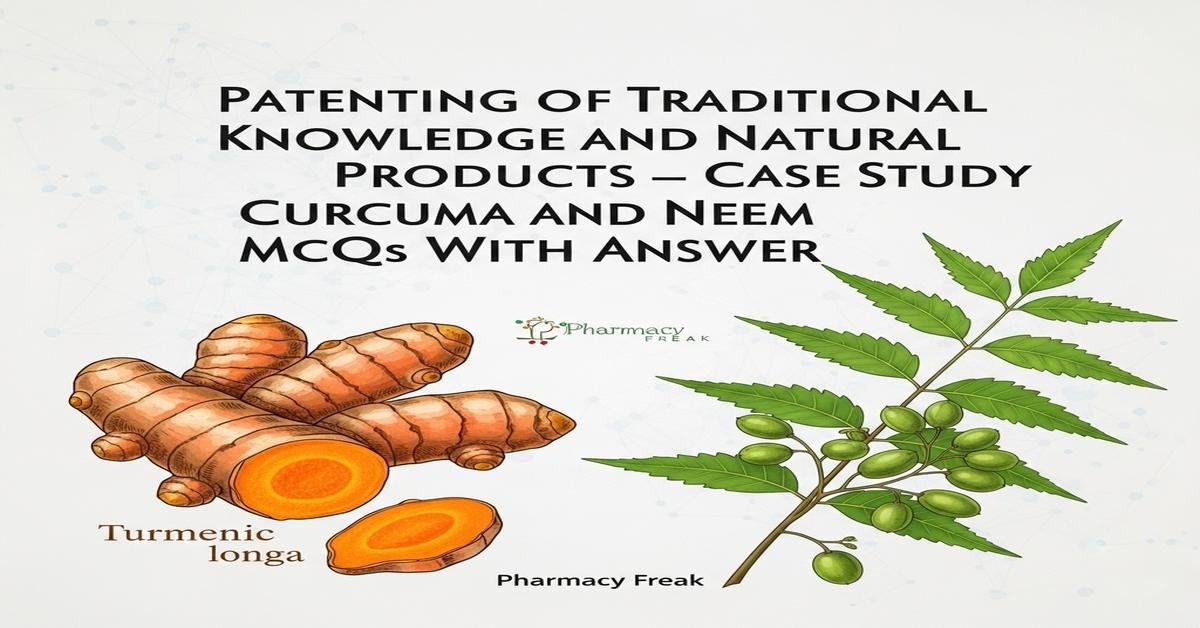
Patenting of traditional knowledge and natural products examines how intellectual property law intersects with biodiversity, indigenous knowledge and pharmaceutical development. This concise introduction covers core keywords: patenting, traditional knowledge, natural products, Curcuma (turmeric), Neem (Azadirachta indica), biopiracy, prior art, novelty, inventive step, disclosure of origin, benefit-sharing, TKDL, TRIPS and national patent laws. For B. Pharm students, the focus is on patent claims for extracts, formulations and processes, evidentiary standards for novelty and inventive step, legal challenges and ethical commercialization strategies that protect community rights while enabling drug development. Now let’s test your knowledge with 30 MCQs on this topic.
Q1. What is the primary legal requirement that a natural product or use must satisfy to be patentable?
- Traditional use by communities for centuries
- Documentation in herbal compendia
- Novelty and inventive step
- Approval by a national biodiversity board
Correct Answer: Novelty and inventive step
Q2. Which international agreement most directly affects patenting, access to genetic resources and benefit-sharing?
- Basel Convention
- Convention on Biological Diversity (CBD)
- World Health Organization (WHO) Treaty
- General Agreement on Tariffs and Trade (GATT)
Correct Answer: Convention on Biological Diversity (CBD)
Q3. The turmeric (Curcuma longa) patent on wound healing was notable because it illustrated which problem?
- Difficulty in isolating curcumin chemically
- Biopiracy and lack of recognition of traditional knowledge as prior art
- High toxicity in clinical trials
- Inability to get regulatory approval for herbal products
Correct Answer: Biopiracy and lack of recognition of traditional knowledge as prior art
Q4. What is the role of the Traditional Knowledge Digital Library (TKDL) in patent examination?
- To publish new patent applications on traditional remedies
- To provide documented prior art from traditional knowledge to patent offices
- To grant patents to indigenous communities
- To fund commercialization of herbal products
Correct Answer: To provide documented prior art from traditional knowledge to patent offices
Q5. Which of the following is an effective defensive strategy to prevent wrongful patents on known traditional uses?
- Keeping knowledge exclusively oral
- Defensive publication and documenting prior art
- Patent pooling by pharmaceutical companies
- Commercial secrecy without disclosure
Correct Answer: Defensive publication and documenting prior art
Q6. In patent law, ‘prior art’ refers to:
- Any biological resource found before 1950
- All publicly available information relevant to novelty and inventive step
- Exclusive traditional practices within a single family
- Only previously granted patents
Correct Answer: All publicly available information relevant to novelty and inventive step
Q7. Which patentability criterion often presents challenges for natural products derived from plants like Neem?
- Industrial applicability
- Novelty and inventive step due to existing traditional uses
- Patent examiners’ expertise
- Payment of filing fees
Correct Answer: Novelty and inventive step due to existing traditional uses
Q8. What mechanism allows third parties to challenge a patent after it is granted?
- Patent grant confirmation
- Post-grant opposition or revocation proceedings
- Trademark infringement action
- Clinical trial objection
Correct Answer: Post-grant opposition or revocation proceedings
Q9. Which international instrument introduced disclosure of origin requirements to address misappropriation?
- TRIPS Agreement mandates disclosure of origin
- Nagoya Protocol complements CBD on access and benefit-sharing
- Paris Convention for the Protection of Industrial Property
- Rotterdam Convention
Correct Answer: Nagoya Protocol complements CBD on access and benefit-sharing
Q10. In the context of Curcuma and Neem, a ‘product claim’ in a patent would typically protect:
- A method of harvesting the plant
- A compound, extract or formulation composition
- Traditional folklore stories
- Geographical location of the plant’s origin
Correct Answer: A compound, extract or formulation composition
Q11. Which term best describes unethical appropriation of traditional knowledge without permission or benefit-sharing?
- Bioprospecting
- Biopiracy
- Benefit-sharing
- Bioremediation
Correct Answer: Biopiracy
Q12. For a patent claim based on a traditional remedy to succeed, applicants typically must provide:
- Only a statement of traditional use
- Robust experimental evidence demonstrating a novel and non-obvious therapeutic effect
- Certification from a village council
- Taxonomic description of the plant only
Correct Answer: Robust experimental evidence demonstrating a novel and non-obvious therapeutic effect
Q13. Which national action was strengthened after cases like Turmeric and Neem to prevent wrongful patents?
- Relaxing patentability standards for natural products
- Creation of databases documenting traditional knowledge
- Elimination of opposition proceedings
- Reducing patent term for pharmaceuticals
Correct Answer: Creation of databases documenting traditional knowledge
Q14. What distinguishes a process patent from a product patent in natural product contexts?
- Process patents never require novelty
- Process patents protect manufacturing or extraction methods; product patents protect the compound or composition itself
- Product patents are only for synthetic chemicals
- Process patents last indefinitely
Correct Answer: Process patents protect manufacturing or extraction methods; product patents protect the compound or composition itself
Q15. Which of the following is a common ground for revoking a granted patent on a natural product?
- Insufficient filing fees
- Lack of novelty due to documented traditional use
- Popular opposition from consumers
- Expiry of clinical trial data
Correct Answer: Lack of novelty due to documented traditional use
Q16. The Neem case outcomes contributed to policy discussions about:
- Limiting botanical research globally
- Access and benefit-sharing, disclosure of origin and preventing biopiracy
- Abolishing patents on all plant-derived products
- Mandatory free distribution of herbal medicines
Correct Answer: Access and benefit-sharing, disclosure of origin and preventing biopiracy
Q17. Which body typically examines patent applications and assesses novelty and inventive step?
- Ethics review board
- Patent office or intellectual property office
- Local traditional councils
- Pharmaceutical marketing associations
Correct Answer: Patent office or intellectual property office
Q18. In patent drafting for a natural product, why is claim scope important for pharmaceutical developers?
- Wider claims always guarantee regulatory approval
- Appropriate claim scope balances protection with defensibility against prior art
- Claims are irrelevant if product is natural
- Only marketing matters, not claims
Correct Answer: Appropriate claim scope balances protection with defensibility against prior art
Q19. Which type of evidence can help overcome a novelty objection for a traditional remedy?
- High-level marketing brochures
- Peer-reviewed experimental data demonstrating a previously unknown mechanism or formulation advantage
- Verbal testimonies without documentation
- Claims of secrecy in traditional use
Correct Answer: Peer-reviewed experimental data demonstrating a previously unknown mechanism or formulation advantage
Q20. Under TRIPS, members may exclude what from patentability to protect traditional knowledge?
- All inventions related to health
- Discoveries of naturally occurring substances as such, in some jurisdictions
- Pharmaceutical formulations
- New chemical entities
Correct Answer: Discoveries of naturally occurring substances as such, in some jurisdictions
Q21. What is ‘defensive disclosure’ in the context of traditional knowledge protection?
- Publishing knowledge publicly to prevent others from patenting it
- Hiding information to maintain trade secrets
- Granting exclusive licenses to multinationals
- Selling traditional remedies on the black market
Correct Answer: Publishing knowledge publicly to prevent others from patenting it
Q22. Which stakeholder is usually entitled to benefit-sharing under the Nagoya Protocol?
- Patent examiners
- Source country and indigenous or local communities providing access to genetic resources
- Pharmaceutical competitors
- Only multinational corporations
Correct Answer: Source country and indigenous or local communities providing access to genetic resources
Q23. When challenging a patent based on Curcuma, what documentary source could be decisive?
- An unpublished household recipe
- Indexed traditional medicine texts or TKDL entries showing prior use
- An advertisement flyer
- Company internal emails
Correct Answer: Indexed traditional medicine texts or TKDL entries showing prior use
Q24. What is a potential ethical requirement before commercializing a product derived from Neem collected from indigenous lands?
- No requirements if product is natural
- Prior informed consent and mutually agreed terms including benefit-sharing
- Only export permits are needed
- Guarantee of monopoly pricing
Correct Answer: Prior informed consent and mutually agreed terms including benefit-sharing
Q25. Which action by a patent applicant can improve acceptance of a natural product patent claim?
- Avoiding any experimental data
- Submitting robust experimental data, detailed descriptions and comparative examples
- Claiming overly broad therapeutic uses without support
- Relying solely on traditional anecdotes
Correct Answer: Submitting robust experimental data, detailed descriptions and comparative examples
Q26. Which is true about patents on plant varieties vs patents on natural product extracts?
- Plant variety protection and patents are identical systems
- Plant variety rights protect breeding lines; patents protect inventive technical contributions like novel extracts or processes
- Extract patents only apply to synthetic compounds
- Variety rights last forever
Correct Answer: Plant variety rights protect breeding lines; patents protect inventive technical contributions like novel extracts or processes
Q27. In countries with TKDL, patent examiners are more likely to:
- Ignore traditional knowledge
- Identify prior art from documented traditional medicine and reject unmerited patent claims
- Grant patents more quickly
- Require no disclosure of origin
Correct Answer: Identify prior art from documented traditional medicine and reject unmerited patent claims
Q28. Which litigation strategy was successfully used to revoke problematic patents on traditional remedies?
- Arguing lack of commercial potential
- Demonstrating prior public disclosure and traditional use as prior art
- Choosing not to file any evidence
- Asserting trademark infringement
Correct Answer: Demonstrating prior public disclosure and traditional use as prior art
Q29. For B. Pharm students, a practical implication of understanding patenting of Curcuma and Neem is:
- To avoid any research on natural products
- To design research and documentation that meets patent and ethical standards, and to identify freedom-to-operate issues
- To always seek patents without prior searches
- That patents are irrelevant to drug development
Correct Answer: To design research and documentation that meets patent and ethical standards, and to identify freedom-to-operate issues
Q30. What is a responsible commercialization practice when developing a drug from traditional knowledge?
- Concealing the source of the knowledge to maximize profits
- Engaging communities, ensuring benefit-sharing, complying with access and disclosure rules, and validating efficacy scientifically
- Skipping regulatory testing because the remedy is traditional
- Outsourcing trials without consent from source communities
Correct Answer: Engaging communities, ensuring benefit-sharing, complying with access and disclosure rules, and validating efficacy scientifically


