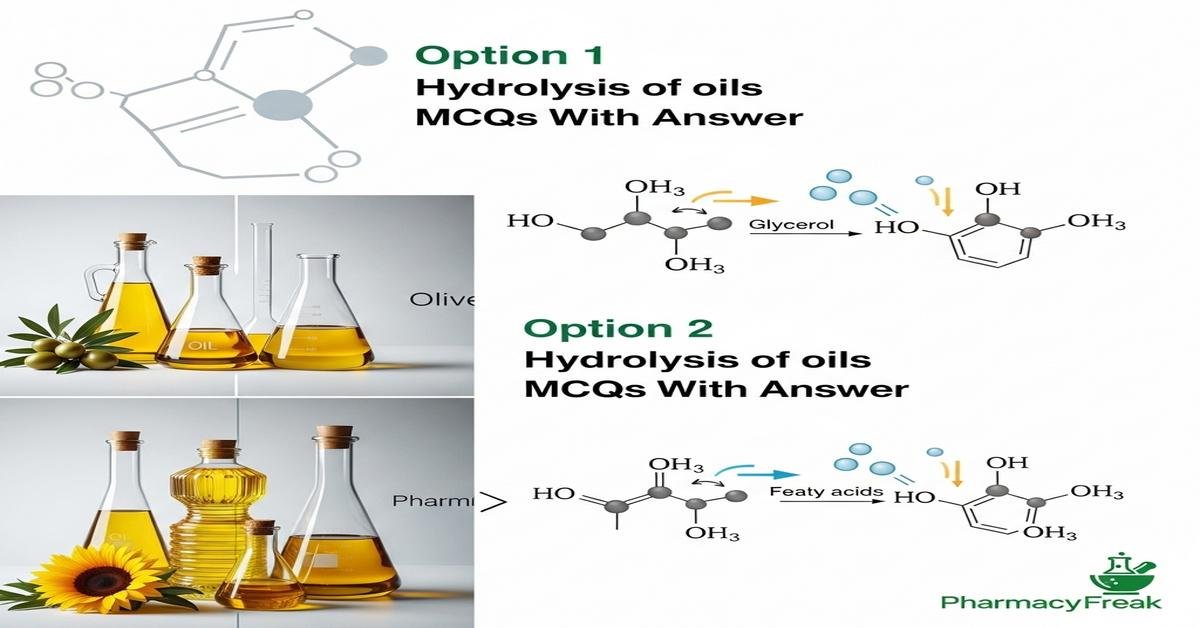
Hydrolysis of oils MCQs With Answer is an essential topic for B.Pharm students studying lipids, esters and drug formulation. This introduction covers mechanisms, types (acid, base and enzymatic hydrolysis), products such as free fatty acids and glycerol, and analytical concepts like saponification and acid values. Understanding hydrolysis helps in quality control, stability testing, and formulation of lipid-based drug delivery systems. Keywords: hydrolysis of oils, saponification, lipase-catalyzed hydrolysis, free fatty acids, B.Pharm exam preparation, ester hydrolysis MCQs. The questions below are designed to deepen conceptual knowledge and test application skills. Now let’s test your knowledge with 50 MCQs on this topic.
Q1. What is the primary chemical outcome of hydrolysis of a triglyceride molecule?
- Formation of fatty acid esters and glyceraldehyde
- Formation of free fatty acids and glycerol
- Production of amino acids and sugars
- Oxidative cleavage into peroxides
Correct Answer: Formation of free fatty acids and glycerol
Q2. Which reagent is typically used in base-catalyzed hydrolysis (saponification) of oils?
- Concentrated hydrochloric acid
- Sodium hydroxide solution
- Potassium permanganate
- Perchloric acid
Correct Answer: Sodium hydroxide solution
Q3. In acid-catalyzed hydrolysis of esters, what is the first mechanistic step?
- Nucleophilic attack by water on the ester carbonyl
- Deprotonation of the alcohol leaving group
- Protonation of the carbonyl oxygen
- Formation of a radical intermediate
Correct Answer: Protonation of the carbonyl oxygen
Q4. Which enzyme specifically catalyzes triglyceride hydrolysis in biological systems?
- Protease
- Lipase
- Amylase
- Oxidase
Correct Answer: Lipase
Q5. Saponification value of an oil indicates:
- The peroxide content of the oil
- The average molecular weight of triglycerides
- The amount of base required to hydrolyze triglycerides to glycerol and fatty acids
- The iodine uptake by unsaturated bonds
Correct Answer: The amount of base required to hydrolyze triglycerides to glycerol and fatty acids
Q6. Which analytical test measures the amount of free fatty acids in an oil sample?
- Iodine value determination
- Saponification value test
- Acid value titration
- Peroxide value assay
Correct Answer: Acid value titration
Q7. In base-catalyzed hydrolysis, why are reactions generally faster than acid-catalyzed hydrolysis?
- Because base protonates the carbonyl making it more electrophilic
- Because hydroxide is a stronger nucleophile than water
- Because base forms stable carbonium ions
- Because base removes water from the system
Correct Answer: Because hydroxide is a stronger nucleophile than water
Q8. What major product is formed when triglycerides are treated with methanol under basic conditions in biodiesel production?
- Fatty acid methyl esters (FAME) and glycerol
- Free fatty acids and methanolates
- Monoacylglycerols and dimethyl ether
- Saponified salts and methane
Correct Answer: Fatty acid methyl esters (FAME) and glycerol
Q9. Which factor does NOT significantly affect the rate of oil hydrolysis?
- Temperature
- Catalyst concentration
- Color of the container
- Water concentration
Correct Answer: Color of the container
Q10. In enzymatic hydrolysis by lipase, what determines regioselectivity with triglycerides?
- The solvent polarity exclusively
- Specificity of the lipase for sn-1, sn-2, or sn-3 positions
- Temperature alone
- Presence of strong acids
Correct Answer: Specificity of the lipase for sn-1, sn-2, or sn-3 positions
Q11. During saponification, the soap produced is chemically classified as:
- Alkali metal salts of fatty acids
- Free fatty acids
- Glycerol esters
- Peroxide radicals
Correct Answer: Alkali metal salts of fatty acids
Q12. Which indicator is commonly used in titration for acid value determination of oils?
- Phenolphthalein
- Methyl orange
- Litmus paper
- Bromothymol blue
Correct Answer: Phenolphthalein
Q13. Hydrolytic rancidity in fats and oils is primarily due to:
- Oxidation of double bonds
- Hydrolysis releasing free fatty acids
- Polymerization of triglycerides
- Enzymatic epoxidation
Correct Answer: Hydrolysis releasing free fatty acids
Q14. Which statement correctly contrasts acid and base hydrolysis of esters?
- Acid hydrolysis is irreversible while base hydrolysis is reversible
- Base hydrolysis yields salts of fatty acids; acid hydrolysis yields free acids
- Acid hydrolysis does not require water; base hydrolysis does
- Base hydrolysis proceeds through carbocation intermediates
Correct Answer: Base hydrolysis yields salts of fatty acids; acid hydrolysis yields free acids
Q15. In lipid hydrolysis kinetics, pseudo-first-order conditions are achieved by:
- Using catalytic amounts of acid
- Using very large excess of nucleophile (water or hydroxide)
- Heating without catalyst
- Performing reaction in nonpolar solvent only
Correct Answer: Using very large excess of nucleophile (water or hydroxide)
Q16. The nucleophile in acid-catalyzed ester hydrolysis is typically:
- Hydroxide ion
- Water molecule
- Alkoxide ion
- Peroxide ion
Correct Answer: Water molecule
Q17. Which property of fatty acids increases their susceptibility to hydrolysis?
- Higher degree of unsaturation
- Longer chain length always
- Presence of electron-withdrawing substituents near ester
- High melting point
Correct Answer: Presence of electron-withdrawing substituents near ester
Q18. Transesterification differs from hydrolysis because transesterification:
- Replaces the alcohol moiety of an ester with another alcohol
- Converts esters to carboxylic acids and alcohol
- Always requires acidic conditions only
- Produces only soaps
Correct Answer: Replaces the alcohol moiety of an ester with another alcohol
Q19. Which technique is commonly used to monitor hydrolysis progress of oils in the lab?
- Thin layer chromatography (TLC)
- X-ray crystallography
- NMR spectroscopy is never useful
- Polarimetry for optical rotation only
Correct Answer: Thin layer chromatography (TLC)
Q20. In base-catalyzed hydrolysis, what happens to the equilibrium when glycerol is continuously removed?
- Equilibrium shifts toward ester formation
- Equilibrium shifts toward hydrolysis products
- No change in equilibrium position
- Reaction becomes endothermic
Correct Answer: Equilibrium shifts toward hydrolysis products
Q21. Which of the following is true about enzymatic hydrolysis by lipases in non-aqueous media?
- Lipases are inactive in organic solvents
- Enzyme specificity can be retained and reactions can be faster
- Only acid hydrolysis is possible
- Water must be absent for any activity
Correct Answer: Enzyme specificity can be retained and reactions can be faster
Q22. What is the role of phase-transfer catalysts in oil hydrolysis?
- They convert triglycerides to free radicals
- They facilitate transfer of ionic nucleophiles into organic phase
- They remove water from the reaction mixture
- They act as strong acids to protonate esters
Correct Answer: They facilitate transfer of ionic nucleophiles into organic phase
Q23. Which measurement increases as hydrolytic rancidity progresses in oils?
- Iodine value
- Acid value
- Refractive index always decreases
- Peroxide value solely decreases
Correct Answer: Acid value
Q24. The rate-determining step in many acid-catalyzed ester hydrolyses is:
- Collapse of the tetrahedral intermediate to give products
- Nucleophilic attack by water on protonated ester
- Diffusion of reactants in the solvent
- Deprotonation of the acid catalyst
Correct Answer: Nucleophilic attack by water on protonated ester
Q25. Which physical condition favors base-catalyzed hydrolysis of oils?
- Low water activity
- High water concentration and strong base
- Absence of alcohols
- Extremely acidic pH
Correct Answer: High water concentration and strong base
Q26. In the mechanism of ester hydrolysis, the tetrahedral intermediate is formed at which atom?
- At the oxygen of the alkoxy group
- At the carbonyl carbon
- At the alpha carbon of the fatty acid
- At the hydrogen of water
Correct Answer: At the carbonyl carbon
Q27. Which oil parameter best reflects unsaturation level and reactive double bonds?
- Saponification value
- Iodine value
- Acid value
- Water content
Correct Answer: Iodine value
Q28. What happens to the pH of a reaction mixture during saponification of triglycerides with NaOH?
- pH decreases significantly due to acid formation
- pH remains neutral
- pH increases or remains basic due to excess NaOH
- pH oscillates between acidic and basic
Correct Answer: pH increases or remains basic due to excess NaOH
Q29. Which structural feature of triglycerides affects accessibility to hydrolytic enzymes?
- Degree of phosphorylation
- Chain length and steric hindrance around ester bonds
- Color and odor
- Presence of sulfur atoms only
Correct Answer: Chain length and steric hindrance around ester bonds
Q30. During laboratory saponification, what byproduct is commonly recovered after acidifying soap solution?
- Sterols
- Free fatty acids
- Fatty alcohols only
- Peroxides
Correct Answer: Free fatty acids
Q31. Which statement describes the effect of temperature on hydrolysis rate of oils?
- Rate decreases with temperature due to enzyme denaturation only
- Rate generally increases with temperature up to enzyme stability limits
- Temperature has no effect
- Higher temperature always favors acid hydrolysis but not base
Correct Answer: Rate generally increases with temperature up to enzyme stability limits
Q32. Which reagent mixture is used to determine saponification value?
- Hot ethanolic KOH followed by titration with HCl
- Perchloric acid and acetic anhydride
- Chromic acid oxidation
- Pyridine and bromine
Correct Answer: Hot ethanolic KOH followed by titration with HCl
Q33. In pharmaceutical formulations, controlling hydrolysis of lipid excipients is important because hydrolysis can:
- Improve drug solubility always
- Alter drug release and stability by generating free fatty acids
- Convert excipients into proteins
- Have no effect on formulation performance
Correct Answer: Alter drug release and stability by generating free fatty acids
Q34. Which is a common industrial method to accelerate hydrolysis without strong heating?
- Use of microwave or ultrasonic irradiation
- Elimination of catalysts
- Decreasing water content drastically
- Cooling to cryogenic temperatures
Correct Answer: Use of microwave or ultrasonic irradiation
Q35. In the context of hydrolysis, what does regioselectivity refer to?
- Preference for breaking specific ester bonds (sn-1, sn-2, sn-3)
- Preference for converting all bonds equally
- Number of carbon atoms in fatty acids
- Optical rotation of products
Correct Answer: Preference for breaking specific ester bonds (sn-1, sn-2, sn-3)
Q36. Which of the following is true for neutral hydrolysis of esters (uncatalyzed)?
- It proceeds extremely fast at room temperature
- It is very slow and requires harsh conditions
- It produces peroxides as primary products
- It selectively hydrolyzes unsaturated esters only
Correct Answer: It is very slow and requires harsh conditions
Q37. What is the major difficulty in hydrolyzing oils in a biphasic system?
- Excessive solubility of water in oil
- Poor mass transfer between aqueous and organic phases
- Too high reaction rate leading to side products
- Complete miscibility of phases
Correct Answer: Poor mass transfer between aqueous and organic phases
Q38. The iodine value decreases during which process?
- Hydrolysis producing more free saturated fatty acids
- Oxidative hydrogenation of double bonds
- Formation of soaps only
- Increase in chain unsaturation
Correct Answer: Oxidative hydrogenation of double bonds
Q39. Which parameter would indicate successful transesterification for biodiesel instead of hydrolysis?
- High glycerol content in organic phase
- High yield of fatty acid methyl esters (FAME)
- Increased acid value only
- Formation of alkali metal fatty acid salts primarily
Correct Answer: High yield of fatty acid methyl esters (FAME)
Q40. Which catalyst is commonly used for acid hydrolysis in laboratory ester cleavage?
- Dilute sulfuric acid
- Sodium carbonate
- Potassium hydroxide
- Tertiary amine
Correct Answer: Dilute sulfuric acid
Q41. Which structural change in lipids results from hydrolysis during digestion?
- Formation of mono- and diacylglycerols and free fatty acids
- Conversion into carbohydrates
- Polymerization into high molecular weight oils
- Incorporation of phosphate groups
Correct Answer: Formation of mono- and diacylglycerols and free fatty acids
Q42. What is typically done to stop base-catalyzed hydrolysis at the desired endpoint?
- Add more base to neutralize
- Acidify the mixture to neutralize the base
- Heat further to evaporate products
- Remove water completely
Correct Answer: Acidify the mixture to neutralize the base
Q43. Which laboratory observation indicates saponification has occurred?
- Clear solution becomes pale yellow gas
- Formation of a cloudy emulsion or soap scum
- Instant crystallization of pure glycerol
- No visible change in mixture
Correct Answer: Formation of a cloudy emulsion or soap scum
Q44. Which of the following speeds up enzymatic hydrolysis of oils in immobilized enzyme systems?
- Increasing diffusion limitations by using dense supports
- Optimizing support pore size and agitation to reduce mass transfer resistance
- Excluding all water from the system
- Reducing surface area of the immobilized enzyme
Correct Answer: Optimizing support pore size and agitation to reduce mass transfer resistance
Q45. Why is controlling water content important in transesterification reactions?
- Water promotes transesterification over hydrolysis always
- Excess water favors hydrolysis and reduces ester yields
- Water is inert and has no impact
- Water forms peroxides that catalyze transesterification
Correct Answer: Excess water favors hydrolysis and reduces ester yields
Q46. Which reagent combination is used to convert soaps back to free fatty acids?
- Treatment with dilute base
- Treatment with strong acid, such as HCl
- Oxidation with KMnO4
- Drying under vacuum
Correct Answer: Treatment with strong acid, such as HCl
Q47. In ester hydrolysis, the leaving group is typically:
- Carboxylate anion
- Alcohol or alkoxide
- Hydride ion
- Nitride ion
Correct Answer: Alcohol or alkoxide
Q48. Which safety concern is most relevant when performing saponification in the lab?
- Risk of explosive peroxide formation
- Handling of caustic alkali and exothermic reaction heat
- Radioactive emissions
- Formation of toxic nitrogen oxides
Correct Answer: Handling of caustic alkali and exothermic reaction heat
Q49. Which of the following best describes a method to quantify glycerol after hydrolysis?
- Gravimetric determination of soap only
- Colorimetric assay or HPLC analysis for glycerol
- Measuring iodine value changes only
- Determining peroxide value exclusively
Correct Answer: Colorimetric assay or HPLC analysis for glycerol
Q50. Which statement is correct about non-enzymatic hydrolysis of oils in formulation storage?
- Non-enzymatic hydrolysis requires enzymes from microbes
- It can occur chemically due to moisture, heat, and pH, affecting shelf life
- It only occurs under vacuum conditions
- It produces only transesterification products
Correct Answer: It can occur chemically due to moisture, heat, and pH, affecting shelf life


