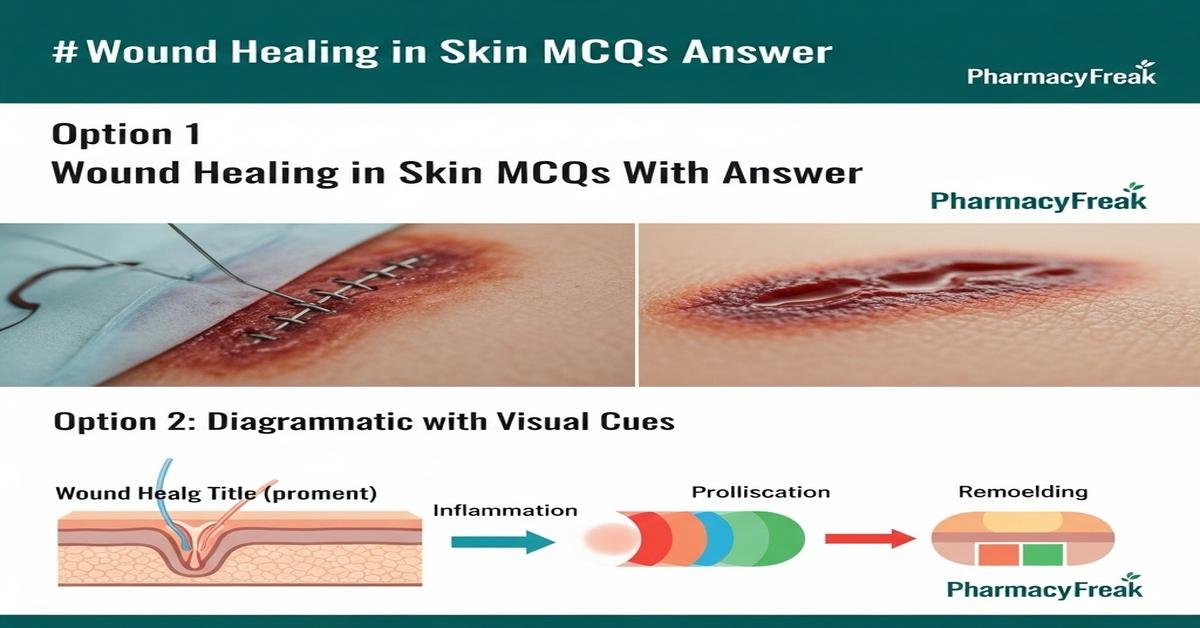
Wound healing in skin MCQs With Answer is an essential review for B. Pharm students preparing for pharmacology and clinical pharmacy exams. This concise, keyword-rich introduction covers core concepts: phases of wound healing, key cells (platelets, neutrophils, macrophages, fibroblasts, keratinocytes), growth factors (VEGF, TGF-β, PDGF, FGF), collagen types, angiogenesis, extracellular matrix, and factors affecting repair such as diabetes, nutrition, infection, and drugs. Understanding these mechanisms helps pharmacists recommend appropriate topical agents, dressings, and systemic therapies. The following set of targeted, exam-focused MCQs on wound healing in skin MCQs With Answer will deepen your knowledge and clinical reasoning. Now let’s test your knowledge with 50 MCQs on this topic.
Q1. Which is the correct sequential order of the phases of cutaneous wound healing?
- Inflammation → Hemostasis → Proliferation → Remodeling
- Hemostasis → Inflammation → Proliferation → Remodeling
- Proliferation → Hemostasis → Inflammation → Remodeling
- Remodeling → Proliferation → Inflammation → Hemostasis
Correct Answer: Hemostasis → Inflammation → Proliferation → Remodeling
Q2. Which cell type is primarily responsible for initiating hemostasis immediately after skin injury?
- Neutrophils
- Fibroblasts
- Platelets
- Keratinocytes
Correct Answer: Platelets
Q3. Which growth factor is most directly associated with angiogenesis during wound healing?
- Transforming growth factor-beta (TGF-β)
- Vascular endothelial growth factor (VEGF)
- Interleukin-1 (IL-1)
- Insulin-like growth factor (IGF)
Correct Answer: Vascular endothelial growth factor (VEGF)
Q4. Which collagen type predominates in early granulation tissue?
- Type I collagen
- Type II collagen
- Type III collagen
- Type IV collagen
Correct Answer: Type III collagen
Q5. Which family of enzymes is chiefly responsible for extracellular matrix degradation during wound remodeling?
- Serine proteases
- Matrix metalloproteinases (MMPs)
- Caspases
- Lipases
Correct Answer: Matrix metalloproteinases (MMPs)
Q6. Which cell type is the main producer of collagen in the healing dermis?
- Endothelial cells
- Fibroblasts
- Macrophages
- Melanocytes
Correct Answer: Fibroblasts
Q7. What is the primary function of myofibroblasts in wound healing?
- Phagocytosis of bacteria
- Contracting the wound to reduce its size
- Secreting antimicrobial peptides
- Forming new blood vessels
Correct Answer: Contracting the wound to reduce its size
Q8. Which epidermal cell type is chiefly responsible for re-epithelialization of skin wounds?
- Fibroblasts
- Keratinocytes
- Langerhans cells
- Basal melanocytes
Correct Answer: Keratinocytes
Q9. Tissue hypoxia in a wound primarily stimulates which adaptive response?
- Decreased VEGF production
- Increased VEGF production and angiogenesis
- Inhibition of fibroblast migration
- Immediate collagen cross-linking
Correct Answer: Increased VEGF production and angiogenesis
Q10. Chronic non-healing wounds commonly show which biochemical imbalance?
- Decreased protease (MMP) activity and excess growth factors
- Elevated MMP activity leading to ECM and growth factor degradation
- Excess collagen crosslinking due to high lysyl oxidase
- Increased vitamin C levels
Correct Answer: Elevated MMP activity leading to ECM and growth factor degradation
Q11. Transforming growth factor-beta (TGF-β) primarily contributes to wound healing by:
- Inhibiting fibroblast proliferation and collagen synthesis
- Stimulating fibroblast proliferation and collagen synthesis
- Directly lysing bacteria in the wound
- Promoting keratinocyte apoptosis
Correct Answer: Stimulating fibroblast proliferation and collagen synthesis
Q12. The optimal pH range that favors wound healing and reduces bacterial growth is:
- Alkaline, around pH 8–9
- Neutral, around pH 7.0
- Slightly acidic, around pH 5.5–6.5
- Highly acidic, around pH 3–4
Correct Answer: Slightly acidic, around pH 5.5–6.5
Q13. Final tensile strength of healed skin typically reaches approximately what percentage of unwounded skin?
- 30% after remodeling
- 50% after remodeling
- 80% after remodeling
- 100% after remodeling
Correct Answer: 80% after remodeling
Q14. Systemic corticosteroids impair wound healing mainly by:
- Stimulating collagen synthesis
- Inhibiting inflammation and fibroblast function
- Increasing angiogenesis
- Enhancing keratinocyte migration
Correct Answer: Inhibiting inflammation and fibroblast function
Q15. Which vitamin is an essential cofactor for prolyl and lysyl hydroxylases required for collagen maturation?
- Vitamin A
- Vitamin B12
- Vitamin C (ascorbic acid)
- Vitamin D
Correct Answer: Vitamin C (ascorbic acid)
Q16. Tissue inhibitors of metalloproteinases (TIMPs) function to:
- Activate MMPs
- Inhibit MMP activity and protect ECM
- Promote bacterial biofilm formation
- Increase collagen degradation
Correct Answer: Inhibit MMP activity and protect ECM
Q17. Which dressing type is most appropriate for highly exudative wounds?
- Hydrocolloid dressing
- Alginate dressing
- Transparent film
- Petrolatum gauze
Correct Answer: Alginate dressing
Q18. Negative pressure wound therapy (NPWT) primarily aids healing by:
- Delivering systemic antibiotics
- Applying continuous heat to the wound bed
- Removing exudate and promoting granulation via mechanical forces
- Delivering ultraviolet light to sterilize tissues
Correct Answer: Removing exudate and promoting granulation via mechanical forces
Q19. Primary intention healing is characterized by:
- Wound left open to heal by granulation and contraction
- Delayed closure after contamination cleansed
- Approximation of wound edges with minimal scarring
- Healing by foreign body reaction
Correct Answer: Approximation of wound edges with minimal scarring
Q20. Secondary intention healing involves:
- Surgical suturing immediately after injury
- Healing by granulation tissue formation and wound contraction
- Immediate primary closure under tension
- Use of skin graft in all cases
Correct Answer: Healing by granulation tissue formation and wound contraction
Q21. Tertiary intention (delayed primary closure) refers to:
- Immediate primary closure of a clean wound
- Wounds closed later after a period of open management to reduce infection risk
- Healing only by epithelization without granulation
- Using synthetic adhesives instead of sutures
Correct Answer: Wounds closed later after a period of open management to reduce infection risk
Q22. A keloid scar differs from a hypertrophic scar by which key feature?
- Keloid stays within the original wound margin
- Keloid extends beyond original wound margins
- Hypertrophic scar extends beyond margins
- Neither contains excess collagen
Correct Answer: Keloid extends beyond original wound margins
Q23. Which inflammatory cell predominates the earliest phase (first 24–48 hours) after skin injury?
- Lymphocytes
- Macrophages
- Neutrophils
- Plasma cells
Correct Answer: Neutrophils
Q24. Macrophages contribute to wound healing primarily by:
- Only phagocytosing bacteria without releasing mediators
- Secreting growth factors, clearing debris, and orchestrating repair
- Forming the provisional fibrin matrix
- Producing melanin to protect from UV light
Correct Answer: Secreting growth factors, clearing debris, and orchestrating repair
Q25. VEGF mainly acts on which target cells to promote wound repair?
- Fibroblasts
- Keratinocytes
- Endothelial cells
- Neutrophils
Correct Answer: Endothelial cells
Q26. Platelet-derived growth factor (PDGF) in wounds primarily:
- Acts as a vasoconstrictor
- Is chemotactic and mitogenic for fibroblasts and smooth muscle cells
- Directly lyses bacteria
- Inhibits collagen synthesis
Correct Answer: Is chemotactic and mitogenic for fibroblasts and smooth muscle cells
Q27. Basic fibroblast growth factor (bFGF/FGF-2) is important because it:
- Inhibits endothelial proliferation
- Stimulates fibroblast proliferation and angiogenesis
- Degrades collagen via proteolysis
- Is primarily an antimicrobial peptide
Correct Answer: Stimulates fibroblast proliferation and angiogenesis
Q28. A hypertrophic scar is best described as:
- A raised scar that remains within the boundaries of the original wound and may regress
- A flat, pale scar with no excess collagen
- A scar that extends beyond original margins and never regresses
- An atrophic depressed scar
Correct Answer: A raised scar that remains within the boundaries of the original wound and may regress
Q29. Which systemic condition most commonly delays wound healing due to microvascular disease and impaired immunity?
- Controlled hypothyroidism
- Uncontrolled diabetes mellitus
- Mild seasonal allergies
- Hypervitaminosis A
Correct Answer: Uncontrolled diabetes mellitus
Q30. Smoking impairs wound healing primarily by:
- Enhancing oxygen delivery to tissues
- Causing vasoconstriction and reducing tissue oxygenation
- Increasing collagen synthesis
- Reducing platelet aggregation
Correct Answer: Causing vasoconstriction and reducing tissue oxygenation
Q31. Nonsteroidal anti-inflammatory drugs (NSAIDs) may affect wound healing by:
- Enhancing prostaglandin synthesis and accelerating repair
- Inhibiting COX enzymes and potentially delaying the inflammatory phase
- Directly increasing collagen cross-linking
- Stimulating keratinocyte proliferation
Correct Answer: Inhibiting COX enzymes and potentially delaying the inflammatory phase
Q32. Topical antibiotic ointments are most appropriately used when:
- For all clean surgical wounds routinely
- Signs of local infection or heavy contamination are present
- To prevent scarring in all small cuts
- They are superior to debridement in chronic wounds
Correct Answer: Signs of local infection or heavy contamination are present
Q33. Granulation tissue in a healing wound is composed mainly of:
- Keratinized epithelial cells and melanocytes
- New capillaries, fibroblasts, and extracellular matrix
- Mature collagen bundles only
- Primarily adipose tissue
Correct Answer: New capillaries, fibroblasts, and extracellular matrix
Q34. Fibronectin in the wound bed functions to:
- Act as a provisional matrix for cell adhesion and migration
- Serve as a bactericidal agent
- Inhibit keratinocyte migration
- Directly cross-link collagen
Correct Answer: Act as a provisional matrix for cell adhesion and migration
Q35. Excessive matrix metalloproteinase activity in chronic wounds results in:
- Enhanced deposition of new extracellular matrix
- Degradation of growth factors and ECM, hindering repair
- Immediate re-epithelialization
- Decreased bacterial colonization
Correct Answer: Degradation of growth factors and ECM, hindering repair
Q36. Re-epithelialization of a clean skin wound typically begins within:
- 24–48 hours after injury
- 7–14 days after injury
- One month after injury
- Only after full granulation
Correct Answer: 24–48 hours after injury
Q37. The inflammatory phase of wound healing commonly lasts approximately:
- 0–72 hours
- 1–2 weeks
- 1–6 months
- Entire life span
Correct Answer: 0–72 hours
Q38. The remodeling (maturation) phase of wound healing may continue for:
- A few hours only
- Several weeks to months, up to a year
- Always exactly 3 days
- Only until sutures are removed
Correct Answer: Several weeks to months, up to a year
Q39. Which enzyme is primarily responsible for initiating collagen cross-linking in the extracellular matrix?
- Procollagen peptidase
- Collagenase
- Lysyl oxidase
- Hyaluronidase
Correct Answer: Lysyl oxidase
Q40. Hyperbaric oxygen therapy supports wound healing mainly by:
- Reducing oxygen tension in tissues
- Increasing tissue oxygen tension to enhance fibroblast and leukocyte function
- Providing a moist wound environment only
- Directly supplying growth factors
Correct Answer: Increasing tissue oxygen tension to enhance fibroblast and leukocyte function
Q41. Silver-impregnated dressings are primarily used for their:
- Pro-angiogenic properties
- Antimicrobial activity
- Collagen synthesis stimulation
- Debriding enzymatic action
Correct Answer: Antimicrobial activity
Q42. Biofilm formation in chronic wounds leads to:
- Improved antibiotic penetration and faster healing
- Persistent infection with increased resistance and impaired healing
- Accelerated re-epithelialization
- Complete sterilization of the wound bed
Correct Answer: Persistent infection with increased resistance and impaired healing
Q43. M1 and M2 macrophage phenotypes are best characterized as:
- M1 is pro-repair and M2 is pro-inflammatory
- M1 is pro-inflammatory and M2 is pro-repair/anti-inflammatory
- Both are identical in function
- Neither is involved in wound healing
Correct Answer: M1 is pro-inflammatory and M2 is pro-repair/anti-inflammatory
Q44. Which specific MMP is primarily known as collagenase that cleaves fibrillar collagen?
- MMP-9 (gelatinase B)
- MMP-1 (collagenase-1)
- MMP-2 (gelatinase A)
- MMP-7 (matrilysin)
Correct Answer: MMP-1 (collagenase-1)
Q45. A commonly used biochemical marker to estimate collagen content in healing tissue is:
- Hydroxyproline content
- Serum glucose level
- C-reactive protein
- Serum creatinine
Correct Answer: Hydroxyproline content
Q46. The immediate plug formed during hemostasis is composed mainly of:
- Keratinocyte sheets
- Platelet aggregates and fibrin
- Collagen type I fibers
- New capillaries
Correct Answer: Platelet aggregates and fibrin
Q47. Nitric oxide (NO) in wound healing functions to:
- Cause vasoconstriction and reduce blood flow
- Promote vasodilation, modulate angiogenesis, and have antimicrobial effects
- Inhibit fibroblast proliferation exclusively
- Directly form collagen cross-links
Correct Answer: Promote vasodilation, modulate angiogenesis, and have antimicrobial effects
Q48. Which topical recombinant growth factor is approved for treating certain chronic diabetic foot ulcers?
- Recombinant human EGF (epidermal growth factor)
- Bevacizumab (anti-VEGF antibody)
- Beclomethasone (topical steroid)
- Recombinant human PDGF (becaplermin)
Correct Answer: Recombinant human PDGF (becaplermin)
Q49. Which chemokine is a potent attractant for neutrophils during the early inflammatory phase?
- Transforming growth factor-beta (TGF-β)
- Interleukin-8 (IL-8/CXCL8)
- Vascular endothelial growth factor (VEGF)
- Fibroblast growth factor (FGF)
Correct Answer: Interleukin-8 (IL-8/CXCL8)
Q50. Chronic hyperglycemia delays wound healing primarily by:
- Enhancing neutrophil function and increasing collagen deposition
- Impairing neutrophil function, promoting glycation of proteins, and reducing collagen synthesis
- Directly increasing VEGF activity and angiogenesis
- Lowering blood glucose to optimal healing levels
Correct Answer: Impairing neutrophil function, promoting glycation of proteins, and reducing collagen synthesis

