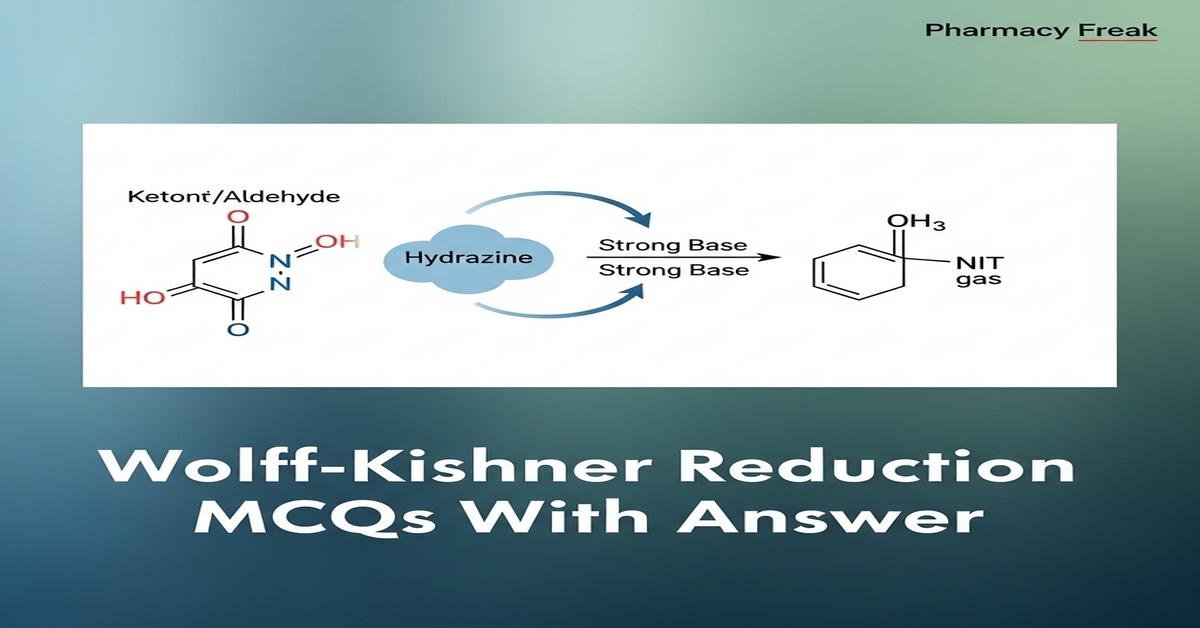
Wolff–Kishner reduction MCQs With Answer
The Wolff–Kishner reduction is a fundamental reaction B. Pharm students must master for converting carbonyls (aldehydes and ketones) into methylene groups under strongly basic, high‑temperature conditions. This metal‑free method uses hydrazine to form a hydrazone intermediate, followed by base‑promoted deprotonation and N2 extrusion to yield the alkane. Key topics include mechanism steps, common reagents (hydrazine, KOH), high‑boiling solvents (ethylene glycol), modifications (Huang‑Minlon), scope, chemoselectivity, and limitations with base‑ or heat‑sensitive groups. Understanding these points improves problem solving in medicinal chemistry and synthesis design. Now let’s test your knowledge with 50 MCQs on this topic.
Q1. What is the overall transformation accomplished by the Wolff–Kishner reduction?
- Oxidation of alcohol to ketone
- Reduction of carbonyl group to methylene (alkane)
- Conversion of alkene to alcohol
- Nitration of aromatic ring
Correct Answer: Reduction of carbonyl group to methylene (alkane)
Q2. Which two reagents are essential for a classical Wolff–Kishner reduction?
- Hydrogen gas and Pd/C
- Hydrazine and strong base (e.g., KOH)
- Sodium borohydride and methanol
- Zinc amalgam and HCl
Correct Answer: Hydrazine and strong base (e.g., KOH)
Q3. What is the key organic intermediate formed before nitrogen elimination in the Wolff–Kishner reaction?
- Oxime
- Hydrazone
- Aldol
- Enamine
Correct Answer: Hydrazone
Q4. Which gas is evolved during the Wolff–Kishner reduction mechanism?
- Carbon dioxide
- Methane
- Nitrogen (N2)
- Hydrogen (H2)
Correct Answer: Nitrogen (N2)
Q5. Which type of solvent is typically used to reach the high temperature required for the Wolff–Kishner reduction?
- Low‑boiling alcohol (e.g., methanol)
- Chloroform
- High‑boiling polyol such as ethylene glycol
- Water
Correct Answer: High‑boiling polyol such as ethylene glycol
Q6. Why are high temperatures needed in the classical Wolff–Kishner reduction?
- To dissolve the substrate only
- To accelerate hydrazone formation alone
- To drive deprotonation and N2 extrusion from the hydrazone anion
- To decompose hydrazine into ammonia
Correct Answer: To drive deprotonation and N2 extrusion from the hydrazone anion
Q7. Which functional group is generally NOT reduced by the Wolff–Kishner procedure?
- Aldehyde
- Ketone
- Carboxylic ester
- Aromatic aldehyde
Correct Answer: Carboxylic ester
Q8. Compared to the Clemmensen reduction, when is Wolff–Kishner preferred?
- When the substrate is acid‑sensitive
- When very acidic conditions are required
- When metal catalysts must be used
- When hydrogen gas is available
Correct Answer: When the substrate is acid‑sensitive
Q9. What is the Huang‑Minlon modification of the Wolff–Kishner reduction known for?
- Using Pd/C and hydrogen instead of hydrazine
- Using tosylhydrazones only
- Shortening reaction time and simplifying workup with ethylene glycol
- Performing the reaction at room temperature
Correct Answer: Shortening reaction time and simplifying workup with ethylene glycol
Q10. Which of the following best describes the role of the base in Wolff–Kishner reduction?
- To protonate the carbonyl oxygen
- To dehydrate the substrate
- To deprotonate the hydrazone and facilitate N2 elimination
- To oxidize hydrazine
Correct Answer: To deprotonate the hydrazone and facilitate N2 elimination
Q11. If acetone undergoes Wolff–Kishner reduction, what is the major product?
- Isopropyl alcohol
- Propane
- Isobutane
- 2‑Propanol
Correct Answer: Propane
Q12. Which of the following is a common strong base used in Wolff–Kishner reductions?
- Pyridine
- Potassium hydroxide (KOH)
- Triethylamine
- Hydrochloric acid
Correct Answer: Potassium hydroxide (KOH)
Q13. How does Wolff–Kishner reduction affect an α,β‑unsaturated carbonyl compound?
- It hydrogenates the C=C bond preferentially
- It typically reduces the C=O while leaving the C=C intact
- It converts it to an alcohol selectively
- It oxidizes the double bond
Correct Answer: It typically reduces the C=O while leaving the C=C intact
Q14. Which statement correctly differentiates the Wolff–Kishner and Shapiro reactions?
- Both reactions produce alkanes from carbonyls under acid catalysis
- Wolff–Kishner gives alkanes; Shapiro (from tosylhydrazones) often generates alkenes or carbanion equivalents
- Shapiro uses hydrazine and base at high temperature
- Wolff–Kishner requires a metal catalyst while Shapiro does not
Correct Answer: Wolff–Kishner gives alkanes; Shapiro (from tosylhydrazones) often generates alkenes or carbanion equivalents
Q15. Which step is the initial chemical event when a carbonyl reacts in a Wolff–Kishner sequence?
- Nucleophilic attack of hydrazine on the carbonyl to form a hydrazone
- Immediate extrusion of N2
- Hydrogen‑atom abstraction from the α‑carbon
- Formation of an enolate
Correct Answer: Nucleophilic attack of hydrazine on the carbonyl to form a hydrazone
Q16. Which of the following side reactions is a practical concern during Wolff–Kishner reductions of enolizable ketones?
- Aldol condensation under basic, high‑temperature conditions
- Diels–Alder cycloaddition
- Radical polymerization
- Nitration
Correct Answer: Aldol condensation under basic, high‑temperature conditions
Q17. Which class of compounds is most directly converted by Wolff–Kishner conditions?
- Esters
- Amides
- Aldehydes and ketones
- Nitriles
Correct Answer: Aldehydes and ketones
Q18. Why does loss of nitrogen gas help make the Wolff–Kishner reaction irreversible?
- N2 is a reactive intermediate that recombines easily
- Evolution of gaseous N2 shifts equilibrium to product side by Le Chatelier’s principle
- N2 increases acidity of the medium
- N2 dissolves and reacts further
Correct Answer: Evolution of gaseous N2 shifts equilibrium to product side by Le Chatelier’s principle
Q19. Which of the following functional groups is generally tolerated under Wolff–Kishner conditions?
- Acid‑sensitive tert‑butyl ester
- Base‑sensitive epoxide
- Aryl halide (e.g., bromide)
- Nitro group reliably unchanged
Correct Answer: Aryl halide (e.g., bromide)
Q20. What is a major practical limitation when applying the classical Wolff–Kishner reduction?
- Requirement for very low temperatures
- Use of expensive precious‑metal catalysts
- Harsh basic and high‑temperature conditions incompatible with many functional groups
- Formation of explosive peroxides
Correct Answer: Harsh basic and high‑temperature conditions incompatible with many functional groups
Q21. Which reagent combination would NOT perform a Wolff–Kishner reduction?
- Hydrazine + KOH + ethylene glycol
- Tosylhydrazone + strong base under heating
- Hydrazine + Pd/C + H2
- Hydrazine + NaOH + high‑boiling solvent
Correct Answer: Hydrazine + Pd/C + H2
Q22. What is the immediate electronic nature of the species formed after base deprotonation of the hydrazone?
- Radical cation
- Hydrazone anion / carbanion character
- Carbocation
- Neutral free radical
Correct Answer: Hydrazone anion / carbanion character
Q23. Which of the following best describes the mechanism type for Wolff–Kishner reduction?
- Radical chain mechanism
- Ionic mechanism involving carbanion and nitrogen elimination
- Pericyclic concerted mechanism
- Transition‑metal mediated hydride transfer
Correct Answer: Ionic mechanism involving carbanion and nitrogen elimination
Q24. How does a tosylhydrazone derivative typically differ from a simple hydrazone in reactivity?
- Tosylhydrazones are more reactive toward formation of vinyl carbanions (Shapiro/Bamford–Stevens) and more stable to isolation
- Tosylhydrazones cannot eliminate nitrogen
- Tosylhydrazones decompose to aldehydes only
- Tosylhydrazones always give alcohols
Correct Answer: Tosylhydrazones are more reactive toward formation of vinyl carbanions (Shapiro/Bamford–Stevens) and more stable to isolation
Q25. What is the product of Wolff–Kishner reduction of benzophenone (diphenyl ketone)?
- Benzhydrol (diphenylmethanol)
- Benzophenone remains unchanged
- Diphenylmethane
- Benzaldehyde
Correct Answer: Diphenylmethane
Q26. Which condition makes Wolff–Kishner unsuitable for a substrate?
- Presence of an aryl chloride
- Presence of base‑sensitive protecting groups and heat‑labile moieties
- Simple alkyl chains
- Non‑enolizable ketone
Correct Answer: Presence of base‑sensitive protecting groups and heat‑labile moieties
Q27. Which of the following is a synthetically useful advantage of Wolff–Kishner reduction?
- It achieves reduction using only hydrogen gas
- It selectively reduces carbonyls without hydrogenating isolated double bonds
- It requires expensive catalysts
- It proceeds under strongly acidic conditions
Correct Answer: It selectively reduces carbonyls without hydrogenating isolated double bonds
Q28. During W‑K reduction, what happens to the oxygen atom of the original carbonyl?
- It becomes part of water
- It remains attached to the product alkane
- It is expelled as carbon dioxide
- It is transferred to hydrazine forming an oxide
Correct Answer: It becomes part of water
Q29. For which of the following substrates is Wolff–Kishner reduction most commonly used in medicinal chemistry?
- Converting a ketone that must be removed to improve metabolic stability
- Hydrogenation of aromatic rings
- Selective nitration of heterocycles
- Oxidation of alcohols to ketones
Correct Answer: Converting a ketone that must be removed to improve metabolic stability
Q30. Which modification of the Wolff–Kishner technique is employed to reduce hydrazone formation time and reagent excess?
- Clemmensen modification
- Huang‑Minlon modification
- Birch modification
- Wittig modification
Correct Answer: Huang‑Minlon modification
Q31. Which kind of carbonyl compound is most at risk of competing aldol reactions under Wolff–Kishner conditions?
- Non‑enolizable aromatic aldehydes
- Enolizable aliphatic aldehydes and ketones
- Carboxylic acids
- Esters
Correct Answer: Enolizable aliphatic aldehydes and ketones
Q32. Which of the following is NOT a typical reason to choose Wolff–Kishner over catalytic hydrogenation?
- To avoid hydrogenating C=C bonds
- To avoid using a metal catalyst
- To run the reaction at ambient temperature
- To reduce only a carbonyl to CH2
Correct Answer: To run the reaction at ambient temperature
Q33. What happens to hydrazine during the Wolff–Kishner sequence?
- It acts as a nucleophile to form hydrazone and supplies hydrogen while being converted to N2
- It is oxidized to nitrobenzene
- It remains unchanged and simply acts as a solvent
- It is converted to ammonia only
Correct Answer: It acts as a nucleophile to form hydrazone and supplies hydrogen while being converted to N2
Q34. Which product results from Wolff–Kishner reduction of benzaldehyde?
- Benzoic acid
- Toluene
- Benzyl alcohol
- Styrene
Correct Answer: Toluene
Q35. Which process is NOT a step in the accepted mechanism of Wolff–Kishner reduction?
- Formation of hydrazone from carbonyl and hydrazine
- Acidic protonation of hydrazone carbon to form carbocation
- Base‑induced deprotonation and elimination of N2
- Formation of carbanion intermediate that is protonated to give alkane
Correct Answer: Acidic protonation of hydrazone carbon to form carbocation
Q36. Which solvent choice helps minimize reaction temperature while maintaining basicity in some Wolff–Kishner modifications?
- Diethyl ether
- Ethylene glycol (modified conditions)
- Methylene chloride
- Hexane
Correct Answer: Ethylene glycol (modified conditions)
Q37. Which of these statements about chemoselectivity in Wolff–Kishner reduction is TRUE?
- It will reduce nitro groups selectively over carbonyls
- It selectively reduces carbonyls without affecting many isolated C=C bonds
- It always removes halogens from aromatic rings
- It selectively converts esters into alcohols
Correct Answer: It selectively reduces carbonyls without affecting many isolated C=C bonds
Q38. In which scenario is Clemmensen reduction usually chosen instead of Wolff–Kishner?
- When the substrate is base‑sensitive but acid‑tolerant
- When the substrate contains acid‑labile groups
- When metal catalysts are to be avoided
- When N2 evolution should be maximized
Correct Answer: When the substrate is base‑sensitive but acid‑tolerant
Q39. Which reagent would most likely destroy a protecting group during classical Wolff–Kishner conditions?
- Tert‑butyl ester protecting group (acid labile)
- Silyl ether (stable to base at high temperature?)
- Benzyl ether under hydrogenolysis conditions
- Boc protecting group (base and heat sensitive)
Correct Answer: Boc protecting group (base and heat sensitive)
Q40. What is the primary driving thermodynamic factor favoring product formation in Wolff–Kishner reduction?
- Formation of a strong C–O bond
- Release of stable N2 gas and formation of stronger C–H bonds
- Consumption of hydrogen gas
- Formation of peroxides
Correct Answer: Release of stable N2 gas and formation of stronger C–H bonds
Q41. Which of the following is true regarding stereochemistry in Wolff–Kishner reductions?
- The reaction creates a stereogenic center by retention of configuration always
- The intermediate carbanion can be protonated, potentially giving racemization at adjacent stereocenters under strong basic conditions
- Stereochemistry is never affected
- The reaction invariably preserves chiral centers alpha to the carbonyl
Correct Answer: The intermediate carbanion can be protonated, potentially giving racemization at adjacent stereocenters under strong basic conditions
Q42. Which of the following transformations is most similar mechanistically to Wolff–Kishner?
- Hydrogenation with H2/Pd
- Shapiro reaction involving tosylhydrazones and base
- Kolbe electrolysis
- Ozonolysis
Correct Answer: Shapiro reaction involving tosylhydrazones and base
Q43. Under Wolff–Kishner conditions, which substrate would likely survive unchanged?
- A base‑sensitive acetal
- A highly enolizable α‑branched aldehyde
- A simple alkyl chloride on an aromatic ring
- A silyl ether (TBDMS) in strong base at high heat
Correct Answer: A simple alkyl chloride on an aromatic ring
Q44. Which of the following best describes a practical laboratory precaution for Wolff–Kishner reductions?
- Perform reaction in closed system to trap evolved N2
- Maintain strongly acidic pH throughout
- Use care to control high temperature and strong base to avoid side reactions
- Avoid use of any high‑boiling solvents
Correct Answer: Use care to control high temperature and strong base to avoid side reactions
Q45. Which of the following is a correct statement about the fate of hydrogens added to the carbon during Wolff–Kishner reduction?
- They come from external H2 gas
- They are supplied internally by hydrazine during the mechanism
- They are supplied by the solvent only
- No hydrogen is added; the carbonyl oxygen is replaced directly by carbon
Correct Answer: They are supplied internally by hydrazine during the mechanism
Q46. Which reaction condition is most likely to improve Wolff–Kishner yield for a sterically hindered ketone?
- Lowering temperature drastically
- Using excess hydrazine and prolonged heating in high‑boiling solvent
- Replacing base with a weak acid
- Switching to catalytic hydrogenation
Correct Answer: Using excess hydrazine and prolonged heating in high‑boiling solvent
Q47. Which transformation cannot be accomplished by Wolff–Kishner reduction?
- Conversion of aldehyde to alkane
- Conversion of ketone to alkane
- Selective reduction of ester to alcohol
- Removal of carbonyl in presence of C=C bond
Correct Answer: Selective reduction of ester to alcohol
Q48. Which of these statements about the mechanism intermediates is correct?
- The hydrazone is converted into a diazene/hydrazone anion before N2 loss
- Hydrazone converts to a stable carbocation intermediate
- Mechanism proceeds solely through free radicals
- No intermediates are formed; it is a concerted reaction
Correct Answer: The hydrazone is converted into a diazene/hydrazone anion before N2 loss
Q49. When designing a synthesis requiring removal of a carbonyl but retention of an olefin, why is Wolff–Kishner a good choice?
- Because it hydrogenates both C=O and C=C
- Because it selectively reduces C=O while typically leaving isolated C=C intact
- Because it uses acidic conditions to isomerize the olefin
- Because it converts olefins into epoxides
Correct Answer: Because it selectively reduces C=O while typically leaving isolated C=C intact
Q50. Which of the following is a recommended approach to avoid decomposition of sensitive substrates during a Wolff–Kishner reduction?
- Increase base strength and temperature
- Use a modified Wolff–Kishner method (e.g., Huang‑Minlon or tosylhydrazone protocols) to milder conditions
- Replace hydrazine with hydrogen gas at atmospheric pressure
- Perform reaction in strongly acidic aqueous medium
Correct Answer: Use a modified Wolff–Kishner method (e.g., Huang‑Minlon or tosylhydrazone protocols) to milder conditions

