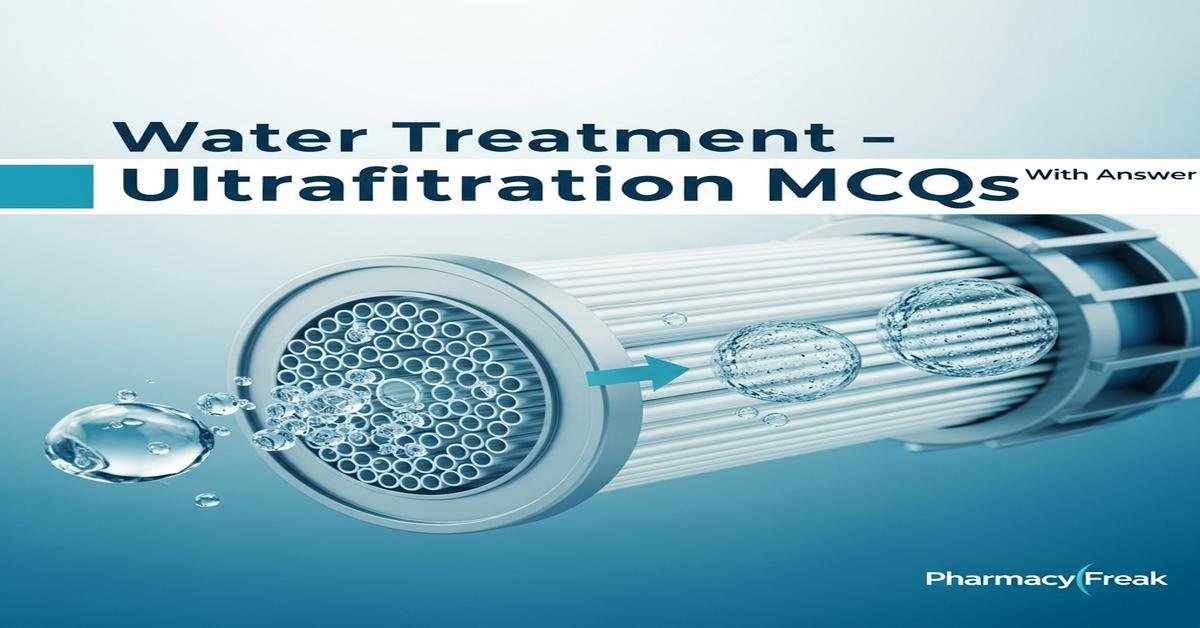
Introduction: Ultrafiltration (UF) is a critical membrane-based separation process in pharmaceutical water treatment used to remove suspended solids, colloids, macromolecules, and microorganisms from process and utility waters. For M.Pharm students studying pharmaceutical production technology, understanding UF fundamentals—membrane materials, module types, transmembrane pressure (TMP), flux behavior, fouling mechanisms, cleaning strategies, and validation requirements—is essential for designing and operating compliant water systems. This blog provides targeted multiple-choice questions with answers to reinforce core principles, regulatory considerations, and practical operational challenges of UF in pharmaceutical contexts, helping students prepare for exams and real-world applications in sterile production and water quality control.
Q1. What is the primary separation mechanism in ultrafiltration used for pharmaceutical water treatment?
- Size-exclusion (sieving) of macromolecules and particulates
- Adsorption onto membrane surface
- Ion exchange through charged pores
- Evaporation and condensation
Correct Answer: Size-exclusion (sieving) of macromolecules and particulates
Q2. Which range best describes typical pore sizes for ultrafiltration membranes applied in pharmaceutical water systems?
- Approximately 1–100 nanometers
- Approximately 0.1–1 micrometers
- Approximately 0.001–0.01 nanometers
- Approximately 1–10 micrometers
Correct Answer: Approximately 1–100 nanometers
Q3. Which membrane material is widely used for pharmaceutical ultrafiltration modules because of good chemical resistance and low protein adsorption?
- Polyethersulfone (PES)
- Polyethylene (PE)
- Polytetrafluoroethylene (PTFE)
- Rubber
Correct Answer: Polyethersulfone (PES)
Q4. What is the main operational advantage of crossflow (tangential) ultrafiltration compared with dead-end filtration?
- Tangential flow reduces deposit build-up at the membrane surface, lowering fouling
- Tangential flow increases permeate salt passage
- Tangential flow eliminates the need for regular cleaning
- Tangential flow allows operation at very high temperatures only
Correct Answer: Tangential flow reduces deposit build-up at the membrane surface, lowering fouling
Q5. How is transmembrane pressure (TMP) commonly calculated for a crossflow ultrafiltration system?
- TMP = (P_feed + P_retentate)/2 − P_permeate
- TMP = P_permeate − P_feed
- TMP = P_feed × P_permeate / P_retentate
- TMP = P_retentate − P_feed
Correct Answer: TMP = (P_feed + P_retentate)/2 − P_permeate
Q6. Which type of fouling is typically reversible and can often be diminished by backwashing or increased crossflow?
- Surface (cake) fouling composed of loosely attached particles
- Irreversible pore blocking by adsorbed organics
- Chemical degradation of the membrane polymer
- Mechanical rupture of membrane fibers
Correct Answer: Surface (cake) fouling composed of loosely attached particles
Q7. Which cleaning strategy is most appropriate for removing organic foulants from UF membranes in pharmaceutical water systems?
- Caustic (alkaline) clean-in-place followed by acid rinse and disinfectant as required
- Pure water rinse only
- Mechanical scraping of membrane surface
- Chlorination at high free chlorine concentrations for extended periods
Correct Answer: Caustic (alkaline) clean-in-place followed by acid rinse and disinfectant as required
Q8. How does permeate flux typically change as transmembrane pressure (TMP) increases under constant conditions?
- Flux increases with TMP until a limiting (critical) flux is reached, then plateaus or increases slowly
- Flux always increases linearly without limit as TMP increases
- Flux decreases as TMP increases due to membrane compaction only
- Flux remains constant regardless of TMP
Correct Answer: Flux increases with TMP until a limiting (critical) flux is reached, then plateaus or increases slowly
Q9. What is the definition of “critical flux” in ultrafiltration?
- The maximum flux below which fouling rate is negligible or steady-state is maintained
- The flux at which membrane physically breaks
- The flux at which permeate conductivity equals feed conductivity
- The flux required to sterilize feed water
Correct Answer: The maximum flux below which fouling rate is negligible or steady-state is maintained
Q10. Which contaminants are ultrafiltration membranes most reliably expected to retain in pharmaceutical water treatment?
- Bacteria, suspended particulates, colloids and high-molecular-weight organics
- Dissolved inorganic salts such as sodium and chloride
- Low-molecular-weight gases like oxygen and nitrogen
- All dissolved ions and monovalent salts
Correct Answer: Bacteria, suspended particulates, colloids and high-molecular-weight organics
Q11. What does the Molecular Weight Cut-Off (MWCO) of an ultrafiltration membrane represent?
- The approximate molecular weight (Daltons) at which the membrane retains 90% of solute
- The pore diameter in micrometers at which 50% retention occurs
- The maximum pressure the membrane can withstand
- The minimum salt rejection percentage for the membrane
Correct Answer: The approximate molecular weight (Daltons) at which the membrane retains 90% of solute
Q12. Which disinfection/sanitization method is commonly used for polymeric UF modules in pharmaceutical water systems because many polymers cannot withstand high-temperature steam cycles?
- Chemical sanitization (e.g., peracetic acid or hydrogen peroxide) and hot water sanitization
- Prolonged bleaching with high-concentration chlorine only
- Continuous steam autoclaving at 140 °C
- Dry-heat sterilization at 200 °C
Correct Answer: Chemical sanitization (e.g., peracetic acid or hydrogen peroxide) and hot water sanitization
Q13. Which routine online parameter is most useful for early detection of membrane integrity loss or gross failure in UF permeate?
- Permeate turbidity or particle count monitoring
- Feed pH measurement only
- Color observation by visual inspection only
- Electrical conductivity of feed only
Correct Answer: Permeate turbidity or particle count monitoring
Q14. What is the primary purpose of periodic backwashing in hollow-fiber ultrafiltration modules?
- To dislodge and remove reversible surface deposits and restore flux
- To chemically alter the membrane polymer to improve selectivity
- To increase feed temperature by recirculation
- To convert dissolved salts into precipitates
Correct Answer: To dislodge and remove reversible surface deposits and restore flux
Q15. How does concentration polarization differ from fouling in the context of ultrafiltration?
- Concentration polarization is accumulation of solutes at the membrane surface and is reversible; it can lead to fouling which may be irreversible
- Concentration polarization is irreversible chemical bonding of solutes within pores, while fouling is always reversible
- They are identical phenomena and the terms are interchangeable
- Concentration polarization only occurs in dead-end systems, while fouling only occurs in crossflow systems
Correct Answer: Concentration polarization is accumulation of solutes at the membrane surface and is reversible; it can lead to fouling which may be irreversible
Q16. What are the common units used to express ultrafiltration permeate flux in pharmaceutical literature?
- Liters per square meter per hour (LMH)
- Meters squared per liter (m2/L)
- Milligrams per liter (mg/L)
- Pascal-seconds (Pa·s)
Correct Answer: Liters per square meter per hour (LMH)
Q17. What is a typical operating transmembrane pressure (TMP) range for polymeric ultrafiltration systems in water treatment?
- Approximately 0.1 to 2.0 bar
- Approximately 5 to 10 bar
- Approximately 10 to 50 bar
- Approximately 50 to 100 bar
Correct Answer: Approximately 0.1 to 2.0 bar
Q18. Which UF module configuration typically provides the highest membrane surface area per unit volume and is common in pharmaceutical water polishing?
- Hollow-fiber modules
- Plate-and-frame modules
- Spiral-wound modules only used for high-salinity feeds
- Membrane cartridges with woven cloth
Correct Answer: Hollow-fiber modules
Q19. Can ultrafiltration alone be universally accepted by pharmacopeial standards as a replacement for distillation to produce Water for Injection (WFI)?
- No — ultrafiltration alone is generally not accepted as a universal replacement for distillation without rigorous validation and regulatory acceptance
- Yes — ultrafiltration always produces WFI equivalent to distillation without further validation
- Yes — ultrafiltration is cheaper and therefore automatically accepted
- No — ultrafiltration cannot remove particulates
Correct Answer: No — ultrafiltration alone is generally not accepted as a universal replacement for distillation without rigorous validation and regulatory acceptance
Q20. Which metric is commonly used to express microbial removal performance (e.g., bacteria or virus) of a membrane process during validation?
- Log Reduction Value (LRV)
- Percent transmittance (%T) only
- Absolute pore number (APN)
- Membrane color index (MCI)
Correct Answer: Log Reduction Value (LRV)


I am a Registered Pharmacist under the Pharmacy Act, 1948, and the founder of PharmacyFreak.com. I hold a Bachelor of Pharmacy degree from Rungta College of Pharmaceutical Science and Research. With a strong academic foundation and practical knowledge, I am committed to providing accurate, easy-to-understand content to support pharmacy students and professionals. My aim is to make complex pharmaceutical concepts accessible and useful for real-world application.
Mail- Sachin@pharmacyfreak.com