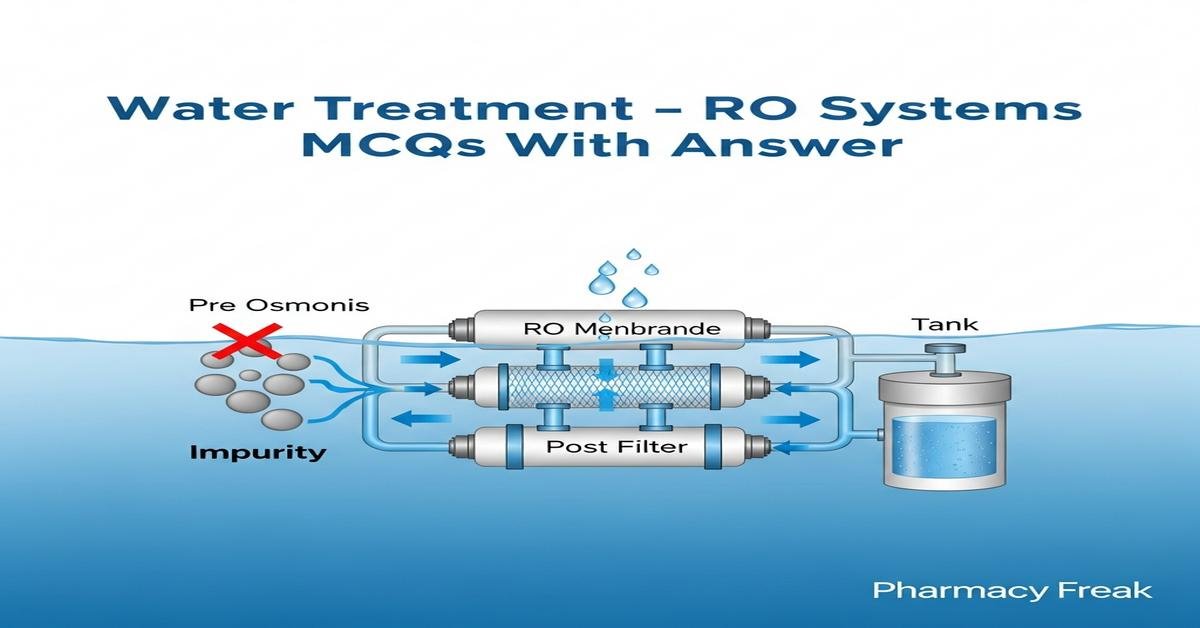
Introduction:
This quiz collection on Water Treatment – RO Systems is tailored for M.Pharm students studying MIP 203T – Pharmaceutical Production Technology. The questions focus on principles, membrane types, pre-treatment, fouling and scaling, operational parameters, monitoring, cleaning and validation considerations of reverse osmosis units used in pharmaceutical water production. Designed to test both theoretical understanding and practical decision-making, the set covers membrane chemistry, flux and rejection, concentration polarization, CIP strategies, and quality control parameters relevant to producing Purified Water and Water for Injection. Use these MCQs to prepare for exams and to strengthen problem-solving for real-world RO system operation and maintenance.
Q1. What is the primary driving force in a reverse osmosis (RO) membrane separation process?
- Temperature gradient across the membrane
- Hydraulic pressure applied to the feed side
- Concentration gradient alone
- Electrical potential across the membrane
Correct Answer: Hydraulic pressure applied to the feed side
Q2. Which membrane material is generally more tolerant to free chlorine commonly found in pretreated feed water?
- Aromatic polyamide thin-film composite
- Cellulose acetate
- Polysulfone
- Polyethylene
Correct Answer: Cellulose acetate
Q3. How is percent salt rejection of an RO membrane defined?
- Rejection (%) = (Cp/Cf) × 100
- Rejection (%) = (1 – Cp/Cf) × 100
- Rejection (%) = (Cf/Cp) × 100
- Rejection (%) = Cp – Cf
Correct Answer: Rejection (%) = (1 – Cp/Cf) × 100
Q4. Which fouling type is primarily caused by divalent cations such as calcium and sulfate precipitating on the membrane?
- Particulate fouling
- Biofouling
- Scaling
- Organic fouling
Correct Answer: Scaling
Q5. In RO systems, what is concentration polarization?
- Permanent chemical change of membrane due to oxidants
- Local increase of solute concentration at the membrane surface reducing effective driving force
- Drop in feed pressure due to pump failure
- Diffusion of water molecules back into the feed stream
Correct Answer: Local increase of solute concentration at the membrane surface reducing effective driving force
Q6. Which pretreatment step is most important to prevent particulate fouling and protect RO membranes?
- Activated carbon adsorption only
- Micro/ultrafiltration or cartridge filtration to remove suspended solids
- Increasing feed pH without filtration
- Continuous chlorination of feed water
Correct Answer: Micro/ultrafiltration or cartridge filtration to remove suspended solids
Q7. What is the typical recommended maximum Silt Density Index (SDI) value for RO feed water in pharmaceutical practice?
- SDI < 10
- SDI < 6
- SDI < 3
- SDI < 0.5
Correct Answer: SDI < 3
Q8. Which cleaning chemical is commonly used to remove inorganic scales such as calcium carbonate from RO membranes?
- Alkaline detergent (sodium hydroxide)
- Oxidizing bleach (sodium hypochlorite)
- Acid cleaner (citric or dilute hydrochloric acid)
- Chelating surfactant-free biocide
Correct Answer: Acid cleaner (citric or dilute hydrochloric acid)
Q9. Why are aromatic polyamide thin-film composite membranes favored for high salt rejection in pharmaceutical RO systems?
- They are completely chlorine-resistant
- They provide high water flux with excellent salt rejection characteristics
- They are inexpensive and disposable
- They allow passage of larger organics to prevent fouling
Correct Answer: They provide high water flux with excellent salt rejection characteristics
Q10. What is the typical effect of increasing feedwater temperature on RO performance?
- Flux decreases and rejection increases
- Flux increases and rejection decreases
- Both flux and rejection remain unchanged
- Flux decreases and rejection decreases
Correct Answer: Flux increases and rejection decreases
Q11. For pharmaceutical Purified Water production using RO, which parameter is most directly monitored to assess ionic purity of permeate?
- Turbidity
- Conductivity
- Bacterial endotoxin units (EU)
- Dissolved organic carbon (DOC)
Correct Answer: Conductivity
Q12. Which action is contraindicated for cleaning aromatic polyamide RO membranes?
- Using low concentrations of chlorine for prolonged periods
- Neutral pH enzymatic cleaners for biological fouling
- Periodic acidic descaling
- Brief exposure to formulated oxidant-neutralizing agents followed by rinse
Correct Answer: Using low concentrations of chlorine for prolonged periods
Q13. What does “recovery” mean in the context of an RO system?
- The percentage of feed that becomes concentrate
- The time taken to clean a membrane
- The percentage of feedwater converted into permeate
- The membrane’s return to original flux after cleaning
Correct Answer: The percentage of feedwater converted into permeate
Q14. Which membrane element configuration is most commonly used in commercial pharmaceutical RO units?
- Hollow fiber membranes in dead-end mode
- Plate-and-frame ultrafiltration stacks
- Spiral-wound membrane elements in crossflow configuration
- Flat-sheet membranes in stirred tanks
Correct Answer: Spiral-wound membrane elements in crossflow configuration
Q15. Which monitoring parameter best indicates early membrane fouling due to particulate accumulation?
- Increase in transmembrane pressure drop (feed-minus-permeate pressure)
- Decrease in feed turbidity
- Constant permeate conductivity
- Reduction in concentrate flow only
Correct Answer: Increase in transmembrane pressure drop (feed-minus-permeate pressure)
Q16. Which antiscalant action helps prevent scaling on RO membranes?
- Oxidizing organic matter to CO2
- Sequestering or dispersing sparingly soluble salts to keep them in solution
- Reducing membrane pore size chemically
- Increasing feedwater hardness to precipitate upstream
Correct Answer: Sequestering or dispersing sparingly soluble salts to keep them in solution
Q17. During validation of an RO system for pharmaceutical use, which quality attribute is commonly included in routine monitoring of the permeate?
- Particle size distribution of concentrate
- Permeate conductivity and total organic carbon (TOC)
- Exact molecular weight distribution of all solutes
- Feed pump motor torque only
Correct Answer: Permeate conductivity and total organic carbon (TOC)
Q18. What is the primary reason for using high-pressure pumps in an RO skid?
- To create turbulence for biological growth
- To provide the hydraulic pressure needed to overcome osmotic pressure and drive permeation
- To decrease feedwater temperature
- To add chemical disinfectant to the feed
Correct Answer: To provide the hydraulic pressure needed to overcome osmotic pressure and drive permeation
Q19. Which statement about membrane compaction is correct?
- Compaction permanently increases membrane pore size and flux
- Compaction occurs when membranes are permanently torn by high pressure
- Compaction is a reversible densification under pressure that can reduce initial flux
- Compaction only occurs in cellulose acetate membranes exposed to chlorine
Correct Answer: Compaction is a reversible densification under pressure that can reduce initial flux
Q20. Which management practice helps control biofouling in RO systems used for pharmaceutical water?
- Eliminating all pre-filtration to allow microbial passage
- Maintaining nutrients in feed to support stable biofilm formation
- Implementing effective upstream disinfection, nutrient removal, and regular cleaning/sanitization
- Using high free chlorine concentrations directly on polyamide membranes routinely
Correct Answer: Implementing effective upstream disinfection, nutrient removal, and regular cleaning/sanitization

