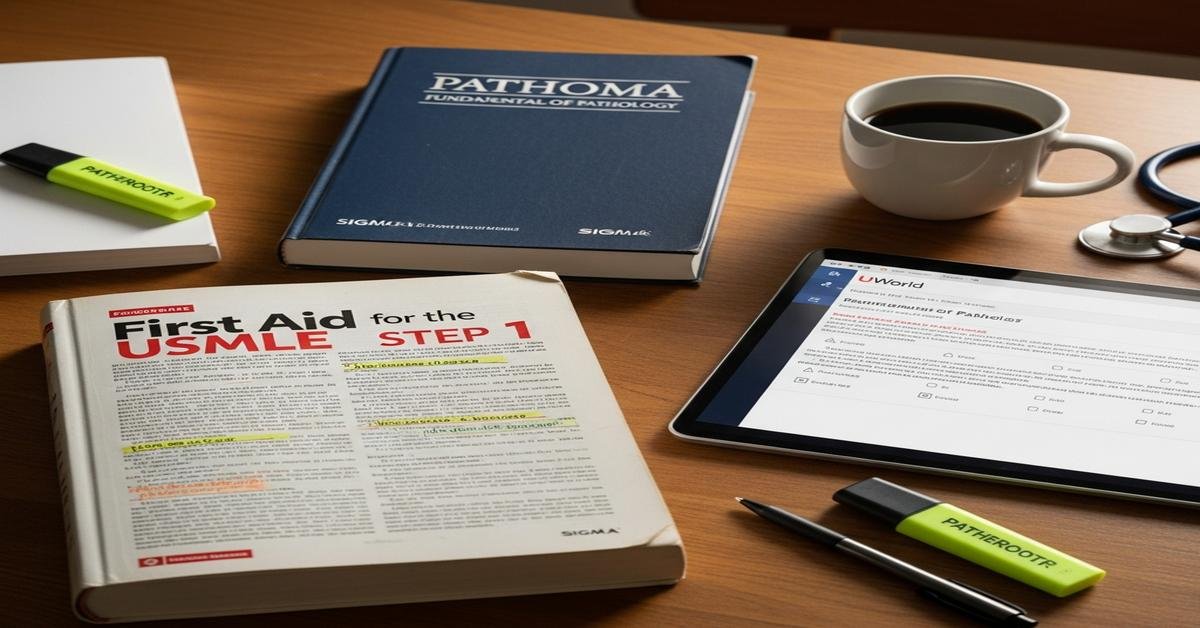
The USMLE Step 1 is tough, but you don’t need a toolbox full of resources to pass. You need a tight system built around the three that matter most: UWorld, Pathoma, and First Aid. These cover application, understanding, and recall. Used together, they mirror how the exam thinks, prevent overwhelm, and make your study hours count. This guide shows you exactly how to use each resource, how to combine them day to day, and how to know when you’re ready.
What Step 1 Tests—and Why These Three Win
Step 1 is not a memory test. It’s a reasoning test wrapped in clinical vignettes. You’ll be asked to pull a clue from the history, connect it to a mechanism, and choose the one answer that fits the mechanism and the facts.
That means you need:
- Application practice (UWorld) to learn how clues map to mechanisms and answers.
- Mechanism mastery (Pathoma) to make sense of disease processes you keep seeing.
- Fact coverage and recall (First Aid) to quickly retrieve names, pathways, and buzzwords.
Anything beyond these is optional. If you can apply concepts (UWorld), understand them (Pathoma), and recall details (First Aid), you’re ready.
UWorld — Your Primary Engine
Why it works: UWorld is the closest match to exam style and difficulty. The stems force you to reason. The explanations teach you how to reason. If you learn the patterns here, you’ll recognize them on test day.
How to use it:
- One strong pass beats two rushed passes. Aim for a complete first pass with careful review. Then do targeted second-pass sets of wrongs and marked questions.
- Do blocks in timed mode. Start with 40-question blocks, system-based early on. Switch to mixed blocks 3–4 weeks before your exam to train stamina and switching.
- Review takes longer than doing. Expect 2–3 hours to review a 1-hour block well. If it takes less, you’re probably skimming.
How to review a question:
- Rebuild the reasoning: Before reading the explanation, say out loud why the correct choice must be right and why each wrong choice must be wrong.
- Capture a single “do differently”: Was the miss due to a knowledge gap (didn’t know the fact), a comprehension gap (misread the stem), or a process gap (changed answer at the end)? Write one fix.
- Annotate tightly: Put only the new, reusable fact or mechanism into First Aid. If a sentence won’t help you answer a future question, don’t add it.
Tag and track:
- Create custom tags like acid-base: renal, biostats: study design, or micro: gram+ rods. Build short, focused review sets from your weak tags weekly.
- Watch for pattern changes: early mixed scores may be messy. If your last 500–800 questions trend upward and your weak tags shrink, you’re consolidating.
Common pitfalls with UWorld:
- Untimed/tutor mode forever. You’ll think you know more than you can do under pressure. Use timed mode to learn pacing.
- Over-annotating First Aid. Ten pages of notes won’t help on test day. Capture only what changes your future answers.
- Chasing percent-correct. Use it to identify weak areas, not to judge yourself. Trends matter more than a single day’s average.
Pathoma — Master Disease Mechanisms
Why it works: Pathoma explains the “why” behind pathology with clean language and high-yield emphasis. When you understand a mechanism, you won’t get tricked by distractors that only change surface details.
How to use it:
- Pair it with systems in UWorld. Before you start renal questions, watch the renal chapters and skim the book pages. Then go do the questions; the mechanism will be fresh.
- Read the book while you watch. Underline the one sentence per subsection that explains the mechanism. Circle the clinical correlates that show up in UWorld.
- Rewatch selectively. If UWorld flags you on a topic twice (e.g., nephrotic syndromes, vasculitides), rewatch just that segment at 1.25–1.5x speed.
Chapters to prioritize if time is tight:
- Inflammation, neoplasia, hemodynamic disorders (these unlock many systems).
- Cardio, renal, respiratory, GI, heme-onc.
- Endocrine and reproductive for classic patterns.
What to write down: One or two lines per disease: the core mechanism, a key lab or morphologic finding, and one classic presentation. Example: Minimal change disease — podocyte foot process effacement; selective albuminuria; child post URI; steroids help. This format directly answers common stems.
First Aid — Your Map and Memory Aid
Why it works: First Aid gives you near-complete content coverage in a tight outline. It won’t teach you how to think, but it makes sure you don’t miss the recall facts that link mechanisms to answers.
How to use it:
- Annotate, don’t rewrite. Add UWorld-derived pearls next to the relevant line. Keep annotations short: 1 line per concept, max.
- Weekly “cover-and-recall.” Take a section (e.g., cardio) and test yourself: cover the right column, recall the enzyme/defect/association, then check. Mark misses with a star and revisit in two days.
- Create a rapid-review list. Star 2–3 pages per system of the most-missed facts. These become your last-week sprint pages.
What not to do: Don’t try to “learn medicine” from First Aid alone. Without UWorld and Pathoma, the facts float without context. Always anchor new facts to a mechanism (Pathoma) or a question you missed (UWorld).
Putting It Together — An 8–12 Week Plan
This plan assumes full-time study. Adjust volume, not structure, if you need longer or shorter.
Weekly structure (system-based first 4–5 weeks):
- Day 1–2: Pathoma for the system (watch + read), then 40–80 UWorld questions on that system in timed mode.
- Day 3–5: 2 blocks/day (80 questions), same system. Afternoon/evening: thorough review + First Aid annotation.
- Day 6: Mixed block (40–80 questions) to keep older systems in play. Quick Pathoma rewatch for topics you missed twice.
- Day 7: Light day: 1 block max, then First Aid cover-and-recall and your error log. Reset for the next system.
Daily flow (during systems):
- Morning: 1–2 timed blocks.
- Midday–afternoon: Deep review of each question. Write one “do differently” per miss.
- Late afternoon: Pathoma chapter for tomorrow’s system topics or rewatch segments for weak spots.
- Evening: First Aid recall, 30–45 minutes of targeted flashcards (only from your own misses/annotations).
Final 3–4 weeks: Switch to all mixed blocks, keep Pathoma for patching weak mechanisms, and increase First Aid rapid review. Add full-length practice exams spaced about 7–10 days apart to check stamina and pacing.
If Your Timeline Is Different
- 16–24 weeks: Slow the volume, not the method. Do 40–60 UWorld questions/day during classes, weekends for review. Finish Pathoma once, then a targeted rewatch. Start mixed blocks earlier.
- 4–6 weeks: Prioritize UWorld completion. Watch only high-yield Pathoma chapters or weak areas. First Aid becomes nightly recall. Keep at least one rest half-day per week to avoid burnout.
- Working around rotations: Do one 40-question block daily in timed mode. Use commutes for Pathoma audio and evenings for First Aid recall. Protect one longer review block on weekends.
Active Review Methods That Actually Work
The error log (kept simple):
- Columns: Topic, Miss type (knowledge/comprehension/process), One-line fix, Reference (FA page or Pathoma chapter), Next review date.
- Example: Biostats — Type I error; knowledge; α = false positive rate, not power; FA p.66; review Fri.
Whiteboard recall: Set a 10-minute timer and write everything you remember about a topic (e.g., nephrotic syndromes). Then fill gaps using First Aid. This forces retrieval and shows you what’s actually in memory.
Personal flashcards: Make cards only from your misses and First Aid stars. One fact per card, question on one side, answer on the other. Aim for 30–50/day, not 300. Spaced repetition only works if you can keep up.
Assessments and Knowing You’re Ready
Why assess: You need an external check on pacing, fatigue, and blind spots. Question banks alone can’t simulate the pressure and mixed content of a full exam.
When to test:
- Baseline (optional): A shorter practice exam can show weak areas but don’t obsess over the number.
- Mid-dedicated: After you’ve finished ~50–60% of UWorld, take a practice exam to see if your system-based gains carry over to mixed sets.
- Final 2–3 weeks: One exam per week, then focus your studying on what the exam exposed (not everything you already know).
Readiness signs:
- Your last 500–800 UWorld questions (mixed) show consistent performance and fewer repeat mistakes in weak tags.
- Your practice exams stabilize near your goal range, with no single domain dragging far behind.
- On review days, you can teach back mechanisms from Pathoma and recall key First Aid facts without peeking.
How to use UWorld self-assessments: Take one 10–14 days before the exam and one about a week out. Use results to target your last-week list. Don’t take a full exam in the final 72 hours unless you know recovery won’t be an issue.
Common Traps and How to Avoid Them
- Passive reading. If you aren’t retrieving or answering questions, you aren’t building exam skills. Every hour should include recall, not just exposure.
- Resource hopping. Switching tools feels productive but resets your mental model each time. Stick to the big three and patch gaps with targeted review, not new primary resources.
- Over-annotating First Aid. If your annotations crowd out the printed text, you’ve gone too far. Keep only what changes future answers.
- Never practicing timing. Untimed question sets won’t prepare you for fatigue. Use timed blocks early and often.
- Skipping biostats and ethics. These are controllable points. Drill study designs, bias types, test characteristics, and basic ethics frameworks.
Final Week and the Last 72 Hours
7 days out:
- Finish your last full practice exam 5–7 days before test day.
- Refine your rapid-review pages (First Aid stars, personal flashcards, top errors).
- Do 1–2 mixed blocks daily with high-quality review, then switch to light recall.
72 hours out:
- No full exams. Do, at most, 1–2 short blocks to stay sharp.
- Review Pathoma segments for your weakest 2–3 mechanisms.
- Run your rapid-review list and biostats formulas once per day.
- Set sleep and meals to test-day schedule. Pack essentials: ID, scheduling permit, snacks, water, layers, earplugs if allowed.
Putting the Three Together, With Examples
Example: A UWorld renal question on metabolic acidosis.
- You miss it by mixing up RTA types. In review, you identify a knowledge gap.
- Pathoma: Rewatch distal vs. proximal RTA. Note the mechanism differences.
- First Aid: Annotate one line: Type I (distal): H+ secretion defect → alkaline urine, kidney stones; Type II (proximal): HCO3− reabsorption defect; Type IV: hypoaldosterone → hyperkalemia.
- Make a 3-card set, then add a tag “acid-base: renal” in UWorld. Do a 10-question custom set on that tag in two days.
Example: A heme-onc vignette with anemia of chronic disease.
- You changed your answer last second (a process error). Your “do differently”: trust first-pass mechanism if labs fit.
- Pathoma: Review iron studies across anemias (ferritin high vs. low, TIBC patterns).
- First Aid: Star the iron panel table. Practice cover-and-recall for two nights.
How to Pace Yourself Without Burning Out
- Set a ceiling. Two high-quality blocks and full reviews per day beat four rushed blocks. Depth over volume.
- Protect a recovery window. One half-day off per week prevents diminishing returns. Use it.
- Batch admin tasks. Keep your error log and annotations tidy as you go. Clutter costs time you don’t have later.
Bottom Line
UWorld trains your application. Pathoma cements your mechanisms. First Aid locks in recall. Use them together, on a schedule that forces timed practice, targeted review, and spaced retrieval. Keep your notes lean, your feedback loops short, and your focus tight. If your recent mixed performance is steady, your practice exams are stable, and you can teach back the “why” behind diseases, you’re ready to pass Step 1.

