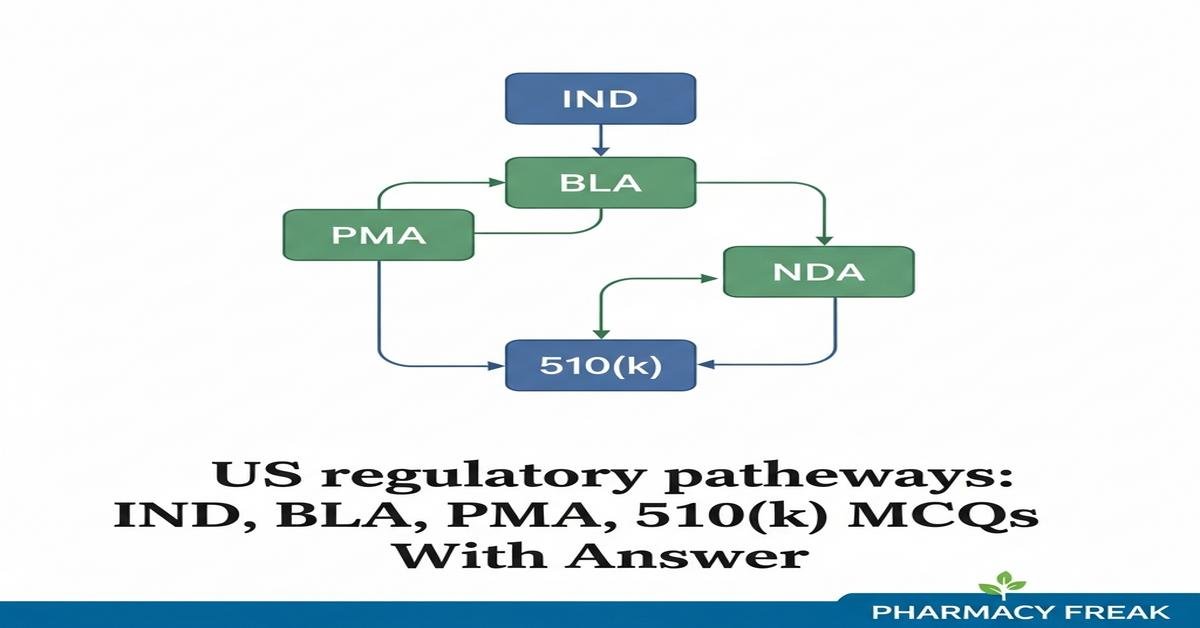
Introduction: This quiz collection is designed for M.Pharm students to strengthen understanding of key US regulatory pathways: IND, BLA, PMA, NDA and 510(k). It explains how investigational new drug applications enable clinical trials, how biologics license applications differ from NDAs, and how device pathways (510(k), De Novo, PMA) determine marketing routes. Questions emphasize submission components, review standards, clinical hold reasons, predicate devices, and regulatory strategies for complex products like biologics and combination products. Working through these focused multiple-choice questions will help consolidate regulatory knowledge needed for drug development planning, regulatory writing, and exam preparation in the context of US FDA requirements.
Q1. What is the primary purpose of an Investigational New Drug (IND) application?
- To obtain marketing approval for a new drug or biologic
- To request permission from FDA to begin or continue human clinical trials
- To establish patent protection for a drug substance
- To register a medical device with the FDA
Correct Answer: To request permission from FDA to begin or continue human clinical trials
Q2. Which FDA center principally reviews Biologics License Applications (BLAs)?
- Center for Drug Evaluation and Research (CDER)
- Center for Devices and Radiological Health (CDRH)
- Center for Biologics Evaluation and Research (CBER)
- Office of Generic Drugs (OGD)
Correct Answer: Center for Biologics Evaluation and Research (CBER)
Q3. Which of the following best describes the regulatory standard for approval of an NDA?
- No evidence required if manufacturing quality is assured
- Substantial evidence of safety and effectiveness from adequate and well-controlled clinical trials
- Demonstration of substantial equivalence to a predicate product
- Only nonclinical toxicology data are required
Correct Answer: Substantial evidence of safety and effectiveness from adequate and well-controlled clinical trials
Q4. A 510(k) submission to the FDA is intended to demonstrate:
- That a new device is safe and effective based on clinical trials
- That a device is substantially equivalent to a legally marketed predicate device
- That a device qualifies as a biologic and requires a BLA
- That a device is intended solely for investigational use
Correct Answer: That a device is substantially equivalent to a legally marketed predicate device
Q5. Which pathway is normally required for high-risk Class III medical devices?
- 510(k)
- Abbreviated New Drug Application (ANDA)
- Premarket Approval (PMA)
- Biologics License Application (BLA)
Correct Answer: Premarket Approval (PMA)
Q6. What regulatory action can the FDA issue to stop a clinical trial under an IND until deficiencies are resolved?
- CE Mark
- Clinical hold
- 510(k) denial
- Notice of compliance
Correct Answer: Clinical hold
Q7. Which submission typically contains detailed CMC (chemistry, manufacturing and controls) information for a biologic product?
- Investigational Device Exemption (IDE)
- Investigational New Drug (IND)
- Biologics License Application (BLA)
- 510(k)
Correct Answer: Biologics License Application (BLA)
Q8. The 30-day waiting period after IND submission primarily serves to:
- Guarantee FDA approval for clinical trials
- Allow FDA time to review and place a clinical hold if needed
- Begin marketing the investigational product
- Establish patent priority
Correct Answer: Allow FDA time to review and place a clinical hold if needed
Q9. Which regulatory pathway would an applicant choose to market a biosimilar in the US?
- 505(b)(2) NDA
- Abbreviated New Drug Application (ANDA) 505(j)
- Biologics pathway under Section 351(k) of the Public Health Service Act
- Premarket Notification 510(k)
Correct Answer: Biologics pathway under Section 351(k) of the Public Health Service Act
Q10. What is “substantial equivalence” in the context of 510(k) submissions?
- Demonstrating identical manufacturing processes to the predicate
- Showing the device has the same intended use and similar technological characteristics as a predicate
- Proving the device works better than any existing device
- Providing clinical trial evidence equivalent to an NDA
Correct Answer: Showing the device has the same intended use and similar technological characteristics as a predicate
Q11. Which of the following is a correct distinction between an NDA and a BLA?
- NDA is for devices; BLA is for small-molecule drugs
- NDA submissions are reviewed by CBER; BLA by CDER
- NDA is used for new drugs reviewed by CDER; BLA is used for biologics reviewed by CBER or CDER
- NDA requires no clinical data; BLA requires clinical trials
Correct Answer: NDA is used for new drugs reviewed by CDER; BLA is used for biologics reviewed by CBER or CDER
Q12. Which FDA program is specifically intended to expedite development and review for products treating serious conditions with preliminary clinical evidence of substantial improvement?
- Pediatric exclusivity
- Breakthrough Therapy designation
- 510(k) clearance
- Abbreviated New Drug Application (ANDA)
Correct Answer: Breakthrough Therapy designation
Q13. A De Novo request to the FDA is most appropriate when:
- A device has a clear predicate and low risk
- A sponsor wants to market a novel low-to-moderate risk device without a predicate
- A device requires a BLA
- A sponsor seeks an investigational exemption for clinical studies
Correct Answer: A sponsor wants to market a novel low-to-moderate risk device without a predicate
Q14. Which of the following is NOT typically part of an IND submission?
- Investigator’s brochure and clinical protocols
- Nonclinical toxicology studies
- Marketing claims and promotional labeling intended for post-approval promotion
- CMC information on drug substance and product
Correct Answer: Marketing claims and promotional labeling intended for post-approval promotion
Q15. What is a common reason the FDA may place a clinical hold on an IND?
- Inadequate nonclinical safety data supporting initial human exposure
- Excessively detailed manufacturing controls
- Submission of a 510(k) instead of a PMA
- Filing of a De Novo request for a drug product
Correct Answer: Inadequate nonclinical safety data supporting initial human exposure
Q16. Which document establishes that a medical device is “substantially equivalent” and can be marketed without PMA?
- Investigational New Drug (IND)
- 510(k) clearance letter
- Biologics License (BLA)
- New Drug Application (NDA)
Correct Answer: 510(k) clearance letter
Q17. For a monoclonal antibody intended as a therapeutic biologic, which submission would be required to obtain marketing authorization?
- New Drug Application (NDA) 505(b)(1)
- 510(k) premarket notification
- Biologics License Application (BLA)
- Abbreviated New Drug Application (ANDA)
Correct Answer: Biologics License Application (BLA)
Q18. Which pathway allows a sponsor to rely in part on published literature or FDA findings of safety and effectiveness for a drug product?
- 505(b)(2) NDA
- 510(k)
- Premarket Approval (PMA)
- BLA 351(a)
Correct Answer: 505(b)(2) NDA
Q19. Which statement about Premarket Approval (PMA) is correct?
- PMA is an expedited pathway equivalent to a 510(k)
- PMA requires demonstration of reasonable assurance of safety and effectiveness, often including clinical data
- PMA is only used for combination products that contain biologics
- PMA allows market entry based solely on substantial equivalence to older devices
Correct Answer: PMA requires demonstration of reasonable assurance of safety and effectiveness, often including clinical data
Q20. What role does the FDA’s Office of Combination Products play in regulatory submissions?
- It conducts all clinical trials for combination products
- It assigns primary review jurisdiction (CDER, CBER, or CDRH) and coordinates review for combination products
- It approves all 510(k) submissions for combination products
- It grants patent exclusivity for combination products
Correct Answer: It assigns primary review jurisdiction (CDER, CBER, or CDRH) and coordinates review for combination products

