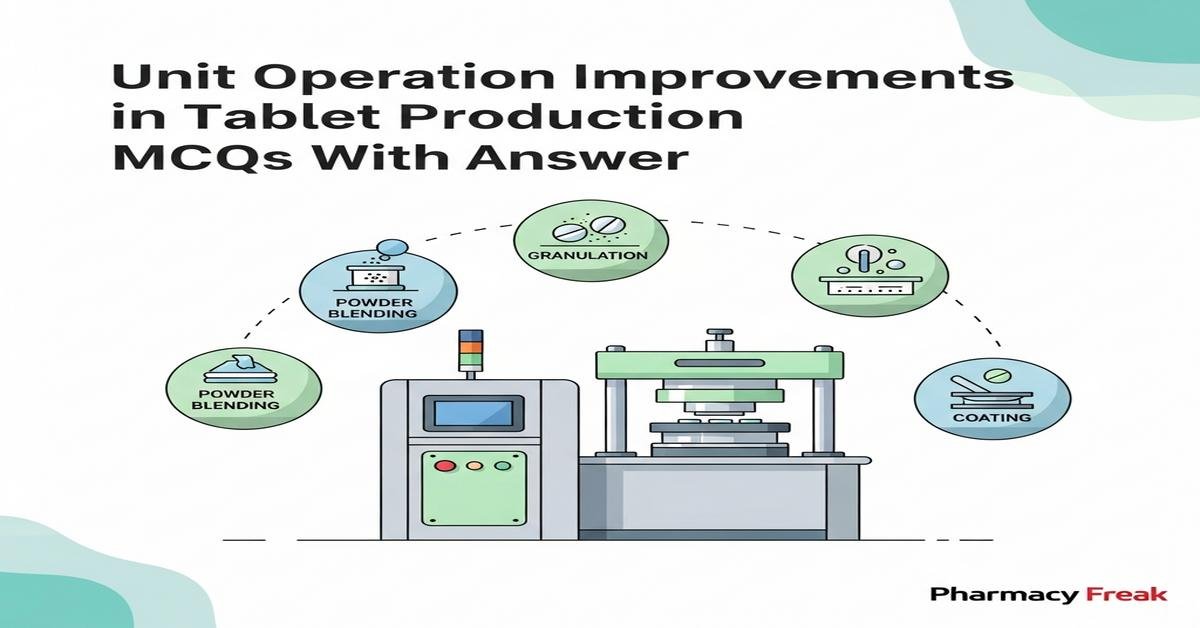
Introduction: This collection of MCQs on Unit Operation Improvements in Tablet Production is tailored for M.Pharm students preparing for MIP 203T – Pharmaceutical Production Technology. The questions emphasize advanced process optimization strategies—covering granulation, compression, coating, continuous manufacturing, PAT, and troubleshooting common defects. Each item probes practical understanding of equipment modifications, formulation adjustments, and control strategies that enhance tablet quality attributes such as content uniformity, hardness, disintegration, and stability. Use these MCQs to test your grasp of contemporary improvements like twin-screw wet granulation, in-line NIR monitoring, loss-in-weight feeding, and QbD approaches, which are essential for modern scalable and robust tablet production.
Q1. Which modification to a high-shear granulator most effectively improves granule uniformity and reduces over-wet granule formation during wet granulation?
- Increasing impeller speed while keeping chopper off
- Introducing a tapered chopper with automated liquid feed control
- Reducing binder concentration and increasing drying temperature
- Replacing stainless steel bowl with glass-lined bowl
Correct Answer: Introducing a tapered chopper with automated liquid feed control
Q2. Which continuous manufacturing element most directly reduces weight variation in tablets during scale-up?
- Converting from rotary to single-punch press
- Implementing loss-in-weight feeders synchronized with a control loop
- Increasing granule moisture to improve compressibility
- Using larger diameter punches without modifying feed frame
Correct Answer: Implementing loss-in-weight feeders synchronized with a control loop
Q3. In roller compaction for dry granulation, which adjustment most improves ribbon density and downstream tablet tensile strength?
- Decreasing roll pressure and increasing roll speed
- Increasing the roll gap and using a coarse screen in the mill
- Optimizing nip force and reducing roll speed to increase specific compaction energy
- Switching to a higher API load without altering compaction settings
Correct Answer: Optimizing nip force and reducing roll speed to increase specific compaction energy
Q4. Which PAT tool is most suitable for real-time monitoring of moisture and binder distribution during fluid-bed granulation?
- Laser diffraction particle size analyzer positioned off-line
- Near-infrared (NIR) spectroscopy with in-process probe
- Off-line HPLC moisture analysis
- Acoustic emission sensor on the coating pan
Correct Answer: Near-infrared (NIR) spectroscopy with in-process probe
Q5. To minimize tablet sticking and picking on punches, which formulation or process change is most recommended?
- Decrease lubricant concentration and shorten mixing time
- Increase the amount of fine lactose to improve adhesion
- Apply an external thin anti-adherent coating to punches and adjust lubrication level
- Reduce dwell time and increase punch speed drastically
Correct Answer: Apply an external thin anti-adherent coating to punches and adjust lubrication level
Q6. Which approach best enhances content uniformity for low-dose potent APIs in direct compression?
- Increase API particle size by coarse milling to reduce segregation
- Use ordered mixing via high-shear granulation prior to compression
- Blend API with low density excipient only at the final stage
- Omit glidant to increase tablet hardness variability
Correct Answer: Use ordered mixing via high-shear granulation prior to compression
Q7. During tableting, which press parameter adjustment increases tablet tensile strength without changing formulation?
- Increase turret speed while keeping compression depth constant
- Reduce compression force to decrease capping risk
- Increase dwell time by reducing turret speed or using a roller compaction-assisted press
- Decrease precompression force to allow greater primary compression
Correct Answer: Increase dwell time by reducing turret speed or using a roller compaction-assisted press
Q8. Which improvement in coating operation most reduces inter-tablet coating variability and mottling?
- Using a smaller spray nozzle with higher inlet air temperature and automated spray pattern control
- Decreasing pan speed while increasing spray rate without atomization changes
- Applying coating at room temperature with a single fixed spray gun
- Switching from aqueous to solvent-based coating without process optimization
Correct Answer: Using a smaller spray nozzle with higher inlet air temperature and automated spray pattern control
Q9. What is the primary benefit of twin-screw wet granulation compared to batch high-shear granulation for difficult-to-wet APIs?
- Lower equipment cost and simpler cleaning
- Improved continuous wetting, shear control, and narrower granule PSD with better scale-up reproducibility
- Elimination of the need for binders
- Ability to operate without downstream milling or drying
Correct Answer: Improved continuous wetting, shear control, and narrower granule PSD with better scale-up reproducibility
Q10. Which excipient change most directly reduces friability while retaining fast disintegration in immediate-release tablets?
- Replace microcrystalline cellulose with higher-viscosity HPMC
- Add small fraction of spray-dried lactose for improved binding and porosity
- Increase magnesium stearate to improve lubrication
- Substitute MCC with talc to enhance flow
Correct Answer: Add small fraction of spray-dried lactose for improved binding and porosity
Q11. Which in-die measurement is most valuable for immediate feedback on compression performance and troubleshooting lamination?
- In-line near-infrared spectra of the powder blend
- In-die pressure and displacement (force-distance) measurements
- Post-compression friability test results
- Off-line tablet disintegration time
Correct Answer: In-die pressure and displacement (force-distance) measurements
Q12. For scale-up from lab to production presses, what strategy best preserves tablet weight and hardness profiles?
- Maintain identical turret speed and tooling geometry regardless of press size
- Use process analytical technology and scale-up by matching specific compaction energy and dwell time rather than RPM alone
- Increase punch diameter proportionally to batch size
- Switch to direct compression to avoid scale-up issues
Correct Answer: Use process analytical technology and scale-up by matching specific compaction energy and dwell time rather than RPM alone
Q13. Which preventive maintenance improvement most reduces unplanned downtime of rotary tablet presses?
- Cleaning the press only at end of campaign
- Implementing a condition-based maintenance program using vibration and thermal sensors
- Replacing all bearings after each batch
- Lubricating with highest permitted grease monthly regardless of runtime
Correct Answer: Implementing a condition-based maintenance program using vibration and thermal sensors
Q14. In efforts to reduce segregation during powder handling, which plant modification is most effective?
- Introduce steep, short hoppers with high drop heights
- Use mass flow hopper design and minimize vertical free-fall with controlled conveying
- Increase vibration of material transfer lines to enhance flow
- Dry-blend at the final stage immediately before tableting without seeding
Correct Answer: Use mass flow hopper design and minimize vertical free-fall with controlled conveying
Q15. Which change to lubricant application can reduce over-lubrication issues that impair tablet dissolution?
- Increase magnesium stearate concentration and mix longer
- Apply lubricant as a dry powder at high energy blending
- Introduce lubricant via a micro-spray liquid lubrication system to coat particles uniformly
- Eliminate lubricant entirely and rely on high punch temperature
Correct Answer: Introduce lubricant via a micro-spray liquid lubrication system to coat particles uniformly
Q16. Which analytic indicator best predicts capping propensity during press operation?
- Bulk density of the feed blend measured off-line only
- Monitoring in-line tablet weight only
- Real-time measurement of tablet ejection force and in-die relaxation behavior
- Frequency of changeover cleaning procedures
Correct Answer: Real-time measurement of tablet ejection force and in-die relaxation behavior
Q17. For improving disintegration in tablets while maintaining mechanical strength, which excipient strategy is recommended?
- Increase binder concentration and remove superdisintegrant
- Use cross-linked polyvinylpyrrolidone (crospovidone) as an intragranular and extragranular disintegrant in optimized split addition
- Replace disintegrant with high levels of MCC
- Rely solely on physical porosity without disintegrants
Correct Answer: Use cross-linked polyvinylpyrrolidone (crospovidone) as an intragranular and extragranular disintegrant in optimized split addition
Q18. Which improvement to tablet press tooling reduces edge wear and improves tablet cosmetic finish when processing abrasive formulations?
- Use standard carbon steel tooling with no coatings
- Apply tungsten carbide or DLC (diamond-like carbon) coatings to tooling faces
- Increase punch clearance to allow more abrasion
- Reduce tool hardness to absorb abrasive particles
Correct Answer: Apply tungsten carbide or DLC (diamond-like carbon) coatings to tooling faces
Q19. When switching from batch to continuous coating to improve throughput, which control measure most ensures uniform film thickness?
- Keep spray rate constant and ignore pan load variations
- Implement closed-loop control of spray rate, atomization, and inlet/outlet air parameters tied to real-time film thickness measurement
- Increase load per batch to maximum capacity without monitoring
- Use a single larger nozzle and maintain same process settings as batch mode
Correct Answer: Implement closed-loop control of spray rate, atomization, and inlet/outlet air parameters tied to real-time film thickness measurement
Q20. Which combined process improvement most effectively reduces the formation of fines and improves overall yield in milling after granulation?
- Use very fine screens and increase mill speed significantly
- Optimize granule moisture, select appropriate mill type (conical or oscillating granulator), and control feed rate to reduce attrition
- Dry-grind at high temperature to embrittle granules
- Eliminate milling step completely regardless of granule size distribution
Correct Answer: Optimize granule moisture, select appropriate mill type (conical or oscillating granulator), and control feed rate to reduce attrition

