Introduction
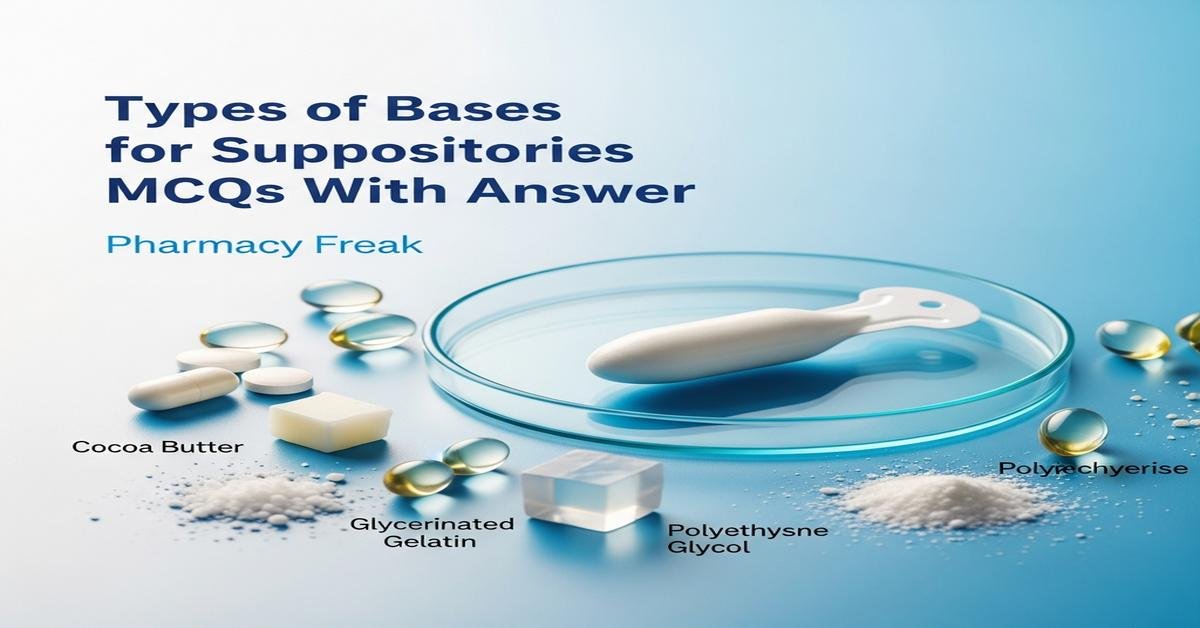
Suppository bases are critical to formulation performance, stability, and patient comfort. B. Pharm students must understand types of suppository bases—oleaginous (fatty) bases like cocoa butter and hard fats, water-soluble/miscible bases such as polyethylene glycol (PEG) and glycerinated gelatin, and water-dispersible emulsifying bases. Key concepts include melting behavior vs dissolution, polymorphism (especially of cocoa butter), hydrophilic–lipophilic balance, drug–base compatibility, displacement value, mold lubrication, shrinkage, viscosity, and impact on drug release and absorption in rectal, vaginal, and urethral routes. Knowledge of hygroscopicity, preservatives, storage, and climate suitability further refines selection. Now let’s test your knowledge with 30 MCQs on this topic.
Q1. Which option best describes the major classes of suppository bases used in pharmacy?
- Only oleaginous and gelatin-based bases
- Oleaginous (fatty), water-soluble/miscible, and water-dispersible bases
- Only water-miscible and carbohydrate bases
- Only synthetic triglyceride and waxy bases
Correct Answer: Oleaginous (fatty), water-soluble/miscible, and water-dispersible bases
Q2. The stable polymorphic form of cocoa butter (theobroma oil) used for suppositories melts approximately at:
- 28–30 °C
- 34–36 °C
- 45–48 °C
- 20–22 °C
Correct Answer: 34–36 °C
Q3. Which of the following is a water-soluble/miscible suppository base?
- Theobroma oil
- Polyethylene glycol (PEG 1000–6000)
- Hydrogenated palm kernel oil
- Hard fat (Witepsol-type)
Correct Answer: Polyethylene glycol (PEG 1000–6000)
Q4. Glycerinated gelatin is most appropriately used for which route due to its hygroscopic nature?
- Rectal (adult)
- Vaginal
- Intranasal
- Buccal
Correct Answer: Vaginal
Q5. For a hydrophilic drug, which base generally promotes faster release in rectal fluids?
- Oleaginous (fatty) base
- Waxy hydrocarbon base
- Absorption base
- Silicone base
Correct Answer: Oleaginous (fatty) base
Q6. The primary purpose of using a displacement value (density factor) in suppository formulation is to:
- Select an appropriate preservative system
- Calculate the amount of base displaced by the active drug
- Determine the mold capacity in milliliters
- Predict the drug’s partition coefficient
Correct Answer: Calculate the amount of base displaced by the active drug
Q7. Which statement best describes drug release from fatty bases like cocoa butter?
- They dissolve slowly in rectal fluids over several hours
- They melt at body temperature and release drug by partition into aqueous fluids
- They swell and disintegrate rapidly
- They undergo ion-exchange to release drug
Correct Answer: They melt at body temperature and release drug by partition into aqueous fluids
Q8. Which base is hygroscopic and may cause dehydration or irritation if used rectally without adequate water?
- Glycerinated gelatin
- Hydrogenated vegetable oil
- Beeswax-modified cocoa butter
- Microcrystalline wax
Correct Answer: Glycerinated gelatin
Q9. For which type of suppository base is mold lubrication often unnecessary due to inherent slipperiness?
- Glycerinated gelatin base
- Polyethylene glycol (PEG) base
- Cocoa butter base
- Ceraceous hydrocarbon base
Correct Answer: Polyethylene glycol (PEG) base
Q10. A key advantage of synthetic hard fat (e.g., Witepsol-type) bases over cocoa butter is:
- Higher water content
- Reduced polymorphism and a narrow, reproducible melting range
- Greater hygroscopicity
- Requirement for refrigeration at all times
Correct Answer: Reduced polymorphism and a narrow, reproducible melting range
Q11. Which base typically requires a preservative due to its water content?
- Hard fat (triglyceride) base
- Polyethylene glycol base
- Glycerinated gelatin base
- Cocoa butter base
Correct Answer: Glycerinated gelatin base
Q12. For a highly lipophilic drug, which base generally promotes faster release into rectal fluids?
- Cocoa butter (oleaginous) base
- Polyethylene glycol (PEG) base
- Beeswax base
- Microcrystalline wax base
Correct Answer: Polyethylene glycol (PEG) base
Q13. Overheating cocoa butter above its stable melting range can cause:
- Formation of a higher-melting polymorph
- Conversion to an unstable polymorph with a lower melting point
- Complete loss of emulsifying capacity
- Permanent crosslinking
Correct Answer: Conversion to an unstable polymorph with a lower melting point
Q14. In hot climates, which suppository base is generally preferred to minimize melting during storage?
- Cocoa butter
- Polyethylene glycol (PEG)
- Glycerinated gelatin
- Paraffin wax
Correct Answer: Polyethylene glycol (PEG)
Q15. Water-dispersible suppository bases are best described as:
- Pure aqueous gels that disintegrate instantly
- Fatty bases containing surfactants to disperse in rectal fluids
- High-MW PEG blends that melt rapidly
- Beeswax blends with high oil content
Correct Answer: Fatty bases containing surfactants to disperse in rectal fluids
Q16. Due to hygroscopicity, glycerinated gelatin suppositories should be stored:
- In well-closed, airtight containers to prevent moisture loss or gain
- Unwrapped at room humidity
- Frozen to prevent dehydration
- In open trays to allow drying
Correct Answer: In well-closed, airtight containers to prevent moisture loss or gain
Q17. Which is an example of a synthetic triglyceride (hard fat) base?
- Witepsol-type hard fat
- Glycerinated gelatin
- Polyethylene glycol 4000
- Paraffin wax
Correct Answer: Witepsol-type hard fat
Q18. Suppositories made predominantly with high-molecular-weight PEGs tend to be:
- Very flexible at low temperatures
- Brittle, especially in cold conditions
- Extremely oily and greasy
- Highly elastic and rubbery
Correct Answer: Brittle, especially in cold conditions
Q19. The rate-limiting step for drug release from a fatty base is commonly:
- Dissolution of the base
- Ionization of the drug
- Melting of the base and subsequent partition into aqueous fluids
- Enzymatic degradation of the base
Correct Answer: Melting of the base and subsequent partition into aqueous fluids
Q20. When incorporating an aqueous drug solution into an oleaginous base, what is typically required?
- A high-MW PEG cosolvent
- An emulsifying agent to stabilize the dispersed phase
- Beeswax to reduce viscosity
- Sodium chloride to increase ionic strength
Correct Answer: An emulsifying agent to stabilize the dispersed phase
Q21. For pediatric rectal suppositories, a commonly preferred base due to gentle melting and minimal irritation is:
- Cocoa butter or synthetic hard fat
- High-MW PEG blend only
- Glycerinated gelatin
- Paraffin wax
Correct Answer: Cocoa butter or synthetic hard fat
Q22. Increasing the molecular weight of PEG in a PEG base generally:
- Lowers melting point and speeds dissolution
- Raises melting/softening range and slows dissolution
- Increases greasiness and oil leakage
- Eliminates brittleness completely
Correct Answer: Raises melting/softening range and slows dissolution
Q23. A potential drawback of PEG bases is that they can:
- Undergo rancidity rapidly
- Interact with certain drugs leading to reduced availability
- Exhibit extreme polymorphism
- Always require refrigeration
Correct Answer: Interact with certain drugs leading to reduced availability
Q24. The most appropriate quality control test to assess release for PEG-based suppositories is often:
- Melting point determination only
- Disintegration in oil at room temperature
- Dissolution testing in an aqueous medium
- Friability testing in a drum
Correct Answer: Dissolution testing in an aqueous medium
Q25. With cocoa butter in metallic molds, which statement is accurate regarding mold release?
- Lubrication is never needed
- Light lubrication with mineral oil may be used to aid release
- Only water is used as a lubricant
- Lubrication causes instant polymorphic change
Correct Answer: Light lubrication with mineral oil may be used to aid release
Q26. Preservatives commonly used in glycerinated gelatin suppositories include:
- BHT and BHA
- Methylparaben with propylparaben
- Sodium nitrite
- Ascorbic acid
Correct Answer: Methylparaben with propylparaben
Q27. Compared with cocoa butter, synthetic hard fat bases typically offer:
- Greater batch-to-batch variability
- More susceptibility to polymorphic transitions
- More consistent melting behavior and composition
- Higher risk of microbial contamination
Correct Answer: More consistent melting behavior and composition
Q28. Which base type is least likely to cause leakage after administration because it dissolves rather than melts?
- Cocoa butter
- Polyethylene glycol (PEG)
- Hard fat (Witepsol)
- Beeswax blend
Correct Answer: Polyethylene glycol (PEG)
Q29. Urethral suppositories (bougies) have traditionally been prepared using:
- Glycerinated gelatin
- Paraffin wax
- Microcrystalline wax
- Beeswax
Correct Answer: Glycerinated gelatin
Q30. Which type of additive tends to lower the melting point of cocoa butter when dissolved in it?
- Microcrystalline wax
- Beeswax
- Cetyl esters wax
- Drugs like chloral hydrate or phenol
Correct Answer: Drugs like chloral hydrate or phenol


