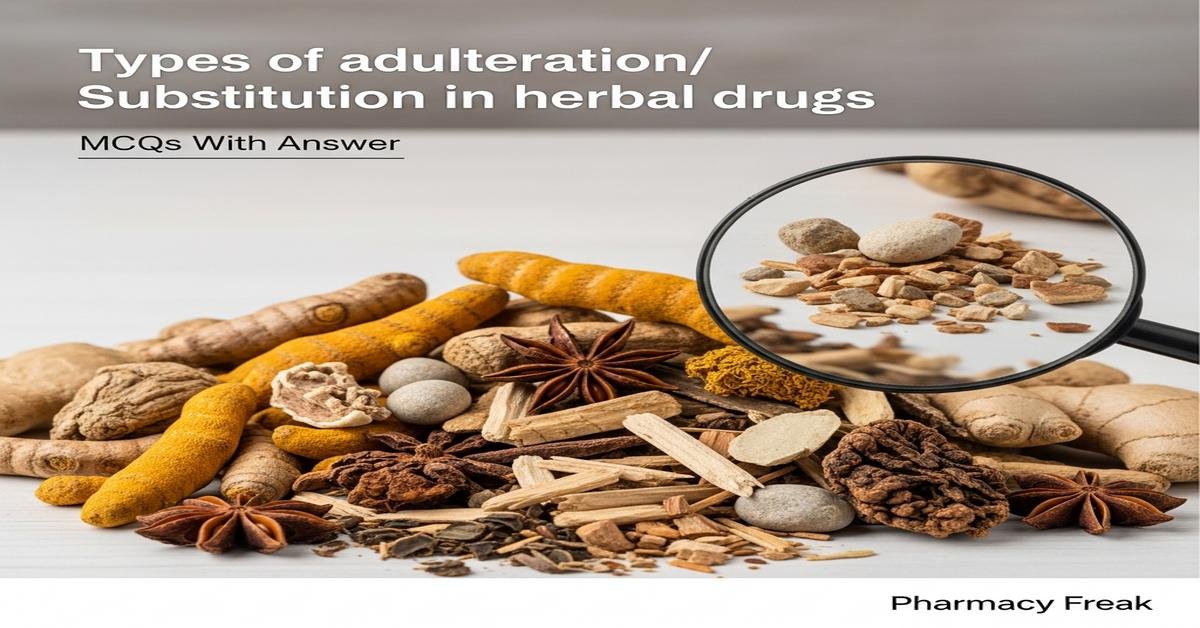
Introduction: Types of adulteration/substitution in herbal drugs MCQs With Answer is designed for M.Pharm students studying Herbal and Cosmetic Analysis (MPA 204T). This set of focused multiple-choice questions explores the various forms of adulteration and substitution encountered in herbal materials — including intentional economic fraud, accidental contamination, admixture, dilution, sophistication, and mislabeling. Questions emphasize causes, real-world examples, analytical detection methods (macroscopy, microscopy, TLC/HPTLC, chromatographic and spectrometric methods, DNA barcoding), and regulatory or preventive strategies such as GACP and pharmacopeial standards. The aim is to deepen practical understanding and diagnostic skills needed for quality assurance and safety evaluation of herbal drugs.
Q1. What best defines “substitution” in the context of herbal drugs?
- Replacement of a genuine herbal drug by another plant of similar appearance or vernacular name
- Addition of inorganic contaminants such as sand and stones
- Deliberate addition of synthetic drugs to increase potency
- Accidental contamination during harvesting
Correct Answer: Replacement of a genuine herbal drug by another plant of similar appearance or vernacular name
Q2. Which of the following is NOT usually considered a type of adulteration/substitution in herbal drugs?
- Admixture (mixing with cheaper plant parts)
- Substitution (replacement by another species)
- Thermal degradation of active constituents during storage
- Sophistication (addition of dyes or pharmaceuticals)
Correct Answer: Thermal degradation of active constituents during storage
Q3. Saffron (Crocus sativus) is commonly adulterated with which plant material?
- Carthamus tinctorius (safflower)
- Cinnamomum verum (true cinnamon)
- Curcuma longa (turmeric)
- Glycyrrhiza glabra (licorice)
Correct Answer: Carthamus tinctorius (safflower)
Q4. Which technique is most reliable for definitive species-level identification to detect botanical substitution?
- Thin-layer chromatography (TLC)
- DNA barcoding (molecular identification)
- Organoleptic (sensory) evaluation
- Loss on drying (moisture determination)
Correct Answer: DNA barcoding (molecular identification)
Q5. What does “admixture” mean in herbal drug adulteration terminology?
- Mixing of the genuine herbal drug with other cheaper or inert plant materials to increase bulk
- Complete replacement of a drug by an unrelated species
- Deliberate addition of synthetic pharmaceuticals
- Incorrect labeling of botanical name on the container
Correct Answer: Mixing of the genuine herbal drug with other cheaper or inert plant materials to increase bulk
Q6. Which of the following best describes “sophistication” as a type of adulteration?
- Unintentional contamination during drying
- Addition of coloring agents or pharmacologically active synthetic drugs to imitate or enhance potency
- Substitution by a closely related species because of similar vernacular name
- Partial mixing with the same plant’s inferior parts
Correct Answer: Addition of coloring agents or pharmacologically active synthetic drugs to imitate or enhance potency
Q7. Which motive is most commonly associated with intentional substitution or adulteration of herbal drugs?
- Economic gain by reducing cost or increasing bulk
- Improvement of therapeutic efficacy for research purposes
- Compliance with pharmacopeial specifications
- Intentional reduction of toxicity
Correct Answer: Economic gain by reducing cost or increasing bulk
Q8. Which analytical method is most appropriate to detect heavy-metal adulterants like lead chromate in turmeric?
- Thin-layer chromatography (TLC)
- Atomic absorption spectroscopy (AAS) or ICP-MS for heavy metal quantification
- Loss on drying
- Organoleptic testing
Correct Answer: Atomic absorption spectroscopy (AAS) or ICP-MS for heavy metal quantification
Q9. How does “contamination” differ from “adulteration” in herbal products?
- Contamination is typically accidental presence of extraneous matter; adulteration is often intentional or economically motivated
- Contamination always involves substitution of the whole drug
- Adulteration refers only to microbial contamination
- There is no difference; the terms are interchangeable
Correct Answer: Contamination is typically accidental presence of extraneous matter; adulteration is often intentional or economically motivated
Q10. Which analytical technique is most suitable to detect the presence of undeclared synthetic steroids or analgesics added to herbal formulations?
- High-performance liquid chromatography coupled with mass spectrometry (HPLC-MS/MS)
- Simple microscopy
- TLC without visualization reagents
- Organoleptic evaluation
Correct Answer: High-performance liquid chromatography coupled with mass spectrometry (HPLC-MS/MS)
Q11. Which of the following is a common example of dilution-type adulteration in powdered herbal drugs?
- Mixing powdered herb with starch or wheat flour to increase weight
- Substitution by a taxonomically related species
- Adding essential oils to enhance aroma
- Sterilization to reduce microbial load
Correct Answer: Mixing powdered herb with starch or wheat flour to increase weight
Q12. Errors due to similar vernacular names leading to replacement of the intended herb are best described as which type of problem?
- Substitution caused by nomenclature confusion
- Sophistication by chemical adulteration
- Microbial contamination
- Intentional addition of metals
Correct Answer: Substitution caused by nomenclature confusion
Q13. Which basic laboratory method is most helpful to detect admixture with starch or flour in powdered herbal samples?
- Microscopic examination with stains (e.g., iodine for starch)
- Determination of refractive index
- pH measurement of aqueous extract
- Loss on ignition at 100°C
Correct Answer: Microscopic examination with stains (e.g., iodine for starch)
Q14. Which regulatory documentation or standard is primarily used to define identification and purity tests for marketed herbal drugs?
- Pharmacopeial monographs (e.g., Indian, British, USP herbal monographs)
- Generic marketing brochures
- Local newspaper reports
- Supplier invoices
Correct Answer: Pharmacopeial monographs (e.g., Indian, British, USP herbal monographs)
Q15. What is the principal hazard when an Aristolochia species is substituted for another medicinal plant?
- Exposure to aristolochic acids causing nephropathy and carcinogenicity
- Loss of color in the formulation
- Increased moisture content only
- Reduced shelf life without toxicity
Correct Answer: Exposure to aristolochic acids causing nephropathy and carcinogenicity
Q16. Which analytical approach provides a reproducible chemical fingerprint useful to detect adulteration or substitution among closely related herbal species?
- High-performance thin-layer chromatography (HPTLC) fingerprinting
- Basic pH testing
- Simple smell test
- Volumetric titration for acidity
Correct Answer: High-performance thin-layer chromatography (HPTLC) fingerprinting
Q17. Which preventive practice is most effective at reducing substitution and adulteration in the supply chain of medicinal plants?
- Implementation of Good Agricultural and Collection Practices (GACP) and documented chain-of-custody with botanical authentication
- Relying solely on organoleptic assessment at the market
- Reducing drying time only
- Using non-standardized seed sources
Correct Answer: Implementation of Good Agricultural and Collection Practices (GACP) and documented chain-of-custody with botanical authentication
Q18. Which situation is an example of mislabeling rather than substitution?
- Correct herb present in the container but the botanical name printed on the label is incorrect
- Cheaper species entirely replaces the genuine drug
- Powdered drug mixed with starch to increase bulk
- Synthetic analgesic added to a herbal preparation
Correct Answer: Correct herb present in the container but the botanical name printed on the label is incorrect
Q19. Which of the following is a classic historical example of substitution leading to severe adverse effects in patients?
- Substitution of Aristolochia for Stephania/other roots leading to aristolochic acid nephropathy
- Mixing turmeric with black pepper to enhance absorption
- Adding honey to a cough syrup for palatability
- Drying herbs in sun instead of shade
Correct Answer: Substitution of Aristolochia for Stephania/other roots leading to aristolochic acid nephropathy
Q20. Which of the following best exemplifies chemical adulteration (sophistication) of herbal weight‑loss products?
- Addition of undeclared synthetic compounds such as sibutramine or other anorectics to herbal preparations
- Substitution of one plant species for another due to vernacular confusion
- Accidental fungal contamination during storage
- Inclusion of benign fillers like cellulose with full disclosure on label
Correct Answer: Addition of undeclared synthetic compounds such as sibutramine or other anorectics to herbal preparations


I am a Registered Pharmacist under the Pharmacy Act, 1948, and the founder of PharmacyFreak.com. I hold a Bachelor of Pharmacy degree from Rungta College of Pharmaceutical Science and Research. With a strong academic foundation and practical knowledge, I am committed to providing accurate, easy-to-understand content to support pharmacy students and professionals. My aim is to make complex pharmaceutical concepts accessible and useful for real-world application.
Mail- Sachin@pharmacyfreak.com