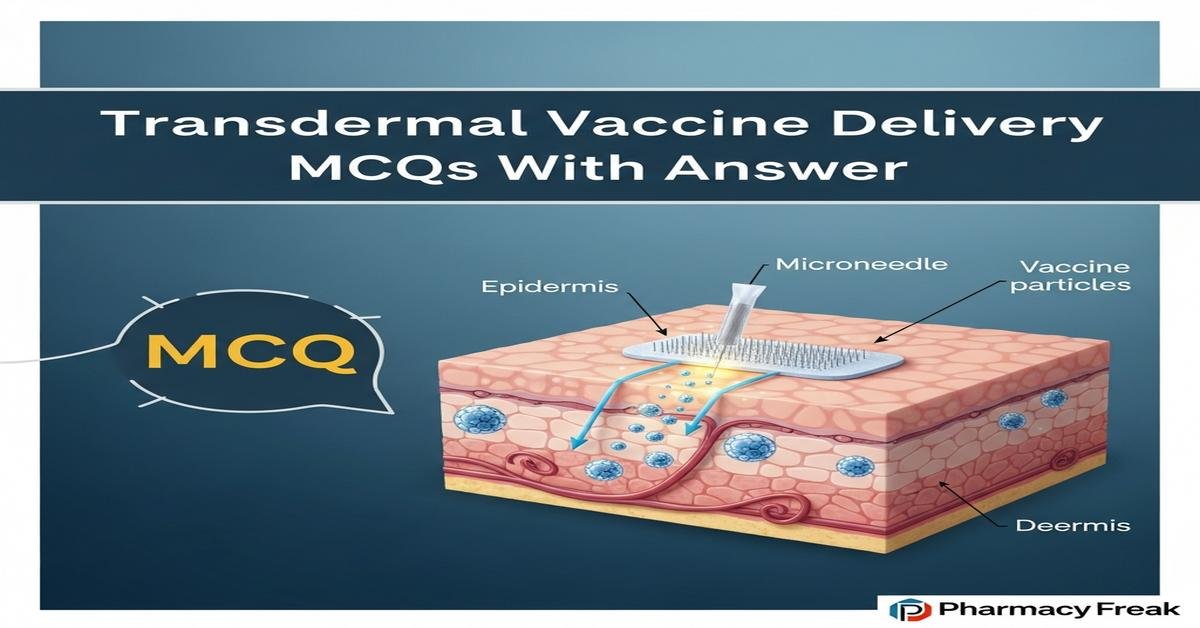
Transdermal vaccine delivery MCQs With Answer offers a focused practice set for M. Pharm students studying Drug Delivery Systems (MPH 102T). Transdermal immunization leverages the immunologically rich skin, enabling dose-sparing vaccination through microneedles, patches, and energy-assisted methods while addressing cold-chain and needle-related challenges. This quiz covers key concepts: skin anatomy and barriers, microneedle types and mechanics, formulation science (stabilizers, adjuvants), enhancement techniques (iontophoresis, sonophoresis), in vitro/in vivo evaluation, quality attributes, safety, and regulatory considerations. Each question targets applied understanding—how design choices affect antigen stability, delivery efficiency, and immunogenicity—helping students connect pharmaceutics, immunology, and device engineering for next-generation vaccine platforms.
Q1. Which skin-resident cells are the principal antigen-presenting targets for transdermal vaccination?
- Langerhans cells in the epidermis and dermal dendritic cells
- Keratinocytes and melanocytes
- Mast cells and fibroblasts
- Merkel cells and adipocytes
Correct Answer: Langerhans cells in the epidermis and dermal dendritic cells
Q2. What is the primary barrier that limits passive transdermal delivery of macromolecular vaccines?
- Dermal vasculature
- Stratum corneum lipid matrix
- Hypodermal adipose tissue
- Sweat ducts and hair follicles
Correct Answer: Stratum corneum lipid matrix
Q3. Which microneedle type eliminates sharps waste by dissolving within the skin to release vaccine payload?
- Solid microneedles with surface coating
- Hollow stainless-steel microneedles
- Dissolving polymeric microneedles
- Silicon microprojections
Correct Answer: Dissolving polymeric microneedles
Q4. A major immunological advantage of skin-targeted vaccination compared to intramuscular injection is:
- Reduced depot formation and faster antigen clearance
- Dose sparing due to high local density of antigen-presenting cells
- Lower risk of hypersensitivity reactions
- Greater penetration into systemic circulation without lymphatic involvement
Correct Answer: Dose sparing due to high local density of antigen-presenting cells
Q5. Typical microneedle length used to achieve painless delivery into viable epidermis/upper dermis is:
- 20–50 μm
- 100–200 μm
- 300–900 μm
- 1–5 mm
Correct Answer: 300–900 μm
Q6. In microneedle vaccine formulations, trehalose is primarily used to:
- Increase ionic strength for iontophoresis
- Act as a penetration enhancer by extracting lipids
- Stabilize antigens via vitrification during drying and storage
- Provide antimicrobial preservation through osmotic effects
Correct Answer: Stabilize antigens via vitrification during drying and storage
Q7. Iontophoresis enhances transdermal delivery mainly through:
- Thermal denaturation of the stratum corneum
- Electrorepulsion of charged molecules and electroosmotic solvent flow
- Formation of microchannels via mechanical abrasion
- Solubilization of keratin by pH modulation
Correct Answer: Electrorepulsion of charged molecules and electroosmotic solvent flow
Q8. Low-frequency ultrasound (sonophoresis) improves skin permeation primarily by:
- Producing sustained hyperthermia in the dermis
- Inducing cavitation that disrupts stratum corneum lipid bilayers
- Generating free radicals that oxidize proteins
- Increasing dermal blood flow only
Correct Answer: Inducing cavitation that disrupts stratum corneum lipid bilayers
Q9. Which measurement is commonly used to quantify barrier disruption after microneedle insertion?
- Skin surface pH
- Transepidermal water loss (TEWL)
- Capillary refill time
- Dermal thickness by ultrasound imaging
Correct Answer: Transepidermal water loss (TEWL)
Q10. For protein vaccines in microneedle patches, the most suitable sterilization approach is:
- Terminal steam sterilization (autoclaving) of the final patch
- Terminal gamma irradiation of the final product
- Ethylene oxide sterilization of finished patches
- Aseptic manufacturing with sterile components and environmental control
Correct Answer: Aseptic manufacturing with sterile components and environmental control
Q11. Which in vitro setup is standard for assessing transdermal permeation of vaccine surrogates across skin?
- USP Apparatus II (paddle) dissolution tester
- Rotating cylinder diffusion cell
- Franz diffusion cell
- Kraemer cell
Correct Answer: Franz diffusion cell
Q12. Skin immunization often allows lower antigen doses to achieve comparable or superior responses because:
- Cutaneous lymphatics bypass lymph nodes
- Keratinocytes directly produce neutralizing antibodies
- High APC density promotes efficient priming and depot-independent immunity
- Dermal vasoconstriction retains antigen longer than muscle tissue
Correct Answer: High APC density promotes efficient priming and depot-independent immunity
Q13. A key limitation of transdermal vaccination using microneedle patches is:
- Inability to target antigen-presenting cells
- Limited payload capacity due to patch area and needle volume constraints
- High pain scores relative to intramuscular injection
- Mandatory cold-chain requirements for all formulations
Correct Answer: Limited payload capacity due to patch area and needle volume constraints
Q14. Hydrogel-forming microneedles function by:
- Dissolving completely to release embedded antigen
- Creating swollen, crosslinked conduits while delivering antigen from an attached reservoir
- Injecting liquid antigen through a hollow bore under pressure
- Electroporating skin to facilitate DNA vaccine entry
Correct Answer: Creating swollen, crosslinked conduits while delivering antigen from an attached reservoir
Q15. In coated solid microneedle systems, antigen delivery occurs primarily via:
- Bulk diffusion through hollow channels
- Dissolution of the dried coating upon skin insertion and contact with interstitial fluid
- Thermal melting of the coating by body heat
- Mechanical scraping into the stratum basale
Correct Answer: Dissolution of the dried coating upon skin insertion and contact with interstitial fluid
Q16. A common failure mode specific to hollow microneedles during skin insertion is:
- Chemical degradation of the polymer matrix
- Clogging of the lumen due to tissue compression and collapse
- Excessive antigen crystallization on the tip
- Electrostatic discharge inside the channel
Correct Answer: Clogging of the lumen due to tissue compression and collapse
Q17. Identify the correct order of skin layers from surface to deeper tissues relevant to transdermal delivery:
- Viable epidermis → Stratum corneum → Dermis → Hypodermis
- Stratum corneum → Viable epidermis → Dermis → Hypodermis
- Dermis → Stratum corneum → Viable epidermis → Hypodermis
- Stratum corneum → Dermis → Viable epidermis → Hypodermis
Correct Answer: Stratum corneum → Viable epidermis → Dermis → Hypodermis
Q18. Which adjuvant is particularly suitable for skin-targeted vaccination due to local TLR activation when applied with or in a patch?
- Imiquimod (TLR7 agonist)
- Aluminum hydroxide gel
- Mineral oil (Freund’s complete)
- Saponin QS-21 in liposomes only
Correct Answer: Imiquimod (TLR7 agonist)
Q19. Enhanced thermostability of dried vaccine-coated microneedles is most closely associated with:
- Low glass transition temperature (Tg) matrices
- High glass transition temperature (Tg) sugar matrices that immobilize antigens
- Increased water activity during storage
- Inclusion of organic solvents with low boiling points
Correct Answer: High glass transition temperature (Tg) sugar matrices that immobilize antigens
Q20. Which quality test best predicts whether a microneedle array will reliably penetrate skin without breaking?
- In vitro antigen ELISA potency assay
- Axial compression/fracture force testing of microneedles
- Residual solvent analysis by GC
- Optical clarity measurement of the backing film
Correct Answer: Axial compression/fracture force testing of microneedles


I am a Registered Pharmacist under the Pharmacy Act, 1948, and the founder of PharmacyFreak.com. I hold a Bachelor of Pharmacy degree from Rungta College of Pharmaceutical Science and Research. With a strong academic foundation and practical knowledge, I am committed to providing accurate, easy-to-understand content to support pharmacy students and professionals. My aim is to make complex pharmaceutical concepts accessible and useful for real-world application.
Mail- Sachin@pharmacyfreak.com