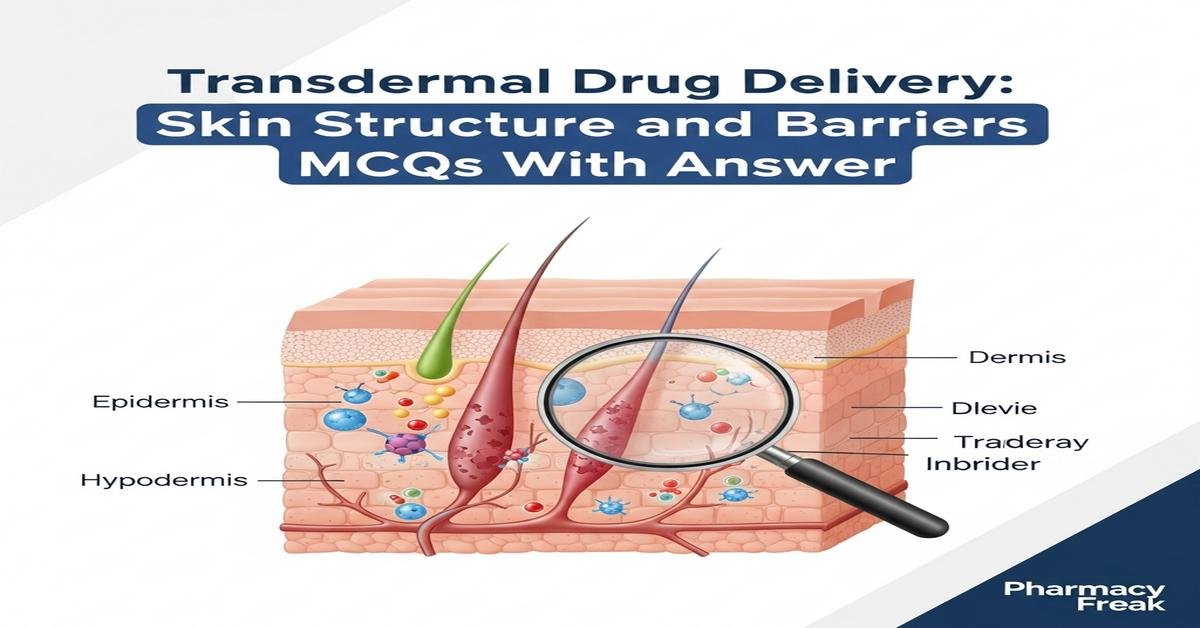
Transdermal drug delivery: skin structure and barriers MCQs With Answer provides M.Pharm students a focused, exam-oriented review of how the skin’s architecture governs percutaneous absorption. This quiz revisits the layered organization of the skin, the physicochemical constraints that dictate passive permeation, and the relative roles of transepidermal and appendageal pathways. You will test your understanding of the stratum corneum’s brick-and-mortar model, lipid phase behavior, tight junctions in viable epidermis, site- and age-related variability, and key metrics such as TEWL and tape stripping. Questions also integrate Fickian principles, partition–diffusion concepts, and the impact of hydration, temperature, and enhancers. Use this set to refine conceptual clarity and build confidence for Drug Delivery Systems (MPH 102T) assessments.
Q1. What is the principal rate-limiting barrier to percutaneous absorption?
- Stratum corneum (SC)
- Viable epidermis
- Dermis
- Subcutaneous tissue
Correct Answer: Stratum corneum (SC)
Q2. The ultrastructure of the stratum corneum is best described by which model?
- Brick-and-mortar model
- Sponge-like hydrogel
- Vascularized lipid bilayers
- Continuous protein matrix
Correct Answer: Brick-and-mortar model
Q3. The dominant lipid classes in the stratum corneum intercellular space are:
- Ceramides, cholesterol, and free fatty acids (≈1:1:1)
- Phosphatidylcholine and triglycerides
- Sphingomyelin and glycolipids only
- Cholesteryl esters only
Correct Answer: Ceramides, cholesterol, and free fatty acids (≈1:1:1)
Q4. For passive transdermal delivery, the optimal lipophilicity (logP) of a drug is typically:
- About −1
- About 0.5
- Between 1 and 3
- Greater than 6
Correct Answer: Between 1 and 3
Q5. A general molecular weight cutoff for efficient passive skin permeation is:
- <200 Da
- <500 Da
- <1000 Da
- No relation to molecular weight
Correct Answer: <500 Da
Q6. For most small molecules, the predominant pathway across the stratum corneum is:
- Intercellular diffusion through lipid domains
- Transappendageal pathway exclusively
- Active transport across keratinocytes
- Vesicular transcytosis via Langerhans cells
Correct Answer: Intercellular diffusion through lipid domains
Q7. Which statement about appendageal pathways (hair follicles, sweat glands) is most accurate?
- Occupy <0.1% of the surface yet can act as shunts for ions and macromolecules
- Account for >50% of area and dominate steady-state flux
- Present only in palms and soles
- They close during occlusion
Correct Answer: Occupy <0.1% of the surface yet can act as shunts for ions and macromolecules
Q8. Hydration or occlusion of the stratum corneum generally:
- Decreases permeation by tightening lipid packing
- Increases permeation by swelling corneocytes and fluidizing lipids
- Has no effect on flux
- Instantly destroys corneodesmosomes
Correct Answer: Increases permeation by swelling corneocytes and fluidizing lipids
Q9. Which skin layer contains functional capillaries for systemic uptake of drugs?
- Stratum basale
- Stratum spinosum
- Dermis
- Stratum corneum
Correct Answer: Dermis
Q10. Tight junctions in viable epidermis are primarily located in which layer and affect which pathway?
- Stratum corneum; restrict transcellular diffusion
- Stratum granulosum; limit paracellular flow
- Dermis; limit vascular diffusion
- Subcutis; limit lymphatic drainage
Correct Answer: Stratum granulosum; limit paracellular flow
Q11. Under steady state, Fick’s first law for transdermal flux (J) across the stratum corneum can be expressed as:
- J = D K ΔC / h
- J = K h / (D ΔC)
- J = D Δx / K
- J = Kp / ΔC
Correct Answer: J = D K ΔC / h
Q12. Which age-related statement about skin permeability is most accurate?
- Neonates have higher percutaneous absorption due to an immature barrier
- Elderly always have 10-fold lower flux than adults
- Age has no effect on skin barrier properties
- Adults have higher TEWL than infants
Correct Answer: Neonates have higher percutaneous absorption due to an immature barrier
Q13. Which anatomical site typically shows the highest permeability to drugs?
- Scrotal skin
- Ventral forearm
- Palm
- Heel
Correct Answer: Scrotal skin
Q14. Transepidermal water loss (TEWL) is primarily used to:
- Quantify systemic drug uptake
- Measure barrier integrity of the stratum corneum
- Determine skin surface pH
- Estimate dermal blood flow
Correct Answer: Measure barrier integrity of the stratum corneum
Q15. Tape stripping is a technique that:
- Sequentially removes stratum corneum layers to profile drug depth and estimate diffusion parameters
- Measures sweat rate under heat stress
- Delivers macromolecules via microperforation
- Quantifies melanocyte density in the basal layer
Correct Answer: Sequentially removes stratum corneum layers to profile drug depth and estimate diffusion parameters
Q16. Increasing skin temperature from 32°C to 40°C typically:
- Decreases diffusion coefficient and flux
- Increases lipid fluidity and diffusion coefficient, raising flux
- Has no effect on drug partitioning
- Closes hair follicles to permeation
Correct Answer: Increases lipid fluidity and diffusion coefficient, raising flux
Q17. Which statement about stratum corneum lipid packing is correct?
- Orthorhombic packing of ceramide-rich bilayers confers lower permeability than hexagonal packing
- Unsaturation in fatty acyl chains decreases permeability
- Cholesterol absence has no effect on barrier function
- Lipids are arranged mainly as micelles in the intercellular space
Correct Answer: Orthorhombic packing of ceramide-rich bilayers confers lower permeability than hexagonal packing
Q18. For a weakly basic drug (pKa ≈ 9), the unionized fraction at skin surface pH (~5.5) is:
- Relatively low at pH 5.5, limiting passive permeation
- Near 100%, enhancing passive permeation
- Independent of pH in the epidermis
- Zero only under occlusive conditions
Correct Answer: Relatively low at pH 5.5, limiting passive permeation
Q19. Which statement about hair follicle “reservoirs” is true?
- Follicles can act as depots that prolong residence and allow targeted delivery to pilosebaceous units
- Follicles are sealed by tight junctions and do not store drugs
- Follicles drain directly into veins for immediate systemic delivery
- Only hydrophilic molecules accumulate in follicles
Correct Answer: Follicles can act as depots that prolong residence and allow targeted delivery to pilosebaceous units
Q20. Which enhancement technique primarily overcomes the stratum corneum barrier by creating micron-scale conduits?
- Microneedles
- Occlusive dressings
- Chemical enhancers like oleic acid
- Hydration alone
Correct Answer: Microneedles


I am a Registered Pharmacist under the Pharmacy Act, 1948, and the founder of PharmacyFreak.com. I hold a Bachelor of Pharmacy degree from Rungta College of Pharmaceutical Science and Research. With a strong academic foundation and practical knowledge, I am committed to providing accurate, easy-to-understand content to support pharmacy students and professionals. My aim is to make complex pharmaceutical concepts accessible and useful for real-world application.
Mail- Sachin@pharmacyfreak.com