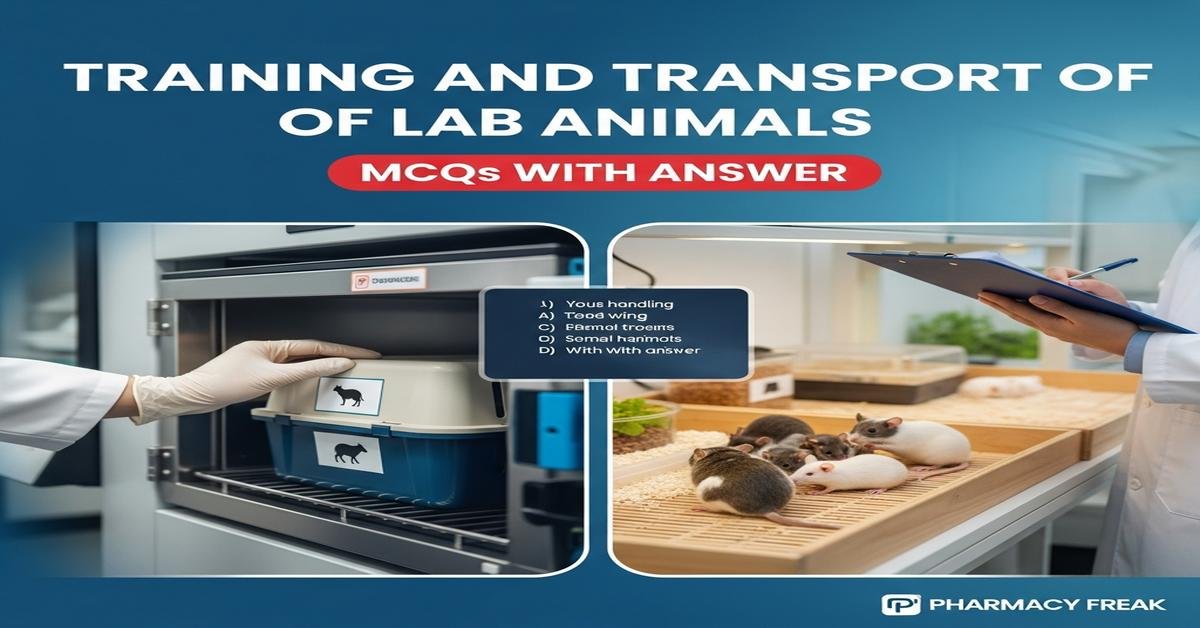
Introduction: This quiz collection on Training and Transport of Laboratory Animals is designed specifically for M.Pharm students preparing for examinations in Research Methodology & Biostatistics and practical laboratory work. It emphasizes animal welfare, regulatory requirements, and scientifically sound practices for acclimatization, handling, conditioning, and movement of common laboratory species. Questions focus on minimizing stress, correct environmental parameters for transport, pre-transport health checks, quarantine and documentation, and humane training methods such as habituation and operant conditioning. The set aims to deepen conceptual understanding and practical decision-making for ethically sound and compliant use of animals in pharmaceutical research.
Q1. What is the primary purpose of an acclimatization period for laboratory animals after transport?
- To increase metabolic rate for experimental consistency
- To allow animals to recover from transport stress and stabilize physiological parameters
- To train animals to perform experimental tasks
- To immediately start experimental dosing to save time
Correct Answer: To allow animals to recover from transport stress and stabilize physiological parameters
Q2. Which of the following is the most suitable method to train a rodent to voluntarily enter a restraint device with minimal stress?
- Using electric shock to speed training
- Performing rapid forced placement repeatedly
- Habituation combined with positive reinforcement (food rewards)
- Withholding food for 48 hours before first placement
Correct Answer: Habituation combined with positive reinforcement (food rewards)
Q3. According to common laboratory guidelines, what is the recommended minimum acclimatization period for most rodents after arrival before experimental use?
- Same day as arrival
- 24 hours
- 3–7 days
- At least 2 weeks for all studies
Correct Answer: 3–7 days
Q4. Which environmental parameter is most critical to control during transport of small mammals to prevent hypothermia?
- Light intensity inside the transport vehicle
- Cage label color
- Ambient temperature and insulation of containers
- Noise level at loading dock only
Correct Answer: Ambient temperature and insulation of containers
Q5. Which documentation is essential to accompany animals during inter-institutional transport?
- Only a verbal confirmation between handlers
- Health certificate, species identification, quarantine status, and experimental permissions
- Photographs of cages only
- Invoice and export tariff information
Correct Answer: Health certificate, species identification, quarantine status, and experimental permissions
Q6. What is the most important pre-transport health check to reduce spread of infectious agents?
- Weighing animals only
- Behavioral testing for maze performance
- Clinical examination and screening for signs of infectious disease
- Measuring cage enrichment use
Correct Answer: Clinical examination and screening for signs of infectious disease
Q7. For social species transported together, which practice is recommended to reduce aggression during transport?
- Mix unfamiliar animals from different sources immediately
- House compatible social groups together and avoid mixing unfamiliar individuals
- Transport all animals individually regardless of species
- Remove bedding to discourage interaction
Correct Answer: House compatible social groups together and avoid mixing unfamiliar individuals
Q8. Which of the following transport container features best reduces ammonia buildup during longer trips?
- Opaque walls to reduce light
- Improved ventilation with absorbent bedding and waste containment
- Stackable solid metal trays
- Sealed airtight containers to prevent escape
Correct Answer: Improved ventilation with absorbent bedding and waste containment
Q9. Which behavioral sign most reliably indicates acute transport stress in rodents?
- Increased cage exploration immediately after arrival
- Reduced activity, piloerection, vocalizations, and freezing
- Improved grooming and social play
- Normal feeding within minutes of arrival
Correct Answer: Reduced activity, piloerection, vocalizations, and freezing
Q10. When training animals using operant conditioning for a study, what is a key principle to ensure reliable task performance?
- Use punishment instead of reward to ensure quick learning
- Provide consistent, timed rewards and progressively shape behaviour
- Change the reward type frequently to avoid habituation
- Only train once per animal regardless of performance
Correct Answer: Provide consistent, timed rewards and progressively shape behaviour
Q11. Which of the following is an important ethical consideration during transport of laboratory animals?
- Transport speed should override welfare considerations
- Minimize duration of transport and provide for thermal comfort, food, and water as appropriate
- Remove identification to protect privacy
- Expose animals to new handlers to promote adaptability
Correct Answer: Minimize duration of transport and provide for thermal comfort, food, and water as appropriate
Q12. In many regulatory frameworks, what is the purpose of quarantine on arrival of animals to a facility?
- To immediately integrate animals into ongoing experiments
- To observe for disease, allow acclimatization, and perform health screening before use
- To change the animals’ genetic background
- To teach animals the facility layout
Correct Answer: To observe for disease, allow acclimatization, and perform health screening before use
Q13. Which handling technique has been shown to reduce anxiety and improve behavioral test results in mice?
- Picking up mice by the tail only
- Use of tunnel handling or cupped-hand handling rather than tail handling
- Hand-spraying mice with water before handling
- Rapid scruffing without prior habituation
Correct Answer: Use of tunnel handling or cupped-hand handling rather than tail handling
Q14. For long-distance transport of non-human primates, which requirement is typically mandatory to protect animal welfare?
- Complete darkness for the entire journey
- Provision for feeding, watering, social compatibility, and rest stops as per regulation
- Use of maximum transport density to save space
- Transport only during extreme weather events
Correct Answer: Provision for feeding, watering, social compatibility, and rest stops as per regulation
Q15. Which identification method is commonly preferred for small rodents to minimize long-term distress?
- Permanent ear notching without analgesia
- Microchip implantation with appropriate analgesia and trained personnel
- Tattooing with no training
- Marking with permanent ink on fur only once
Correct Answer: Microchip implantation with appropriate analgesia and trained personnel
Q16. Which factor is LEAST important when planning transport of laboratory animals for scheduled experimental use?
- Timing to allow necessary post-arrival recovery before procedures
- Animal age and reproductive status
- Researcher convenience to start experiments immediately upon arrival
- Regulatory permits and health certification
Correct Answer: Researcher convenience to start experiments immediately upon arrival
Q17. Which analgesic consideration is important when transporting animals that recently underwent minor surgery?
- Withholding analgesia during transport to avoid sedation
- Ensure appropriate analgesic coverage and monitor for respiratory depression during transport
- Use only non-pharmacologic methods for pain control
- Assume transport reduces pain and omit analgesia
Correct Answer: Ensure appropriate analgesic coverage and monitor for respiratory depression during transport
Q18. Which of the following describes a good practice for feeding during transport of adult laboratory rats on journeys exceeding 24 hours?
- Deprive food and water for the entire trip to prevent contamination
- Provide food and water suitable for travel, secure containers to prevent spillage, and check availability at rest stops
- Offer only novelty foods to encourage consumption
- Feed ad libitum and change diet brand mid-journey
Correct Answer: Provide food and water suitable for travel, secure containers to prevent spillage, and check availability at rest stops
Q19. What is the recommended action if an animal shows signs of severe distress during transit?
- Continue the journey without stopping to avoid delays
- Immediately provide first aid, assess clinical status, seek veterinary advice, and if necessary, divert to the nearest approved facility
- Increase handling to calm the animal
- Administer unprescribed sedatives from the vehicle first-aid kit
Correct Answer: Immediately provide first aid, assess clinical status, seek veterinary advice, and if necessary, divert to the nearest approved facility
Q20. Which training outcome best supports reproducibility and animal welfare in behavioral pharmacology studies?
- Short, high-stress training to force rapid compliance
- Standardized, gradual training with objective criteria for task acquisition and minimal stress
- Allowing each handler to use their own ad hoc training protocol
- Using different reward values across animals to motivate them unequally
Correct Answer: Standardized, gradual training with objective criteria for task acquisition and minimal stress

