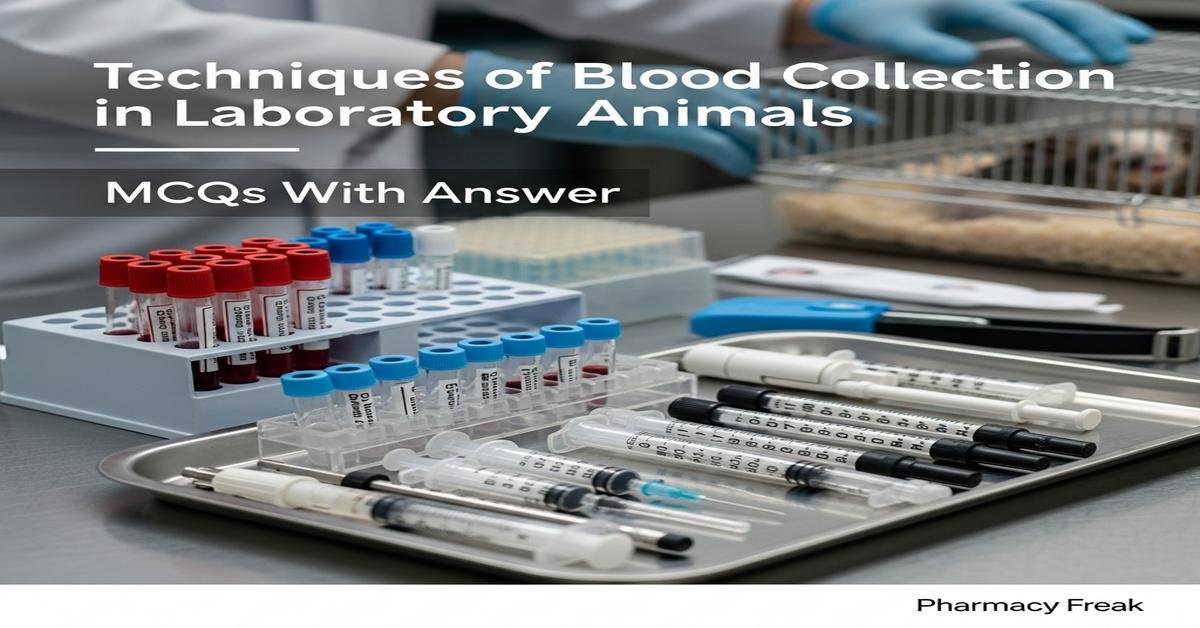
Blood collection in laboratory animals is a core competency for B.Pharm students focused on pharmacology, toxicology and pharmacokinetics. This concise guide covers techniques such as tail and saphenous venipuncture, lateral tail vein, submandibular, retro‑orbital/retrobulbar, jugular, ear and cardiac puncture, plus equipment selection, anticoagulants, sample handling, volumes, anesthesia, analgesia and ethical considerations. Emphasis is placed on minimizing stress and hemolysis, maintaining aseptic technique, adhering to safe volume and frequency limits, and proper tube choice for hematology or plasma drug assays. Also learn sample labeling, storage conditions, microsampling and data quality control. Now let’s test your knowledge with 30 MCQs on this topic.
Q1. Which site is commonly preferred for repeated, non‑terminal small-volume blood sampling in mice without anesthesia?
- Saphenous vein
- Cardiac puncture
- Retro‑orbital sinus
- Jugular vein
Correct Answer: Saphenous vein
Q2. What is the commonly recommended maximum single blood withdrawal from a healthy adult mouse (20–30 g)?
- 0.02 mL
- 0.2 mL
- 2 mL
- 5 mL
Correct Answer: 0.2 mL
Q3. Which blood collection technique is typically terminal and requires deep anesthesia or euthanasia?
- Lateral tail vein puncture
- Cardiac puncture
- Saphenous vein bleed
- Ear vein sampling
Correct Answer: Cardiac puncture
Q4. Retro‑orbital (retrobulbar) blood collection in rodents requires which of the following precautions?
- No training is necessary because it is simple
- Use of local cooling only
- Appropriate anesthesia, strict technique and trained personnel
- Perform only without anesthesia to speed collection
Correct Answer: Appropriate anesthesia, strict technique and trained personnel
Q5. Which anticoagulant is most commonly preferred for plasma collection in many pharmacokinetic drug assays?
- Potassium oxalate
- EDTA
- Lithium heparin
- Sodium fluoride
Correct Answer: Lithium heparin
Q6. Microhematocrit capillary tubes are primarily used to measure which parameter?
- Plasma protein concentration
- Packed cell volume (hematocrit)
- Serum creatinine
- Blood glucose
Correct Answer: Packed cell volume (hematocrit)
Q7. Which technique is an example of capillary blood collection in rodents?
- Jugular venipuncture
- Tail nick/tip snip
- Submandibular vein puncture
- Cardiac puncture
Correct Answer: Tail nick/tip snip
Q8. Which practice is most likely to cause hemolysis and compromise sample quality?
- Using an appropriate needle gauge and gentle aspiration
- Immediate gentle mixing with anticoagulant
- Forceful aspiration through a small‑gauge needle
- Keeping samples on ice promptly after collection
Correct Answer: Forceful aspiration through a small‑gauge needle
Q9. Which anticoagulant chelates calcium and is commonly used for complete blood counts (hematology) in many species?
- Sodium citrate
- Lithium heparin
- EDTA
- Sodium fluoride
Correct Answer: EDTA
Q10. Marginal ear vein blood collection is most applicable to which laboratory species?
- Mouse
- Rat
- Rabbit
- Guinea pig
Correct Answer: Rabbit
Q11. The saphenous vein used for blood collection is located on which part of the animal?
- Lateral aspect of the hind limb
- Ventral neck
- Ventral thorax
- Base of the tail
Correct Answer: Lateral aspect of the hind limb
Q12. For repeated small-volume sampling in mice, what is a generally recommended minimum interval to allow recovery of blood volume and hematologic parameters?
- 2–4 hours
- 24 hours
- 48–72 hours
- 1 week
Correct Answer: 48–72 hours
Q13. What general rule is recommended for maximum single blood withdrawal as a percentage of total blood volume in laboratory animals?
- 1% of total blood volume
- 5% of total blood volume
- 10% of total blood volume
- 50% of total blood volume
Correct Answer: 10% of total blood volume
Q14. Which serious complication is most commonly associated with improper retro‑orbital blood collection?
- Renal failure
- Eye trauma and vision loss
- Peritonitis
- Fracture of the femur
Correct Answer: Eye trauma and vision loss
Q15. Which needle gauge is commonly used for tail vein sampling in mice to balance flow and tissue trauma?
- 18 gauge
- 21 gauge
- 27 gauge
- 14 gauge
Correct Answer: 27 gauge
Q16. Which procedure typically requires local or systemic analgesia because it is painful and non‑terminal?
- Saphenous venipuncture
- Tail tip amputation
- Cardiac puncture
- Retro‑orbital bleed under anesthesia
Correct Answer: Tail tip amputation
Q17. Which blood collection method yields the largest single volume and is therefore used for terminal sampling in many species?
- Saphenous vein bleed
- Retro‑orbital sinus
- Cardiac puncture
- Ear vein lance
Correct Answer: Cardiac puncture
Q18. For short‑term storage (hours) of plasma before drug analysis, what temperature is generally recommended?
- Room temperature (20–25°C)
- 4°C (refrigeration)
- -20°C
- -80°C
Correct Answer: 4°C (refrigeration)
Q19. Which venous site is well suited for conscious sampling in rats with minimal restraint?
- Jugular vein
- Retro‑orbital sinus
- Saphenous vein
- Cardiac puncture
Correct Answer: Saphenous vein
Q20. Which anticoagulant is typically used for coagulation studies such as prothrombin time and activated partial thromboplastin time?
- EDTA
- Lithium heparin
- Sodium citrate
- Sodium fluoride
Correct Answer: Sodium citrate
Q21. Hemolysis in a blood sample most commonly produces a spurious increase in which analyte?
- Sodium
- Potassium
- Albumin
- Glucose
Correct Answer: Potassium
Q22. To minimize animal numbers and stress during pharmacokinetic studies, which approach is recommended?
- Use large‑volume terminal bleeds for each time point
- Pool samples from several animals at each time point
- Use microsampling and sparse sampling designs
- Avoid anesthesia for all collections
Correct Answer: Use microsampling and sparse sampling designs
Q23. Which device is most appropriate for collecting very small volumes (2–20 µL) of blood for spot analysis?
- Large syringe with 18G needle
- Heparinized microcapillary tube
- Glass vacutainer (10 mL)
- Standard red‑top serum tube
Correct Answer: Heparinized microcapillary tube
Q24. What is the recommended immediate action to control bleeding after a small peripheral venipuncture (e.g., tail vein)?
- Apply gentle pressure at the puncture site
- Allow the animal to run and disperse blood
- Use glue to seal the wound immediately
- Place the animal on ice until bleeding stops
Correct Answer: Apply gentle pressure at the puncture site
Q25. Which authoritative guideline specifically provides standards and recommendations for blood collection and animal care in research institutions?
- Good Laboratory Practice (GLP)
- International Conference on Harmonisation (ICH)
- The Guide for the Care and Use of Laboratory Animals
- United States Pharmacopeia (USP)
Correct Answer: The Guide for the Care and Use of Laboratory Animals
Q26. For transthoracic cardiac puncture in rodents, which insertion angle relative to the chest wall is commonly recommended?
- 0° (parallel to chest)
- 30–45°
- 90° (perpendicular)
- More than 60° only
Correct Answer: 30–45°
Q27. Which anticoagulant can interfere with metal‑dependent enzymatic assays by chelating divalent cations?
- Lithium heparin
- EDTA
- Sodium citrate
- Sodium fluoride
Correct Answer: EDTA
Q28. Best practice for labeling blood samples collected from animals is which of the following?
- Label tubes at the bench after returning from the procedure
- Label samples immediately at the cage/bedside after collection
- Label only at the end of the day when processing all samples
- Rely on memory to match samples to animals
Correct Answer: Label samples immediately at the cage/bedside after collection
Q29. What is the principal physiological risk of repeated large-volume blood sampling in small animals?
- Hyperglycemia
- Anemia and hypovolemia
- Hypercalcemia
- Increased hair growth
Correct Answer: Anemia and hypovolemia
Q30. Which practice is universally considered unacceptable during blood collection from multiple animals?
- Using aseptic technique and single‑use needles
- Warming a tail to dilate veins before venipuncture
- Reusing the same needle between different animals
- Having trained personnel perform the procedure
Correct Answer: Reusing the same needle between different animals

