Introduction
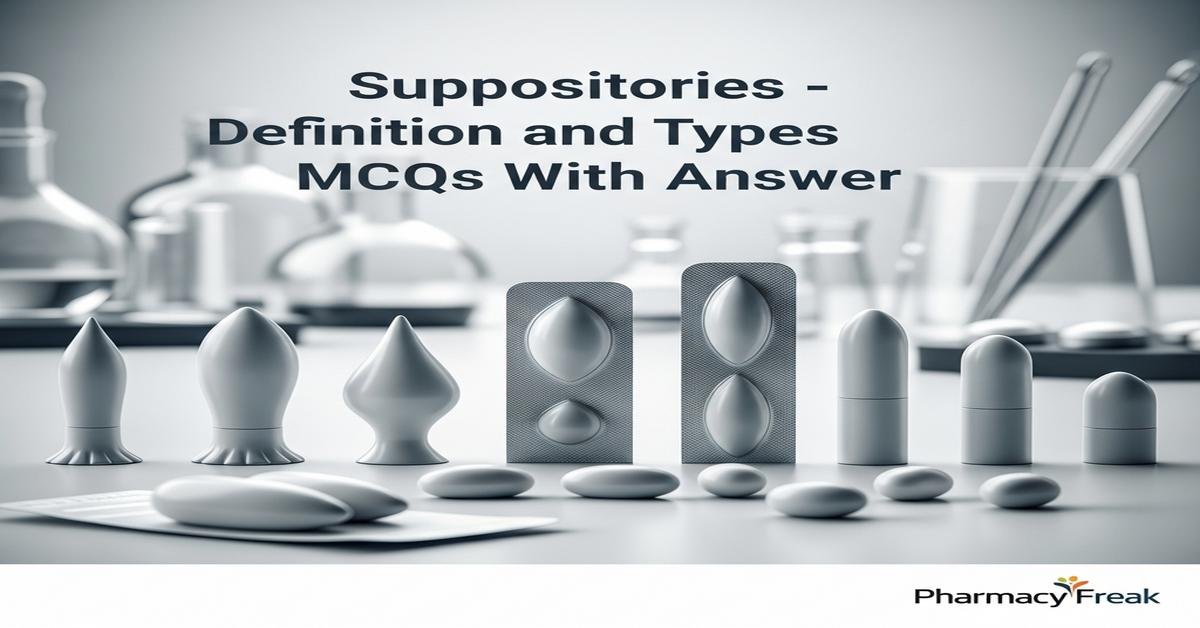
Suppositories are solid dosage forms inserted into the rectal, vaginal, or urethral cavity, where they melt, soften, or dissolve to provide local or systemic effects. For B. Pharm students, understanding the definition, classification by route, base types (fatty/oleaginous, water-soluble/miscible), and release mechanisms is essential. Key bases include cocoa butter (theobroma oil), glycerinated gelatin, polyethylene glycols (PEGs), and hydrogenated vegetable oils—each affecting melting range, drug release, stability, and patient acceptability. Shapes, sizes, and weights differ for rectal (torpedo), vaginal (oviform pessaries), and urethral (bougies). Master concepts like advantages, limitations, polymorphism, displacement value, and evaluation tests for quality control. Now let’s test your knowledge with 30 MCQs on this topic.
Q1. Which statement best defines a suppository in pharmaceutics?
- A sterile injectable solution administered parenterally
- A solid dosage form inserted into a body orifice to melt or dissolve and release drug
- A chewable oral solid designed for pediatric use
- A medicated transdermal adhesive system
Correct Answer: A solid dosage form inserted into a body orifice to melt or dissolve and release drug
Q2. Suppositories are primarily classified by route into which of the following types?
- Rectal, vaginal, and urethral
- Oral, sublingual, and buccal
- Nasal, otic, and ophthalmic
- Intravenous, intramuscular, and subcutaneous
Correct Answer: Rectal, vaginal, and urethral
Q3. Which of the following is NOT a type of suppository by route?
- Rectal
- Vaginal (pessary)
- Urethral (bougie)
- Buccal suppository
Correct Answer: Buccal suppository
Q4. The typical shape of a rectal suppository is best described as:
- Flat disc
- Bullet or torpedo-shaped
- Ring-shaped
- Cylindrical tablet
Correct Answer: Bullet or torpedo-shaped
Q5. The usual adult rectal suppository weight (with cocoa butter base) is approximately:
- 200 mg
- 1 g
- 2 g
- 5 g
Correct Answer: 2 g
Q6. Pediatric rectal suppositories commonly weigh around:
- 250 mg
- 500 mg
- 1 g
- 3 g
Correct Answer: 1 g
Q7. Vaginal pessaries typically have a weight around:
- 0.5 g
- 1 g
- 3 g
- 6 g
Correct Answer: 3 g
Q8. Urethral suppositories (bougies) for males typically weigh about:
- 0.5 g
- 1 g
- 4 g
- 10 g
Correct Answer: 4 g
Q9. Suppository bases are most accurately grouped into which categories?
- Volatile and non-volatile
- Hydrophilic and lipophilic surfactants
- Fatty (oleaginous) and water-soluble/water-miscible
- Crystalline and amorphous
Correct Answer: Fatty (oleaginous) and water-soluble/water-miscible
Q10. Which of the following is a fatty (oleaginous) base?
- Polyethylene glycol 4000
- Glycerinated gelatin
- Theobroma oil (cocoa butter)
- Polyvinylpyrrolidone
Correct Answer: Theobroma oil (cocoa butter)
Q11. Which base is water-soluble and commonly used to prepare dissolving-type suppositories?
- Beeswax
- Polyethylene glycols (PEGs)
- Hydrogenated vegetable oils only
- Hard paraffin
Correct Answer: Polyethylene glycols (PEGs)
Q12. A key advantage of cocoa butter as a suppository base is that it:
- Dissolves slowly in rectal fluids over many hours
- Melts at body temperature to release the drug
- Is highly hygroscopic, enhancing water uptake
- Requires no temperature control during manufacture
Correct Answer: Melts at body temperature to release the drug
Q13. An advantage of PEG bases compared to cocoa butter is that they:
- Always avoid rectal irritation
- Do not melt at room or body temperature and need no refrigeration
- Are ideal for heat-labile drugs due to high melting points
- Are preferred for oily drug solubilization
Correct Answer: Do not melt at room or body temperature and need no refrigeration
Q14. Glycerinated gelatin bases are mainly recommended for:
- Vaginal pessaries because they dissolve slowly and are hygroscopic
- Rectal suppositories because they melt rapidly
- Urethral bougies due to their high rigidity
- Transdermal patches for enhanced adhesion
Correct Answer: Vaginal pessaries because they dissolve slowly and are hygroscopic
Q15. Which statement about rectal absorption and first-pass metabolism is correct?
- All rectal veins drain into the portal vein causing complete first-pass
- No rectal veins drain into systemic circulation
- Lower and middle rectal veins drain systemically, reducing first-pass effect
- Rectal administration always eliminates first-pass completely
Correct Answer: Lower and middle rectal veins drain systemically, reducing first-pass effect
Q16. Rectal fluid is best described as having:
- Large volume and strong buffering capacity
- Minimal volume and near-neutral pH with low buffering capacity
- Highly acidic pH and high enzyme content
- Highly alkaline pH and abundant bile salts
Correct Answer: Minimal volume and near-neutral pH with low buffering capacity
Q17. Which drug–base pairing generally promotes faster release into rectal fluids?
- Water-soluble drug in fatty base
- Lipophilic drug in fatty base
- Water-soluble drug in PEG base
- Lipophilic drug in PEG base
Correct Answer: Water-soluble drug in fatty base
Q18. Overheating cocoa butter during preparation can lead to:
- Formation of a more stable high-melting polymorph
- Polymorphic transition to lower-melting unstable forms
- Complete sterilization without any impact on melting point
- Conversion to a water-soluble base
Correct Answer: Polymorphic transition to lower-melting unstable forms
Q19. Displacement value (DV) in suppository formulation is used to:
- Predict rectal absorption rate from pH
- Calculate the amount of base replaced by a given mass of drug
- Determine the hardness of PEG suppositories
- Assess microbiological quality of glycerinated gelatin
Correct Answer: Calculate the amount of base replaced by a given mass of drug
Q20. Which is NOT a common method of suppository manufacture?
- Fusion (molding)
- Compression molding
- Hand molding
- Wet granulation and tableting
Correct Answer: Wet granulation and tableting
Q21. The typical shape of a vaginal suppository (pessary) is:
- Oviform (egg-shaped)
- Flat disc
- Ring
- Capsule-shaped with enteric coat
Correct Answer: Oviform (egg-shaped)
Q22. Which of the following is primarily a local therapeutic use of rectal suppositories?
- Treatment of hemorrhoids with anesthetics and vasoconstrictors
- Systemic analgesia with opioids
- Treating hypertension
- General anesthesia induction
Correct Answer: Treatment of hemorrhoids with anesthetics and vasoconstrictors
Q23. Preferred storage condition for cocoa butter suppositories is:
- At 40–45°C to prevent crystallization
- Room temperature near heating vents
- Refrigeration to avoid softening and polymorphic changes
- Direct sunlight to reduce moisture
Correct Answer: Refrigeration to avoid softening and polymorphic changes
Q24. Which base usually does NOT require mold lubrication due to contraction on cooling?
- Glycerinated gelatin
- Polyethylene glycol blends
- Theobroma oil (cocoa butter)
- Carbomer gel
Correct Answer: Theobroma oil (cocoa butter)
Q25. A quality control test indicative of fatty-base performance is the:
- Liquefaction/softening time test
- Friability test
- Wicking test
- Viscosity of molten PEG at 80°C
Correct Answer: Liquefaction/softening time test
Q26. Disintegration testing is particularly relevant for which suppository type?
- Fatty base suppositories only
- PEG and other water-soluble/miscible base suppositories
- All transdermal systems
- Compressed tablets only
Correct Answer: PEG and other water-soluble/miscible base suppositories
Q27. Which excipient can raise the melting point and firm up cocoa butter suppositories?
- Beeswax
- Propylene glycol
- Sodium lauryl sulfate
- Sorbitol solution
Correct Answer: Beeswax
Q28. Urethral suppositories are also known as:
- Pessaries
- Bougies
- Pastilles
- Caplets
Correct Answer: Bougies
Q29. Regarding urethral bougies, which statement is correct?
- Female bougies are longer than male bougies
- Male bougies are longer than female bougies
- Both male and female bougies have identical dimensions
- Length is irrelevant; only diameter matters
Correct Answer: Male bougies are longer than female bougies
Q30. Which clinical situation can make rectal administration unreliable for systemic therapy?
- Severe diarrhea
- Mild fever
- Dry mouth
- Seasonal allergies
Correct Answer: Severe diarrhea


I am a Registered Pharmacist under the Pharmacy Act, 1948, and the founder of PharmacyFreak.com. I hold a Bachelor of Pharmacy degree from Rungta College of Pharmaceutical Science and Research. With a strong academic foundation and practical knowledge, I am committed to providing accurate, easy-to-understand content to support pharmacy students and professionals. My aim is to make complex pharmaceutical concepts accessible and useful for real-world application.
Mail- Sachin@pharmacyfreak.com