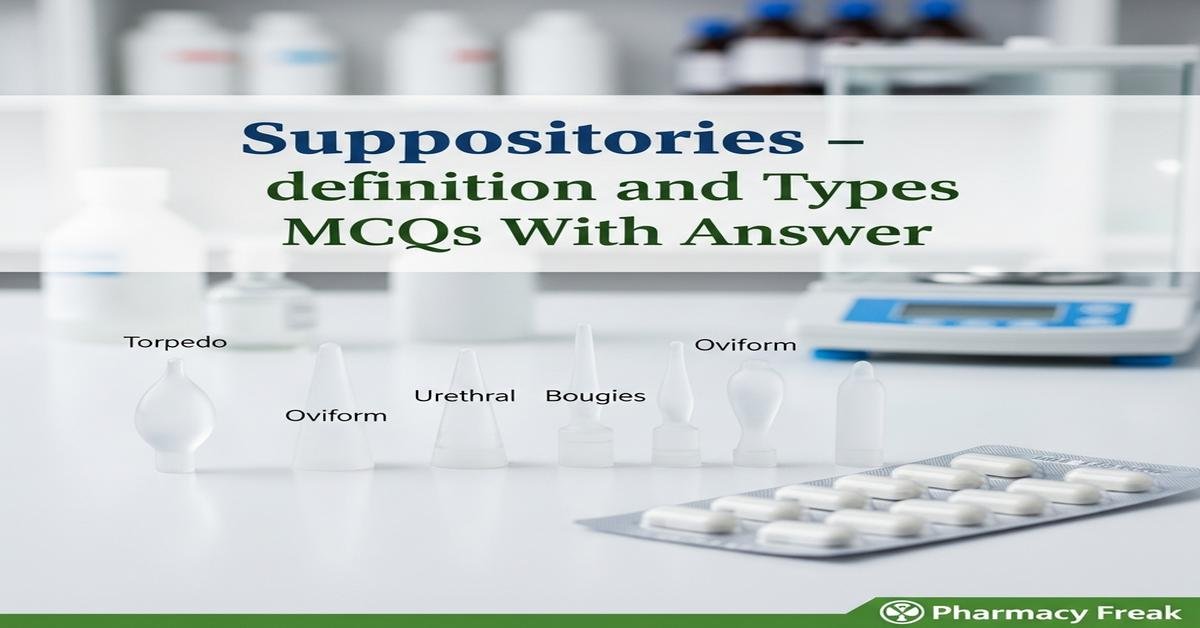
Suppositories – definition and types MCQs With Answer
Suppositories are solid or semi-solid dosage forms designed for insertion into body cavities (rectal, vaginal, urethral) to deliver local or systemic drugs. This concise introduction covers definition, common types (rectal, vaginal, urethral), formulation bases (cocoa butter, polyethylene glycols, glycerinated gelatin, hydrogenated vegetable oils), manufacturing methods (molding, compression), drug release mechanisms, advantages, limitations, and critical quality attributes like displacement value, melting point, softening time and dissolution. Keywords: suppositories, rectal suppositories, vaginal suppositories, urethral suppositories, bases, cocoa butter, PEG, glycerinated gelatin, compression molding, drug release, B.Pharm students. Now let’s test your knowledge with 30 MCQs on this topic.
Q1. What is the primary definition of a suppository?
- A liquid preparation for oral administration
- A solid or semi-solid dosage form for insertion into body cavities to deliver drugs
- An injectable oily solution for intramuscular use
- A topical cream for skin application
Correct Answer: A solid or semi-solid dosage form for insertion into body cavities to deliver drugs
Q2. Which of the following is NOT a common route for suppository administration?
- Rectal
- Vaginal
- Urethral
- Intravenous
Correct Answer: Intravenous
Q3. Which base is traditionally known as theobroma oil and commonly used for suppositories?
- Polyethylene glycol (PEG)
- Cocoa butter
- Glycerinated gelatin
- Hydrogenated vegetable oil
Correct Answer: Cocoa butter
Q4. Which base is water-soluble and often used for suppositories intended to dissolve rather than melt?
- Cocoa butter
- Polyethylene glycol (PEG)
- Gelatin
- White soft paraffin
Correct Answer: Polyethylene glycol (PEG)
Q5. Glycerinated gelatin bases are particularly suitable for which type of suppository?
- Urethral suppositories only
- Vaginal suppositories where prolonged dissolution is desired
- Oral fast-dissolving tablets
- Intramuscular implants
Correct Answer: Vaginal suppositories where prolonged dissolution is desired
Q6. Which manufacturing method involves pouring molten base into molds and allowing it to solidify?
- Compression molding
- Fusion (molding) method
- Lyophilization
- Spray drying
Correct Answer: Fusion (molding) method
Q7. Compression molding is especially useful when the drug is:
- Thermostable and soluble in molten base
- Heat-sensitive and cannot be melted with the base
- Only available as liquid extracts
- Extremely volatile
Correct Answer: Heat-sensitive and cannot be melted with the base
Q8. Displacement value in suppository formulation refers to:
- The volume of suppository mold
- The weight of base displaced by a unit weight of drug
- The melting point of the base
- Rate of drug absorption from rectum
Correct Answer: The weight of base displaced by a unit weight of drug
Q9. A high displacement value (greater than 1) indicates that 1 g of drug will:
- Displace more than 1 g of base
- Displace less than 1 g of base
- Have no effect on base volume
- Increase the melting point of base
Correct Answer: Displace more than 1 g of base
Q10. Which factor does NOT significantly affect rectal drug absorption from a suppository?
- Rectal fluid volume and pH
- Drug lipophilicity
- Cardiac output
- Presence of fecal matter
Correct Answer: Cardiac output
Q11. Which statement about cocoa butter (theobroma oil) is TRUE?
- It is water-soluble and dissolves in rectal fluids
- It has a sharp melting point near body temperature and can polymorph
- It is synthetic and used to increase drug release rate
- It does not require refrigeration for stability
Correct Answer: It has a sharp melting point near body temperature and can polymorph
Q12. Which test evaluates how quickly a suppository softens at body temperature?
- Disintegration test
- Softening time test
- Friability test
- Hardness test only used for tablets
Correct Answer: Softening time test
Q13. Which drug is commonly formulated as a rectal suppository for fever and pain in pediatric patients?
- Paracetamol (acetaminophen)
- Ibuprofen topical gel
- Amoxicillin capsule
- Diltiazem injection
Correct Answer: Paracetamol (acetaminophen)
Q14. Eutectic mixtures in suppository formulation are important because they:
- Increase melting point of base
- Lower melting point allowing components to liquefy at room temperature
- Prevent drug absorption
- Make base insoluble in water
Correct Answer: Lower melting point allowing components to liquefy at room temperature
Q15. Which preservative approach is commonly used for glycerinated gelatin suppositories to prevent microbial growth?
- Inclusion of antimicrobial preservatives (e.g., parabens)
- Avoiding all preservatives for safety
- Adding excess water to dilute microbes
- Sterilization by autoclaving after molding
Correct Answer: Inclusion of antimicrobial preservatives (e.g., parabens)
Q16. For a drug that is highly lipophilic, which base would typically enhance its release from a suppository?
- A lipophilic base like cocoa butter
- A hydrophilic PEG base
- Glycerinated gelatin without additives
- Pure paraffin wax
Correct Answer: A hydrophilic PEG base
Q17. Which quality control test assesses uniformity of drug content among individual suppositories?
- Melting point determination
- Content uniformity or weight variation test
- Disintegration only for tablets
- Viscosity measurement
Correct Answer: Content uniformity or weight variation test
Q18. Which statement is TRUE about rectal route advantages for systemic delivery?
- It always provides 100% bioavailability
- It can partially avoid first-pass hepatic metabolism depending on absorption site
- It is unsuitable for unconscious patients
- It guarantees rapid gastric absorption
Correct Answer: It can partially avoid first-pass hepatic metabolism depending on absorption site
Q19. Which lubricant is often used to aid removal of molded suppositories from molds?
- Castor oil or mineral oil
- Sodium chloride solution
- Polyvinyl alcohol (PVA) film
- Alcohol only
Correct Answer: Castor oil or mineral oil
Q20. Which phenomenon can cause cocoa butter suppositories to become grainy or have altered melting behavior?
- Polymorphism (formation of different crystal forms)
- Use of preservatives
- Compression molding at low pressure
- Storing at -20°C
Correct Answer: Polymorphism (formation of different crystal forms)
Q21. Which test is used to evaluate the rate of drug release from a suppository in vitro?
- Dissolution testing
- pH measurement only
- Softening time but not dissolution
- Thin-layer chromatography exclusively
Correct Answer: Dissolution testing
Q22. Which excipient class is often added to suppository formulations to increase drug solubility and release?
- Surfactants (e.g., polysorbates)
- Heavy metals
- Iron oxide pigments only
- Silicates to reduce solubility
Correct Answer: Surfactants (e.g., polysorbates)
Q23. A rectal suppository intended for local action (e.g., laxative) primarily relies on:
- Systemic absorption through blood vessels
- Local dissolution and mucosal contact
- Inhalation after melting
- Transdermal transport through the skin
Correct Answer: Local dissolution and mucosal contact
Q24. Which of the following drugs is commonly used as a rectal antiemetic suppository?
- Methotrexate
- Promethazine
- Simvastatin
- Insulin
Correct Answer: Promethazine
Q25. What is a primary disadvantage of glycerinated gelatin suppositories?
- They melt too readily at room temperature
- They are hygroscopic and may absorb moisture, requiring special packaging
- They are always incompatible with water-soluble drugs
- They cannot be sterilized
Correct Answer: They are hygroscopic and may absorb moisture, requiring special packaging
Q26. Which packaging consideration is important for suppositories made of cocoa butter?
- Store at elevated temperatures to keep them soft
- Protect from high temperatures to prevent melting and polymorphic changes
- Expose to sunlight to maintain stability
- Allow humidity to keep surface moist
Correct Answer: Protect from high temperatures to prevent melting and polymorphic changes
Q27. Which parameter is measured to ensure the heat behavior of a suppository base is appropriate?
- Melting point or softening point
- Optical rotation
- Electrical conductivity
- Magnetic susceptibility
Correct Answer: Melting point or softening point
Q28. For calculation of the amount of base to use per suppository, which value is necessary?
- Displacement value of the drug in that base
- Color index of the base
- Boiling point of the drug
- Vapor pressure of the base
Correct Answer: Displacement value of the drug in that base
Q29. Which statement is TRUE regarding urethral (bougie) suppositories?
- They are intended for rectal systemic delivery
- They are slender, designed for insertion into the male or female urethra for local therapy
- They melt at very high temperatures only
- They are identical in shape to vaginal suppositories
Correct Answer: They are slender, designed for insertion into the male or female urethra for local therapy
Q30. When selecting a base for a particular drug, which combined considerations are most important?
- Drug solubility in the base, desired release profile, stability and patient acceptability
- Only the color and odor of the base
- Whether the base is edible as food
- Base should always be lipophilic regardless of drug properties
Correct Answer: Drug solubility in the base, desired release profile, stability and patient acceptability

